MiCA Slows Down USDT in Europe, but Global Demand Remains Strong
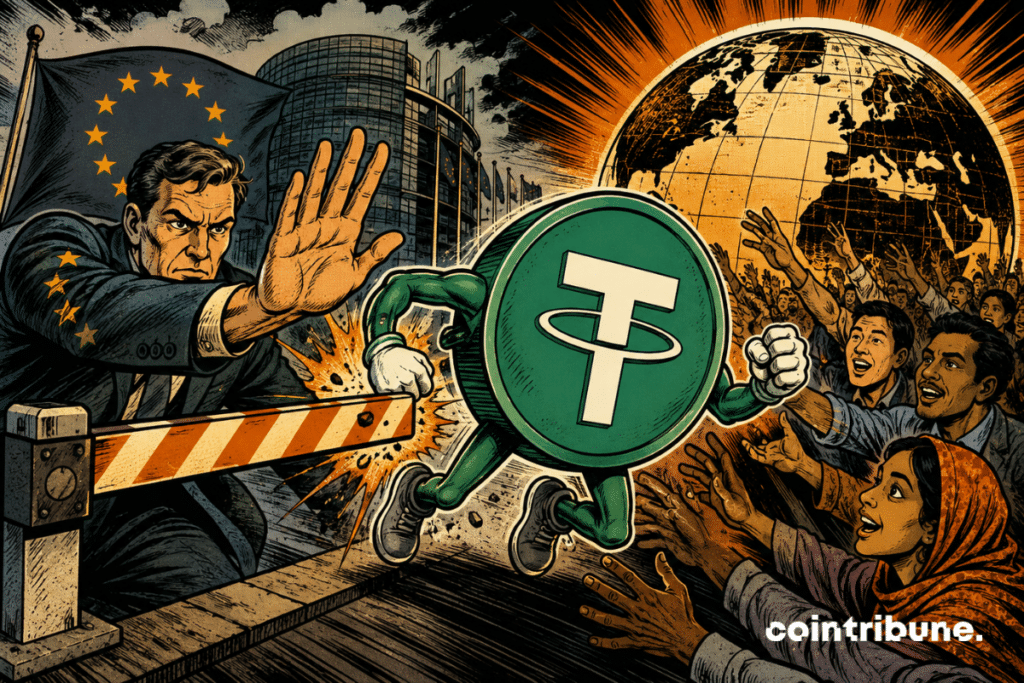
European pressure on stablecoins is changing access to digital assets. Since the end of the European transition period, several platforms have removed USDT from their offerings. However, available data do not show a net decline in global demand. Activity is growing in some emerging markets, where people use stablecoins for payments, transfers, and financial services. This development places MiCA at a central challenge: regulating European access without altering global usages of the digital dollar.
In brief
- MiCA is pushing several European platforms to gradually remove USDT from their offerings.
- The end of the European transition period did not cause a notable drop in global demand.
- In Argentina, the use of stablecoins is growing with payments, transfers, and financial services.
- Activity is also increasing on Tron and Binance Smart Chain, notably thanks to their low fees.
- Euro stablecoins are attracting more interest in Europe, but the dollar maintains a central role in the global market.
USDT withdraws from European platforms
Revolut announced to its European users the removal of USDT after August 31. They are adapting their offerings to the requirements of the regulation on crypto-asset markets. Rules concerning stablecoins have been progressively applied since 2024. The European Union’s transition period ended on July 1.
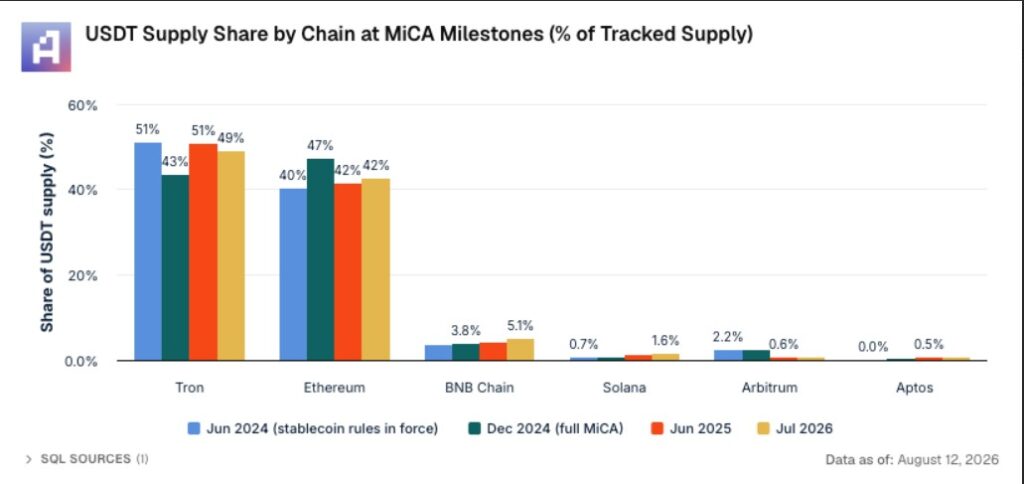
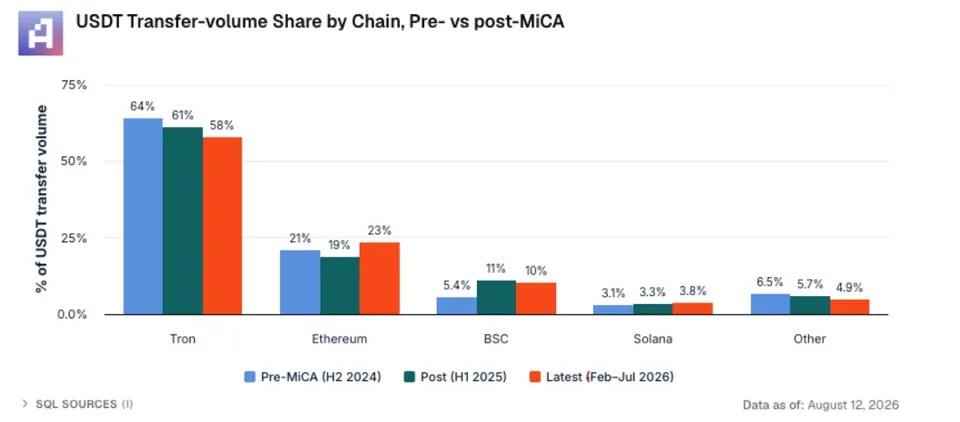
This deadline increases pressure on platforms that must exclude non-compliant tokens. The MiCA regulation thus transforms access to the European market without reducing the global use of stablecoins. According to a report by Artemis Analytics, relayed by Cointelegraph, this development has not caused significant changes in USDT-related activity. Alex Weseley, head of research and data, does not observe a clear change in supply or demand directly linked to MiCA’s entry into force.
He explains that “data do not show any major migration between platforms or chains either.” The European withdrawal appears, therefore, as a transformation of regulated access. This situation distinguishes the constraints imposed on European platforms from the activity observed on global markets. Demand thus remains supported despite the tightening of the regional framework.
Global demand resists the European shock
The situation observed in Argentina offers another perspective on this demand. Dollar stablecoins are no longer used only for trade or saving preservation. They occupy a growing role in payments, transfers, and certain financial services. This evolution reduces the relevance of demand measurement based solely on regulated European platforms.
Lemon, an Argentine cryptocurrency and financial services platform, processed 9.3 billion dollars in 2025. This volume represents a 60% increase year-on-year. At the same time, the number of active users involved in transactions increased by 70%, reaching nearly 1.8 million. The volume of stablecoins also rose by 45%, confirming broader use of digital assets pegged to the dollar.
Ignacio Gimenez, Chief Commercial Officer and Planning Director at Lemon, describes an evolution in the role of USDT and other stablecoins:
The role of USDT and other dollar-pegged stablecoins is evolving. We observe a shift from stablecoins as a store of value to those as financial infrastructure.
Ignacio Gimenez, Chief Commercial Officer and Planning Director of Lemon. Source: Cointelegraph.
According to him, their function is gradually moving from a store of value to financial infrastructure. Users can pay in Brazil via PIX, receive dollars or euros from abroad, and hold digital balances. These usages explain why demand can remain strong despite European restrictions.
MiCA transforms the European gateway
Artemis data also show a notable growth in activity on certain blockchains. On Tron, the number of daily users increased by 44%, reaching about 908,000. These networks notably attract stablecoin users thanks to their low fees. This development accompanies broader use of digital assets in some markets.
For Alex Weseley, this growth resembles an expansion of usages in global and emerging markets. He stated that:
On-chain data do not show a clear break corresponding to the MiCA launch. They do not therefore indicate a specific shift of European activity to other networks. The observed movement rather supports broader use of stablecoins.
Alex Weseley, head of research and data at Artemis Analytics. Source: Cointelegraph.
MiCA nevertheless retains a major role for regulated European platforms. It determines the stablecoins they can offer and gradually changes the regional market structure. Maksym Sakharov, CEO and co-founder of WeFi, believes that “regulation mainly acts on access to dollar stablecoins.” Underlying demand remains tied to trading, payments, and cross-border transfers.
Euro stablecoins seek their place
The European market must determine which alternatives users will adopt. Dollar-denominated stablecoins have a historical advantage, as the dollar remains the primary reference in the cryptocurrency market. A restriction thus does not eliminate the needs supporting this use. It can mainly change the channels through which users access digital assets.
Erald Ghoos, Managing Director of OKX Europe, states that “its platform had already stopped offering USDT to European users for about two years.” The latest regulatory deadline therefore did not have a major effect on its activity. Some platforms had anticipated the rule changes. The European transition thus does not occur simultaneously for all players.
In this context, euro stablecoins are attracting growing interest from institutions. Ghoos observes a willingness to create more euro-denominated digital assets. For individuals, these solutions could simplify transactions and reduce currency conversions. However, their growth will also depend on their ability to meet usages already established around dollar stablecoins.
A global market less dependent on European platforms
Argentina explicitly illustrates this transformation of usages. The growth in volume processed by Lemon, active users, and transactions in stablecoins accompanies more daily use. In other emerging markets, the increase in users on Binance Smart Chain and Tron confirms this trend. These data do not prove a transfer from Europe, but they show expansion independent of this region.
For European platforms, MiCA therefore imposes stricter selection of offered assets. For global users, available data describe demand based on liquidity, usage by counterparties, and presence in multiple markets. Euro alternatives may gain ground, notably among institutions. But the dollar’s international role remains a central factor in the future evolution of stablecoins.
In the short term, the European market should continue adapting to applicable rules. At the same time, growth observed in some emerging markets could continue to support global demand. The balance will therefore depend less on European withdrawals alone than on the evolution of payments, transfers, and digital financial services. Within this context, USDT can remain present in global usages, while MiCA will keep reshaping its access in Europe. USDT thus remains subject to two distinct dynamics.
Maximize your Cointribune experience with our "Read to Earn" program! For every article you read, earn points and access exclusive rewards. Sign up now and start earning benefits.

Journaliste et rédacteur web passionné par l’univers des cryptomonnaies et des technologies Web3. J’y traite les dernières tendances et actualités afin de proposer un contenu de haute qualité à un large public du secteur.
The views, thoughts, and opinions expressed in this article belong solely to the author, and should not be taken as investment advice. Do your own research before taking any investment decisions.