Revolut Will Remove USDT in August for Regulatory Reasons
The cryptocurrency market continues to adapt to the new regulatory requirements that are gradually being implemented. In this context, Revolut informed some of its customers that it would remove USDT from its offering during the summer of 2026. This decision comes with a precise schedule that outlines several steps before the permanent removal of the stablecoin. It also illustrates how financial service platforms are gradually adjusting their cryptoasset offerings in response to the evolving regulatory framework.
In brief
- Revolut will gradually remove USDT, stopping purchases from July 6 and complete removal scheduled for August 31, 2026.
- USDT deposits will be permanently ceased starting July 30, 2026, and any incoming transfers will be automatically rejected.
- Holdings in USDT still present after August 31 will be automatically converted into users’ base currency at the day’s exchange rate.
- The platform justifies this decision based on regulatory and risk considerations, without specifying the jurisdictions concerned or the exact regulatory framework.
- This removal comes as USDT is progressively being removed from European platforms following Tether’s refusal to comply with MiCA regulation requirements.
Revolut Specifies the Steps for the Removal of Tether’s Stablecoin
Revolut announced that the purchase of Tether’s stablecoin will no longer be available from July 6, 2026. The complete removal of the asset is then scheduled for August 31, 2026. According to the information reported by Cointelegraph, this decision is based on regulatory and risk management considerations. However, it does not specify the rules that directly motivate this change.
At the same time, Revolut will end deposits of the stablecoin from July 30, 2026. After this date, all incoming transfers will be automatically rejected. Users therefore have a transition period to sell their tokens or transfer them to another compatible service. This schedule gives them several weeks to organize their operations.
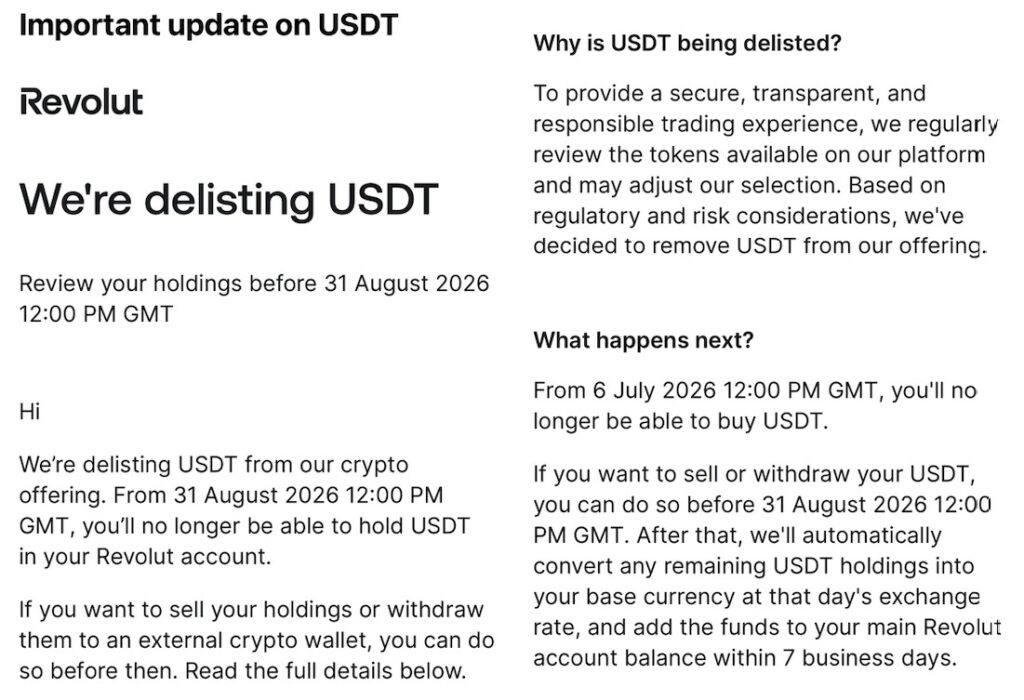
Finally, Revolut indicated that users who still hold tokens after August 31 will not lose them. The platform will automatically convert remaining holdings into each client’s base currency at the exchange rate applicable at the time of the operation. This conversion will mark the end of support for this digital asset on the service.
USDT Continues to Face Regulatory Changes
The removal of USDT occurs in a context where several industry players are gradually adapting their services. Digital asset service providers are modifying their offerings to accommodate the new regulatory requirements applied in Europe. This trend notably affects certain stablecoins whose compliance remains debated.
In its notice to users, Revolut only mentions “regulatory and risk considerations.” However, the company does not specify whether this measure will be applied globally or only in certain jurisdictions. It also does not mention the exact regulatory framework behind this decision. This communication leaves several questions regarding the precise scope of the removal.
USDT holders must also consider the deadline set by the platform. Tokens still present in accounts after August 31 will be automatically converted into each user’s primary currency. The rate applied will correspond to the market price on the day of the conversion. Customers thus have a clearly defined period to manage their holdings.
MiCA Regulation Continues to Transform the Market
This decision comes as Revolut obtained, in November 2025, a license as a crypto-asset service provider (CASP) under MiCA regulation. This authorization appears in the official register of the European Securities and Markets Authority (ESMA). It was granted by the Cyprus Securities and Exchange Commission, allowing the company to operate under this new regulatory framework.
Finally, Cointelegraph indicated that Revolut did not respond to requests for comments concerning the jurisdictions involved or the exact extent of this measure at the time of publication. Meanwhile, USDT has been progressively withdrawn from European digital asset service providers since the end of 2024.
This situation is due to its issuer, Tether, refusing to comply with the requirements set by the MiCA regulation. Its CEO, Paolo Ardoino, regularly criticizes several provisions of this regulation, especially the obligations concerning reserves held with credit institutions within the European Union.
This development shows that Revolut continues adapting its offering to new rules governing the cryptoasset market. USDT remains at the heart of discussions on the application of MiCA regulation within the European Union. Thus, the next decisions of platforms and issuers will allow observation of how the stablecoin market continues to evolve in this new regulatory environment.
Maximize your Cointribune experience with our "Read to Earn" program! For every article you read, earn points and access exclusive rewards. Sign up now and start earning benefits.

Journaliste et rédacteur web passionné par l’univers des cryptomonnaies et des technologies Web3. J’y traite les dernières tendances et actualités afin de proposer un contenu de haute qualité à un large public du secteur.
The views, thoughts, and opinions expressed in this article belong solely to the author, and should not be taken as investment advice. Do your own research before taking any investment decisions.