Nvidia: Trump Demands Jensen Huang’s Return as CEO
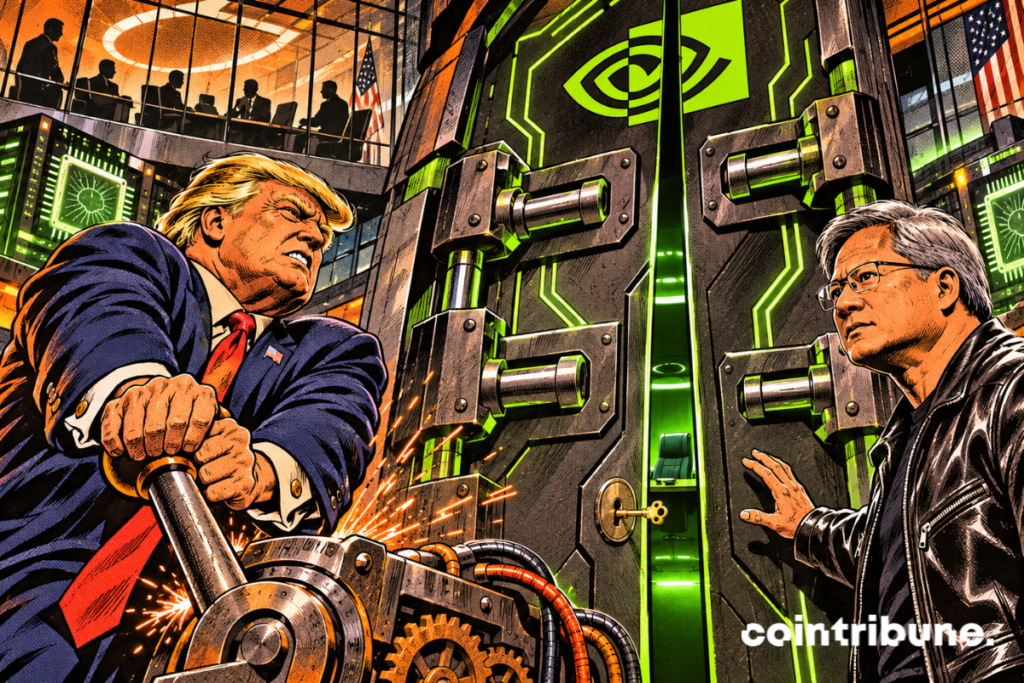
Donald Trump once again demands the return of Jensen Huang to the head of Nvidia. In a message posted on Truth Social on November 22, 2026, the American president believes that the co-founder’s return would be beneficial to the company and the United States. A request that comes eleven days after his resignation, while the board of directors officially refused his reinstatement. The case also takes on a political dimension with American investigations into chip exports to China.
In brief
- Donald Trump publicly asks Nvidia to reinstate Jensen Huang after his resignation.
- The board refuses his return and continues the search for a new CEO.
- Nvidia’s chip sales to China are now under review by U.S. authorities.
Nvidia refuses to take back Jensen Huang despite Trump
Donald Trump does not seem ready to let go of Jensen Huang. On Sunday, November 22, the American president renewed his support for the former Nvidia leader in a post on Truth Social. He wants the board of directors to return his CEO position to him.
This intervention came after Nvidia’s already expressed refusal to reinstate Jensen Huang. The co-founder of the chip manufacturer had resigned on November 12, following revelations about personal behaviors contrary to the company’s internal rules.
The information published about his private relationships, one of which allegedly involved a woman suspected of ties with Chinese intelligence services, also raised national security concerns.
No judicial conviction has been announced against Huang in this case. On November 17, Harvey Jones, chairman of the board, was categorical. During the conference devoted to quarterly results, he confirmed that the directors unanimously accepted the resignation and did not intend to reinstall Huang.
Colette Kress, Nvidia’s CFO since 2013, is interim CEO. The group has also commissioned the Heidrick & Struggles firm to search for a permanent successor. Donald Trump had already expressed his support for Huang on November 16. His new intervention thus comes despite an officially known position.
Trump changes tone as Nvidia faces investigations
Donald Trump’s position evolved within a few days. On November 12, after Huang’s departure, the American president mentioned Tim Cook as a possible successor to the leadership of Nvidia. Cointribune notably reported Tim Cook’s appearance among possible candidates to succeed Jensen Huang.
Ten days later, Trump finally demands the return of the former leader. The case is also complicated politically. U.S. Treasury Secretary Scott Bessent confirmed on November 22 that the authorities want explanations about Nvidia chip sales to China.
Washington is particularly interested in compliance with restrictions imposed on exports of advanced components intended for artificial intelligence. The U.S. government has recently tightened these limitations.
Nvidia, for its part, announced the creation of a committee specialized in overseeing national security and export control issues. The group must thus simultaneously manage a leadership transition, regulatory questions, and strong political pressure.
Financially, results remain solid. On November 17, Nvidia announced a record quarterly revenue of $116 billion, more than double that recorded a year earlier.
Data centers represent $108 billion of revenue, about 93% of quarterly activity. For the following quarter, the company forecasts about $130 billion in revenue. Governance difficulties have thus far not caused a visible break in its commercial performance.
Nvidia must protect its business despite leadership crisis
Nvidia’s board of directors now faces several pressures. On one side, Donald Trump and several Silicon Valley personalities support Jensen Huang’s return. Elon Musk is notably among the leaders who have publicly defended the former boss.
On the other hand, the directors must manage legal and regulatory risks linked to the revelations that preceded his departure. The campaign favoring Huang already mobilized more than 180,000 signatures on November 16, according to Reuters.
Support remains significant. But Huang’s return could complicate the group’s relations with authorities as long as national security questions remain unresolved.
Nvidia occupies a special place in the digital economy. Its processors power a large part of artificial intelligence infrastructures, while its industrial decisions directly concern cloud computing companies.
This activity also touches certain crypto players. Several companies historically specialized in Bitcoin mining are redirecting their data centers towards artificial intelligence, attracted by more predictable computing contracts.
In September, Anthropic and Nvidia notably signed an agreement related to the infrastructures of a major Bitcoin mining player. Huang’s departure does not mean these partnerships are threatened. Nvidia affirms it is pursuing its technological roadmap and maintaining relations with its main clients. Trump nevertheless wants to see the co-founder at the helm again. The board of directors still refuses this possibility. For the group, the stakes now go beyond choosing a leader: it must preserve its relations with Washington and its customers while preparing a sustainable succession.
Maximize your Cointribune experience with our "Read to Earn" program! For every article you read, earn points and access exclusive rewards. Sign up now and start earning benefits.

Enseignante et ingénieure IT, Lydie découvre le Bitcoin en 2022 et plonge dans l’univers des cryptomonnaies. Elle vulgarise des sujets complexes, décrypte les enjeux du Web3 et défend une vision d’un futur numérique ouvert, inclusif et décentralisé.
The views, thoughts, and opinions expressed in this article belong solely to the author, and should not be taken as investment advice. Do your own research before taking any investment decisions.