OCC Warns Banks Over Controversial Debanking Practices
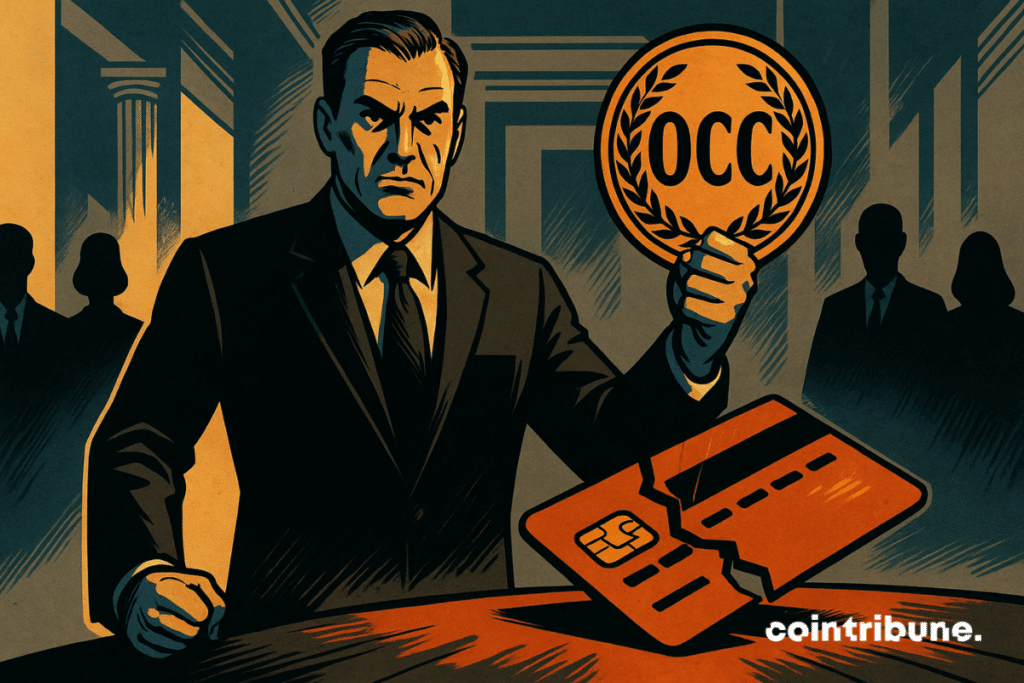
Washington hardens its tone. The Office of the Comptroller of the Currency (OCC), the American banking regulator, denounces banking practices deemed discriminatory. In an unprecedented report, the agency accuses several major banks of restricting access to financial services for sensitive sectors, including cryptocurrencies. This phenomenon of “debanking”, long denounced by the industry, could now be considered illegal. A strong signal sent to Wall Street, as the Trump administration intends to restore fair access to the banking system.
In Brief
- The U.S. banking regulator (OCC) has published a report denouncing “debanking” practices targeting controversial sectors.
- Several major banks, including JPMorgan, Bank of America, and Citigroup, are accused of restricting access to services for crypto businesses.
- These restrictions, implemented between 2020 and 2023, were based on internal criteria related to the bank’s reputation or “values.”
- The OCC says it wants to hold banks accountable, although the report is not grounded in a clearly defined legal framework.
The OCC reveals banking filtering practices targeting crypto actors
In a report published on December 10, the Office of the Comptroller of the Currency (OCC) states that several major American banks have implemented internal policies restricting access to financial services for certain sectors, notably the crypto sector with account closures.
The agency, led by Comptroller Jonathan Gould, indicates that “banks have maintained public and non-public policies restricting access to banking services for certain industrial sectors.”
Among the practices denounced are “enhanced review and approval” systems imposed before being able to serve certain clients deemed sensitive. The institutions cited, including JPMorgan Chase, Bank of America, and Citigroup, are accused of applying these restrictions between 2020 and 2023 based on subjective criteria, related to the institution’s “values” or reputation.
The OCC report, based on the analysis of internal policies of nine major national banks, details several measures that made access to banking services more difficult for sectors deemed controversial. According to the investigation, these banks have :
- Required additional approval procedures for clients from industries such as crypto, armaments, or fossil fuels ;
- Restricted account openings or the provision of services to companies not aligned with the bank’s perceived “values” ;
- Imposed entry barriers higher than standard for certain categories of economic activity ;
- Continued to apply these restrictions quietly, via internal policies not made public.
The OCC declared its intention to “hold banks accountable for any illegal debanking activity, including by forwarding cases to the attorney general”, although the report does not specify any specific legal basis for such actions.
This publication marks a turning point by officially recognizing practices long denounced by the crypto industry, without clarifying the legal grounds of any potential sanction.
A report motivated by a presidential directive, but without clear legal basis
The OCC report follows an executive order signed by Donald Trump last August, which explicitly instructs regulators to identify institutions guilty of debanking practices and to take disciplinary actions against them.
The presidential text requires regulators to punish banks that “have unjustly broken off relationships with legitimate banking system clients,” resorting if necessary to fines, consent decrees, or other sanctions.
However, the order in question “is not a law”, but an internal administrative directive. It does not apply directly to banks, and the legal references it contains, notably regarding unfair competition or abusive practices towards consumers, do not explicitly incriminate banking institutions.
The OCC report does not cite any precise legal provision likely to support prosecutions. The agency only refers to its own internal bulletins, a past Trump initiative, and the presidential executive order. This structural weakness is pointed out by several observers, including Nicholas Anthony, analyst at the Cato Institute, who denounces a report “that criticizes banks for breaking off with controversial clients, but forgets that it is the regulators themselves who evaluate banks on their reputation.”
In this context of regulatory tightening, bitcoin once again crystallizes tensions. Long considered a marginal speculative asset, it now embodies for some a form of financial sovereignty in the face of traditional banking restrictions. The growing attention to “debanking” could strengthen its status.
While regulators tighten the noose on discriminatory banking practices, the line between compliance and exclusion becomes fragile. For the crypto ecosystem, this dynamic could accelerate the rise of DeFi, seen as an autonomous alternative to the restrictions imposed by traditional finance.
Maximize your Cointribune experience with our "Read to Earn" program! For every article you read, earn points and access exclusive rewards. Sign up now and start earning benefits.

Diplômé de Sciences Po Toulouse et titulaire d'une certification consultant blockchain délivrée par Alyra, j'ai rejoint l'aventure Cointribune en 2019. Convaincu du potentiel de la blockchain pour transformer de nombreux secteurs de l'économie, j'ai pris l'engagement de sensibiliser et d'informer le grand public sur cet écosystème en constante évolution. Mon objectif est de permettre à chacun de mieux comprendre la blockchain et de saisir les opportunités qu'elle offre. Je m'efforce chaque jour de fournir une analyse objective de l'actualité, de décrypter les tendances du marché, de relayer les dernières innovations technologiques et de mettre en perspective les enjeux économiques et sociétaux de cette révolution en marche.
The views, thoughts, and opinions expressed in this article belong solely to the author, and should not be taken as investment advice. Do your own research before taking any investment decisions.