Public miners' hashrate slides 21% in six months — and AI is to blame
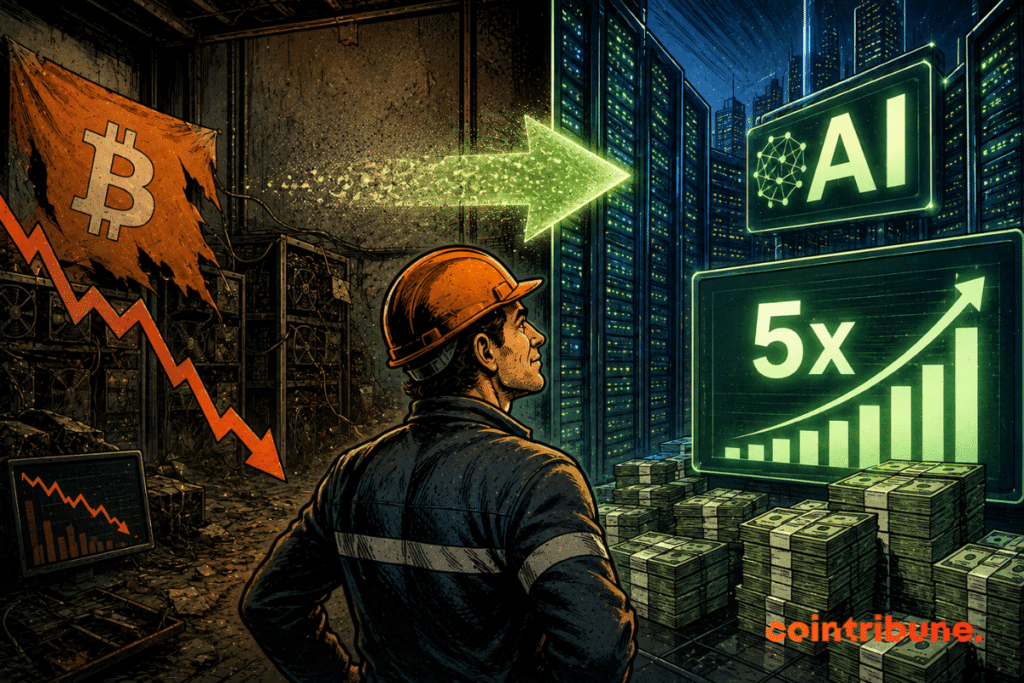
The mining market is experiencing a shift in pace. After several years of expansion, listed miners are now reducing part of their capacities. In the second quarter, this trend intensified, while some operators are redirecting their infrastructures toward AI and high-performance computing. Excluding Bitdeer, the realized hash rate of the monitored miners declined by 21.2% in six months. This decrease highlights a shift of resources, while revenues related to colocation are rising among several bitcoin players.
In brief
- The hash rate of listed miners declines by 13.4% in six months, reaching 319 EH/s in the second quarter of 2026.
- Excluding Bitdeer, the computing power drops by 21.2%, falling from 324.6 to 255.9 EH/s.
- Bitdeer grows by 44% and reaches 63 EH/s of realized hash rate in the second quarter.
- Core Scientific and TeraWulf now derive a large share of their revenues from HPC colocation.
- The decline is explained by reduced mining profitability and competition for electricity and capital.
Public miners are pulling back on computing power
The analysis by Blocks Bridge Consulting, reported by Bitcoin News, is based on an extended cohort of listed bitcoin miners and an updated series of networks. Their realized hash rate combined reached 368.3 EH/s in the fourth quarter of 2025. It then dropped to 344.4 EH/s in the first quarter of 2026, then to 319 EH/s in the second quarter. Over six months, the decline is therefore 13.4%, compared to 10.6% for the network average, which decreased from 1,071 to 957 EH/s. The listed companies thus reduced their power faster than the entire network.
In the first quarter, a few expanding miners still compensated for several shutdowns. This compensation disappeared in the second quarter, as capacity additions were no longer sufficient. Excluding Bitdeer, the realized hash rate of the other miners fell from 324.6 to 255.9 EH/s according to the study. This mainly reflects the capacity decline at several miners who redirect their installations to other regional uses.
Bitdeer is the only thing keeping the public hashrate from freefall
Bitdeer is the main exception in this trend. Its realized hash rate increased by 44% between the fourth and second quarters, reaching 63 EH/s. The company relies notably on its own SEALMINER production chain. In June, it announced 73 EH/s of self-mining capacity and 15.9 EH/s of co-mining capacity. It also produced 990 bitcoins during the month, an increase of 388% year-on-year.
MARA and American Bitcoin have also increased their capacities. However, their additions did not offset the reductions observed at Cango, Cipher, Keel Infrastructure, Core Scientific, TeraWulf, and IREN. Cango particularly illustrates this change of trajectory. After reaching 50 EH/s of deployed capacity in 2025, the company began withdrawing inefficient machines. It also rents part of its power and moves some capacities to less costly regions.
HPC revenue is rewriting the mining playbook
The capacity decline accompanies a shift in revenues toward colocation and high-performance computing. At Core Scientific, this activity now takes a central place in the second quarter results. TeraWulf follows a similar path, while other players remain largely dependent on bitcoin mining.
Here are the main figures for the quarter:
- Core Scientific: 136.7 million dollars of revenue from colocation, compared to 27.5 million from mining.;
- Core Scientific colocation: 83% of revenue in the second quarter, compared to 67% in the first;
- TeraWulf: 31.9 million dollars of HPC revenue, compared to 12.8 million from mining;
- HPC at TeraWulf: 71% of total revenue and 62% market share in the first quarter;
- Riot Platforms: 23.2 million dollars related to data centers, compared to 113.7 million from mining;
- Bitdeer: 14 million dollars of revenue from AI cloud, compared to 197.1 million related to mining.
The rest of the sector is, however, progressing more slowly in this transformation. Hut 8 and MARA reported more modest contributions in high-performance computing. Cipher and Keel Infrastructure, for their part, had not yet recorded any HPC revenue.
This contraction doesn’t look anything like the post-China ban era
The current movement takes a different shape than that caused by China’s mining ban in 2021. At that time, Bitcoin network power had nearly halved. The hash rate reached 57.5 EH/s in June 2021, before miners gradually relocated their activities. By December, the network had almost regained its previous level. The United States then became the main American center of bitcoin mining.
Public companies had raised capital, acquired electrical sites, and ordered new generations of ASICs. This momentum eventually pushed the network beyond one zettahash per second. Only one halving event has occurred since the beginning of this expansion. Now, part of the equipment and infrastructures accumulated after China are gradually exiting the network.
Some machines are decommissioned, while electrical infrastructures change use. Other capacities are depreciated more quickly to support activities related to GPUs. The movement therefore does not rely on a single shock comparable to the Chinese ban. It rather results from lower mining profitability and increased competition for capital and electricity. Several miners must therefore balance between production, power rental, and new infrastructures.
The future will depend on how quickly operators continue these conversions. If HPC revenues keep growing, infrastructures could maintain an increasing place in their business models. Conversely, a stabilization of bitcoin mining profitability could change the pace of shutdowns and reallocations. The coming quarters will mainly measure whether the decline becomes permanent or remains linked to this transition phase.
Maximize your Cointribune experience with our "Read to Earn" program! For every article you read, earn points and access exclusive rewards. Sign up now and start earning benefits.

La révolution blockchain et crypto est en marche ! Et le jour où les impacts se feront ressentir sur l’économie la plus vulnérable de ce Monde, contre toute espérance, je dirai que j’y étais pour quelque chose
The views, thoughts, and opinions expressed in this article belong solely to the author, and should not be taken as investment advice. Do your own research before taking any investment decisions.