Revolut accelerates in crypto: Stablecoins, trading, and payments are at the heart of its strategy
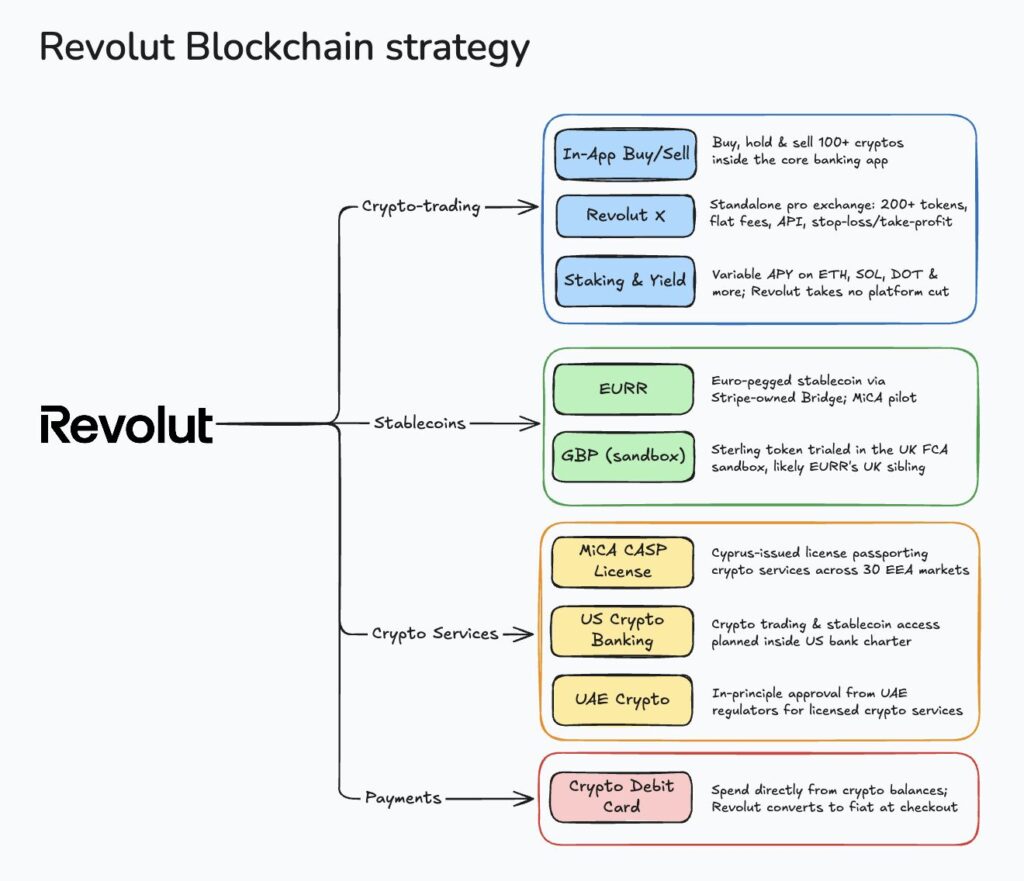
Revolut no longer just integrates cryptocurrencies into its banking app. With the launch of EURR, the development of Revolut X, and its new regulatory approaches, the fintech is building a much broader crypto offering. Maxim Krasnov, founder of Construct.tech, analyzes this evolution as a rapprochement between banking and digital assets. His analysis notably highlights the role of Bridge, a company owned by Stripe, in the issuance of the stablecoin. This strategy now extends to several markets and various uses.

In brief
- Revolut launches EURR, its euro stablecoin issued by Bridge, a company owned by Stripe.
- The fintech is also exploring a sterling stablecoin in the FCA regulatory sandbox.
- Revolut X and staking strengthen its crypto trading and investment offering.
- Revolut continues its regulatory expansion with MiCA in Europe and a future bank in the United States.
- Stablecoins, trading, payments and banking services could soon form a unified crypto ecosystem.
Revolut transforms EURR into a bridge between banking and blockchain
Revolut has launched EURR as its first euro-backed stablecoin. The fintech announced in a statement the gradual rollout of this token to eligible customers in Denmark, Poland, and Portugal. The launch takes place on Ethereum and is intended to enable value transfer between fiat currency, crypto, and external wallets. Revolut also plans to gradually extend EURR availability to other markets.
One detail distinguishes this operation from entirely internal token creations. Revolut does not hold the issuer role for EURR, as Bridge Building fulfills this function according to the same statement. Bridge is owned by Stripe, which has strengthened its stablecoin infrastructure business with this company. Revolut thus retains distribution, user experience, and product access via its banking app. This separation allows the fintech to rely on specialized infrastructure.
This model is precisely highlighted by Maxim Krasnov, founder of Construct.tech, in his analysis published on LinkedIn. According to him, Revolut becomes a gateway to on-chain markets directly from a banking app. The interest is therefore not only in creating a new European stablecoin. The combination of massive distribution, banking services, and blockchain access constitutes the real strategic challenge.
After the euro, Revolut experiments with a sterling stablecoin
Revolut’s strategy does not stop at EURR. In the United Kingdom, the fintech is exploring a sterling stablecoin within the Financial Conduct Authority’s Regulatory Sandbox. The FCA indicated that the project aims for an asset designed to maintain a 1-to-1 value with the pound. The associated reserves must also be denominated in GBP.
This experiment remains different from a confirmed commercial launch. The FCA uses its sandbox to allow companies to test products in a controlled environment. Revolut is among the four firms selected in the stablecoins cohort. The regulator mainly wants to observe uses related to payments, settlement, and crypto trading.
This approach mainly shows that Revolut considers multiple currencies rather than a single stablecoin. The company already has a favorable environment to link traditional currencies and digital assets. EURR brings this logic to the euro, while the British project explores extension to the pound. Revolut could thus gradually develop a multi-currency infrastructure adapted for crypto transfers and uses.
Trading, staking, and exchange: Revolut expands its crypto offering
The stablecoin is only part of this strategy. Revolut is also developing Revolut X, a platform for users who want access to more advanced trading features. The platform notably offers market orders and limit orders, as well as access to over 300 tokens according to its current presentation. It also allows automating certain strategies through its API.
This infrastructure changes crypto’s place in Revolut’s ecosystem. Casual users can continue buying and selling assets via the main app. More active traders have a distinct environment with tools suited to their needs. The API notably allows retrieving market data and sending orders programmatically.
Staking complements this offering with another usage source for crypto asset holders. Revolut currently offers staking on several networks, including Ethereum, Solana, and Polkadot. Rewards vary and depend on each network’s specific conditions. The platform also mentions that assets may remain locked during certain periods.
Regulation becomes a central piece of Revolut’s strategy
In Europe, Revolut has already strengthened its regulatory framework for its crypto activities. Revolut Digital Assets Europe Ltd holds a CASP license granted by Cyprus’ CySEC under MiCA regulation. This authorization covers custody, transfers, and several crypto asset exchange services. CySEC also confirms the existence of cross-border services to other member states.
The UK plays a different role in this architecture. Revolut is testing its GBP stablecoin project with support from the FCA sandbox. This approach allows the company to explore a new product while considering the future UK regulatory framework. The fintech thus advances on two complementary fronts, with MiCA in Europe and regulatory experimentation in the UK.
In the US, ambitions are even greater. Contrary to Maxim Krasnov’s claim about a “California bank charter,” official CAS documents and Revolut’s September 3 statement indicate that the fintech received approval to form Revolut Bank US, N.A., with proposed headquarters in Stamford, Connecticut. The OCC approved the application on September 2, 2026, while Revolut mentions conditional approval and specifies that further validations remain necessary with the FDIC, Federal Reserve, and OCC. The bank launch is still planned for 2027.
Revolut is also progressing in the United Arab Emirates market. In July 2026, the fintech obtained in-principle approval from VARA to offer several services related to virtual assets. This authorization notably covers brokerage, management, and crypto asset exchange. However, this is a preliminary regulatory step and not a definitive operational license.
From cryptocurrencies to payments: Revolut seeks to close the loop
The last piece of the setup concerns payments. Revolut already allows its customers to use a Crypto Card to spend their digital assets. Its crypto terms also mention the possibility to buy, sell, hold, transfer, and spend crypto assets from its environment. This integration thus directly brings crypto custody and everyday money usage closer.
The logic becomes clearer when viewing all the elements. Trading attracts active users, while staking provides a new utility to held assets. Stablecoins then add an on-chain settlement layer between traditional currency and crypto. Cards and payments can finally transform this digital value into a regular spending method.
Maxim Krasnov’s analysis makes full sense in this configuration. His observation does not only focus on EURR, but on the rapprochement between banking services and digital assets within a single product. Revolut progressively builds a chain linking trading, stablecoins, regulated services and payments. This architecture could become one of the fintech’s main differentiation axes against traditional exchanges and classic banks.
Ultimately, the next step could therefore surpass the mere launch of new tokens. If Revolut manages to unify banking, trading, stablecoins, and payments into a unique experience, crypto could become a native infrastructure of its financial services. EURR, the GBP project, Revolut X, and the future American bank already constitute the main building blocks of this evolution. The question now will be how far Revolut can integrate these services while maintaining a coherent regulatory framework on each market.
Maximize your Cointribune experience with our "Read to Earn" program! For every article you read, earn points and access exclusive rewards. Sign up now and start earning benefits.

Journaliste et rédacteur web passionné par l’univers des cryptomonnaies et des technologies Web3. J’y traite les dernières tendances et actualités afin de proposer un contenu de haute qualité à un large public du secteur.
The views, thoughts, and opinions expressed in this article belong solely to the author, and should not be taken as investment advice. Do your own research before taking any investment decisions.