Russia And Iran Settle Billions In Yuan As Dollar Pressure Grows
The dollar is losing ground where it ruled uncontested for decades. In March 2026, Russia and Iran settled $214 billion in trade in Chinese yuan, confirming the acceleration of dedollarization led by the BRICS. Behind this monetary shift lies a strategic battle between Washington and Beijing for control of global trade. Energy commerce, geopolitical tensions, and the rise of the “petroyuan”: the great powers quietly redraw the rules of the international financial system.
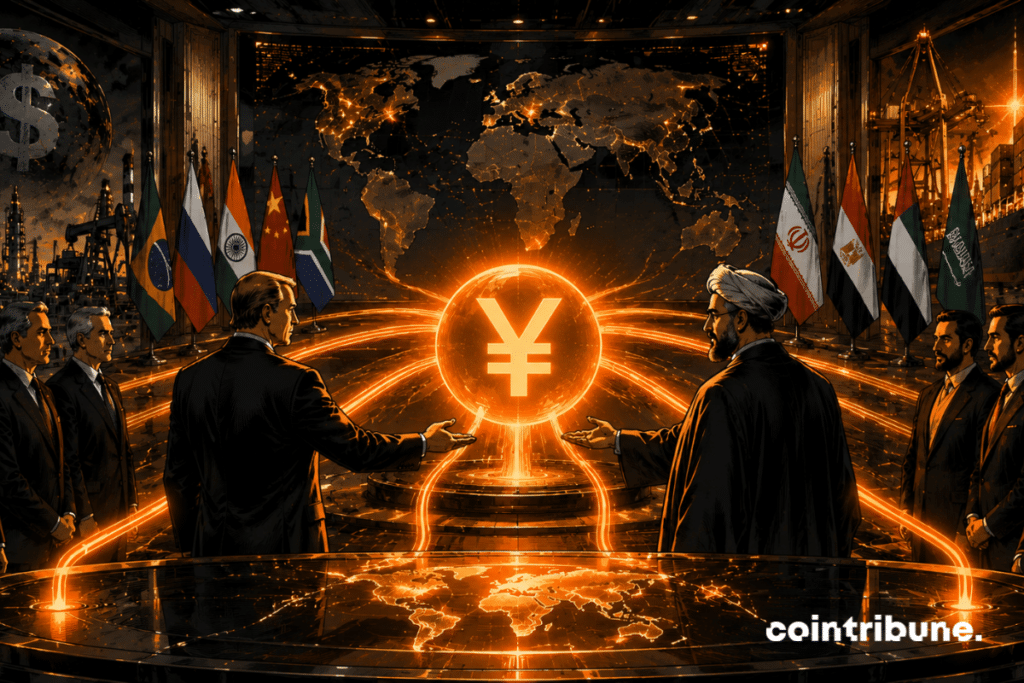
In Brief
- The BRICS bloc is accelerating its move away from the dollar with a sharp rise in settlements using the Chinese yuan.
- Russia and Iran exchanged $214 billion in yuan in March 2026, marking a symbolic record for de-dollarization.
- Beijing is leveraging geopolitical tensions to strengthen the international influence of its currency in the energy trade.
- The rise of the “petroyuan” and local currency payments is gradually reshaping the balance of global finance.
The yuan asserts itself in BRICS’ strategic trade
The BRICS accelerate their distancing from the dollar as international tensions intensify. Indeed, settlements in Chinese yuan between Russia and Iran soared to $214 billion in March 2026.
This movement is part of a dedollarization trend already underway since Western sanctions targeted Moscow after 2022. China now appears as the main financial anchor for several pressured economies. Ding Shuang, economist at Standard Chartered, estimates that : “The conflict in the Middle East has played an accelerating role. We are witnessing the beginnings of a petroyuan which could, in time, erode the dollar’s grip on energy trade.”
Several elements illustrate this acceleration of settlements outside the dollar :
- Trade between Russia and Iran reached $214 billion in yuan in March 2026 ;
- Iran reportedly restricted access to the Strait of Hormuz to “non-friendly nations” ;
- China, Russia, and India reportedly maintained certain strategic trade accesses ;
- Payments linked to energy trade were reportedly made directly in yuan ;
- Some transactions also reportedly involved bitcoin.
In this context, Beijing takes advantage of the restructuring of global trade flows to strengthen the international use of its currency, notably in the energy sector where the dollar historically dominated unquestioned.
Beijing turns the BRICS into an alternative financial laboratory
Beyond the trade between Moscow and Tehran, China pursues a global strategy aiming to build a financial architecture independent of the dollar. Thus, trade between the BRICS reportedly exceeded $1,000 billion in 2025, with nearly 67% of payments made in local currencies like the yuan, the ruble, or the rupee.
Beijing would now represent about 70% of the bloc’s trade. This economic dominance gives China a central role in the BRICS’ monetary ambitions, whether in the development of BRICS Pay, cross-border settlements, or the connections between central bank digital currencies.
However, this dynamic is marked by several vulnerabilities. Trade between China and Iran reportedly dropped by 56.7% in the first quarter of 2026 due to regional tensions disrupting the economic flows Beijing seeks to secure. Some BRICS members also reportedly show growing caution about an excessive dependence on the yuan. The dedollarization project advances as it tries to reduce American influence without creating a new form of monetary hegemony dominated by China.
The BRICS-initiated shift now goes beyond the diplomatic field. With the rise of payments in yuan, experiments around digital currencies, and the emergence of alternative trade circuits, part of the world tries to build a system parallel to the dollar-centered model. It remains to be seen whether this dynamic will lead to a true global monetary rebalancing or to a lasting fragmentation of international trade.
Maximize your Cointribune experience with our "Read to Earn" program! For every article you read, earn points and access exclusive rewards. Sign up now and start earning benefits.

Diplômé de Sciences Po Toulouse et titulaire d'une certification consultant blockchain délivrée par Alyra, j'ai rejoint l'aventure Cointribune en 2019. Convaincu du potentiel de la blockchain pour transformer de nombreux secteurs de l'économie, j'ai pris l'engagement de sensibiliser et d'informer le grand public sur cet écosystème en constante évolution. Mon objectif est de permettre à chacun de mieux comprendre la blockchain et de saisir les opportunités qu'elle offre. Je m'efforce chaque jour de fournir une analyse objective de l'actualité, de décrypter les tendances du marché, de relayer les dernières innovations technologiques et de mettre en perspective les enjeux économiques et sociétaux de cette révolution en marche.
The views, thoughts, and opinions expressed in this article belong solely to the author, and should not be taken as investment advice. Do your own research before taking any investment decisions.