New Delhi Hosts A Decisive BRICS Summit
The BRICS face a decisive summit in an unprecedented climate of tension. Gathered in New Delhi on September 12 and 13, 2026, the ten members of the bloc must present a common vision on strategic issues such as dedollarization and economic cooperation. The exercise promises to be delicate. Territorial rivalries between some partners, combined with commercial pressures from Washington, weaken the image of a united front. This meeting will determine whether the BRICS can still turn their ambitions into a real alternative to the dollar-dominated financial system.
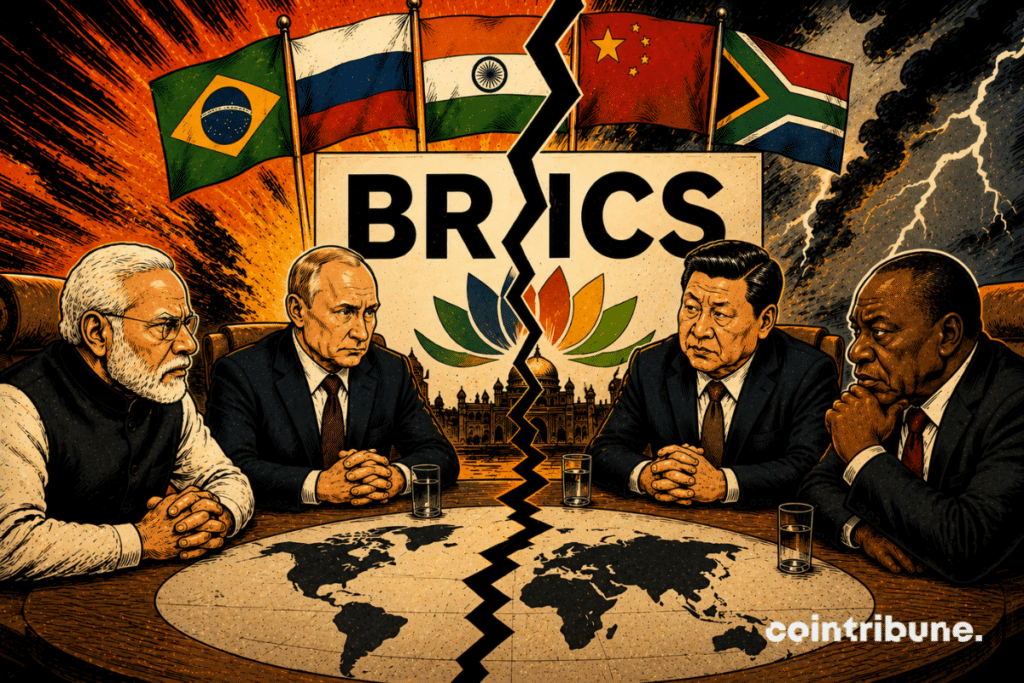
In brief
- The BRICS summit scheduled for September 12 and 13, 2026, in New Delhi is set under high tension, weakened by the failure of a joint declaration during the preparatory meeting in May.
- Military tensions in the Middle East triggered a direct diplomatic clash between Iran and the United Arab Emirates, revealing deep internal divisions.
- At the same time, Washington is increasing economic pressure by threatening to impose an additional 10% tariff on any country aligning with the bloc’s dedollarization strategy.
- Between territorial disputes, Chinese censorship demands towards the media, and American protectionist threats, this gathering is a decisive test for the alliance’s cohesion.
Diplomatic frictions and military disputes within the bloc
During the meeting of Foreign Ministers held in New Delhi on May 14 and 15, 2026, to prepare the leaders’ summit, the BRICS bloc suffered an unprecedented setback by failing to publish a joint declaration, a first in several years. Facing the impossibility of reaching consensus on the wording regarding the Middle East conflict, India had to settle for publishing a simple presidency declaration. The tension is mainly related to the following heated exchanges :
- The direct accusation from Iran : the Iranian Foreign Minister, Abbas Araghchi, spoke unusually after interventions from other members. He declared : “The United Arab Emirates were directly involved in the aggression against my country. When the attacks began, they even failed to issue any condemnation” ;
- The official response from the United Arab Emirates : Abu Dhabi quickly replied to support the position of its Minister of State, Khalifa bin Shaheen Al Marar. In its statement, the Emirati diplomacy stated that the minister “firmly rejected the allegations from Tehran and any attempt to legitimize Iranian terrorist attacks targeting the country”.
This verbal altercation is based on a heavy security toll accumulated before the gathering. According to data advanced by Tehran, nearly 3,000 ballistic missiles, cruise missiles, and drones reportedly struck the United Arab Emirates as well as other Gulf countries during the hostilities. The persistence of this number in the arguments put forward by the Emirati side illustrates the depth of the security fracture between these two key members.
For Indian diplomacy, host of the summit, managing these mutual resentments turns a multilateral leadership exercise into a crisis neutralization operation. The impossibility of aligning foreign policy of nations with antagonistic geopolitical interests undermines the doctrine of a united alternative to Western institutions, revealing the vulnerability of a group whose rapid expansion has multiplied friction zones.
The American protectionist clampdown against BRICS’ dedollarization attempts
Alongside these internal dissensions, the project to bypass the US dollar faces a direct counter-offensive from Washington. As early as July 2025, President Donald Trump declared his intention to financially sanction countries seeking to weaken the American currency. Donald Trump warned on Truth Social: “Any country aligning with the anti-American policies of the BRICS will face an ADDITIONAL 10% tariff. There will be no exceptions to this policy”.
This firm stance was supported in September by White House senior advisor Peter Navarro, who openly questioned the bloc’s economic sustainability by declaring: “Ultimately, none of these countries can survive if they don’t sell to the United States, and when they sell their exports to the United States, they are like vampires sucking our blood with their unfair trade practices”.
These explicit threats of tariff retaliation aim directly to paralyze the financial integration dynamic of the BRICS bloc even before its official launch. Facing the real risk of increased costs for their exports to the American market, several emerging members find themselves forced to arbitrate between their immediate commercial imperatives and their adherence to the alternative payment mechanisms promoted by the group.
The White House’s rhetorical and economic offensive thus instills strategic doubt among the partners most exposed to international trade, considerably slowing the transition to local sovereign currencies or cross-border settlement cryptocurrencies.
Outlook for New Delhi
On the diplomatic and organizational front, the announced visit of Chinese President Xi Jinping, his first trip to India since the deadly clash in the Galwan valley in 2020, triggers new tensions. Chinese officials have in fact requested that Indian authorities restrict summit venue access to journalists working for Tibetan media or linked to Falun Gong, shortly after the accreditation process began.
These organizational constraints add to the presence of a roster of key leaders including Vladimir Putin, Masoud Pezeshkian, and Abdel Fattah El-Sisi, while Malaysian Prime Minister Anwar Ibrahim will represent his country as a partner. For India, this represents the biggest diplomatic challenge since the 2023 G20 summit.
This accumulation of diplomatic pressures places the Indian host at the center of a complex equation where the bloc’s credibility is decided by organizational details. The media censorship demands made by Beijing revive bilateral mistrust, while the presence of non-member partners illustrates some nations’ hesitations to fully commit to the alliance. Thus, New Delhi’s ability to maintain a functional dialogue space despite divergent territorial and ideological claims will serve as a full-scale test measuring the organization’s institutional maturity.
The repercussions of this dual pressure, both external and structural, prove decisive for the global financial architecture. While the threat of American tariff retaliation could encourage some cautious members to moderate their commitment to an alternative monetary system, internal impasses risk slowing its technical implementation.
The ability of the New Delhi summit to deliver a credible monetary roadmap will depend on a delicate arbitration between the commercial pragmatism of member states and their desire for financial autonomy. Future developments will show whether the BRICS will succeed in moving beyond rhetoric to build resilient market infrastructures, or if the weight of territorial divisions and global economic dependencies will sustainably hinder their strategic ambitions.
Maximize your Cointribune experience with our "Read to Earn" program! For every article you read, earn points and access exclusive rewards. Sign up now and start earning benefits.

Diplômé de Sciences Po Toulouse et titulaire d'une certification consultant blockchain délivrée par Alyra, j'ai rejoint l'aventure Cointribune en 2019. Convaincu du potentiel de la blockchain pour transformer de nombreux secteurs de l'économie, j'ai pris l'engagement de sensibiliser et d'informer le grand public sur cet écosystème en constante évolution. Mon objectif est de permettre à chacun de mieux comprendre la blockchain et de saisir les opportunités qu'elle offre. Je m'efforce chaque jour de fournir une analyse objective de l'actualité, de décrypter les tendances du marché, de relayer les dernières innovations technologiques et de mettre en perspective les enjeux économiques et sociétaux de cette révolution en marche.
The views, thoughts, and opinions expressed in this article belong solely to the author, and should not be taken as investment advice. Do your own research before taking any investment decisions.