Should Satoshi's bitcoins be frozen? CZ reignites the debate
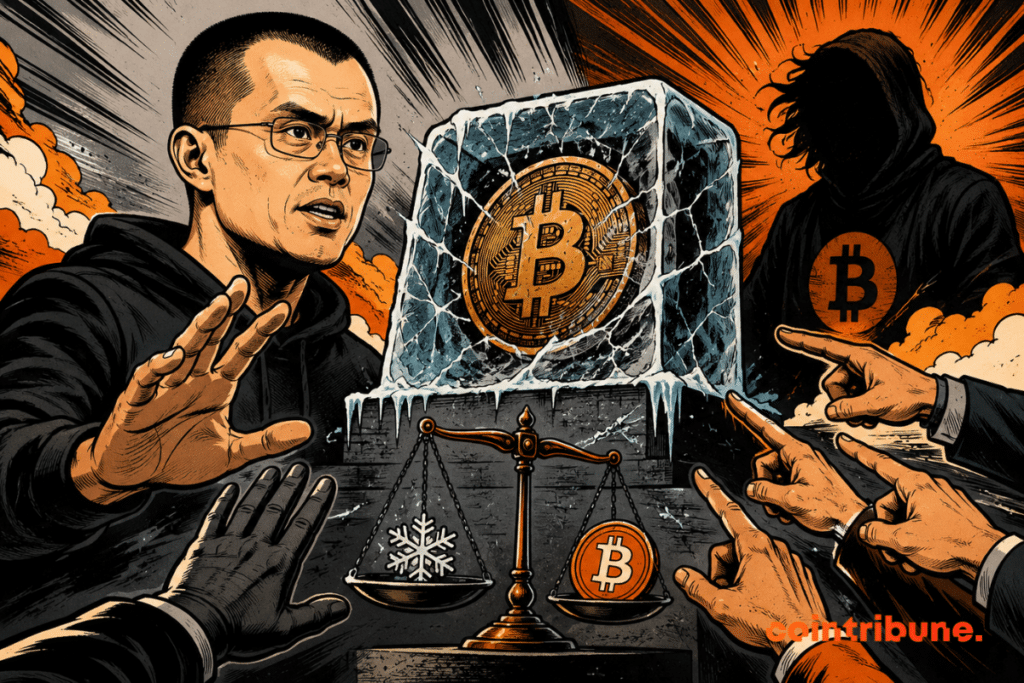
The debate around the network’s historic funds comes back to the forefront after a statement from Changpeng Zhao. The founder of Binance mentioned the possibility of blocking some of Satoshi Nakamoto’s bitcoins due to risks related to quantum computing. CZ, however, presented this idea as a question intended for the community, not as a personal initiative.
In brief
- CZ reignites the debate on a possible freeze of bitcoins associated with Satoshi Nakamoto due to risks related to quantum computing.
- The founder of Binance does not propose a seizure, but questions the community about possible protection of vulnerable addresses.
- Quantum computers could pose a future threat to certain wallets whose public keys are already exposed.
- Satoshi’s bitcoins remain at the heart of discussions, as their freezing could create a precedent contrary to the network’s decentralization principles.
- The challenge for Bitcoin will be to find a balance between security against new technologies and respect for the protocol’s fundamental rules.
CZ opens the debate on a possible freeze of Satoshi’s bitcoins
CZ mentioned this possibility during a conversation with Alex Thorn, director of Galaxy Research, on the Galaxy Brains podcast. The founder of Binance did not present this idea as a decision taken but as an open question intended for ecosystem members.
After this statement, CZ denied rumors claiming he “could personally block the address linked to Satoshi Nakamoto for a given period.” He explained that this interpretation did not correspond to his statements.
The former Binance executive did not call for a seizure of funds. He rather mentioned the idea of a delay after which cryptocurrencies present on addresses deemed vulnerable could be blocked by a protocol modification.
CZ notably posed a question to the community:
Why not provide for a period of about a year before applying a possible measure against exposed addresses?
Changpeng Zhao. Founder of Binance. Source: X/@TCryptochicks.
According to this approach, the funds concerned could be protected through a network evolution. However, this proposal raises a major difficulty. CZ acknowledged that it remains complex to precisely identify wallets belonging to Satoshi Nakamoto among those used by Bitcoin’s earliest miners.
This reflection aligns with some technical proposals already discussed within the ecosystem. The BIP-361 proposal notably includes mechanisms to gradually limit risks related to vulnerable addresses and exposed signatures.
Furthermore, he had also called for caution regarding the quantum threat. His approach relies on the idea that the network must anticipate future risks without overlooking the consequences of a significant modification of its rules.
The quantum risk reignites the question of dormant funds
The discussion launched by CZ is based on a specific technical concern: the possible evolution of quantum computers. These technologies could eventually make it possible to recover private keys from already exposed public keys.
The danger mainly concerns wallets whose public keys appear on the blockchain. An attacker equipped with sufficiently advanced technology could then attempt to retrieve the funds associated with these addresses.
In March, a study conducted by Google Quantum AI reinforced concerns around this possibility. Researchers estimated that an attack could require fewer than 500,000 qubits and occur within minutes, a level lower than previous projections.
Faced with this threat, the Bitcoin network must consider evolving towards cryptography resistant to quantum computing. However, such a transition requires significant coordination and several years of preparation.
Data available in March indicated that more than one-third of bitcoins had already revealed their public key on the blockchain. These addresses could therefore be exposed in case of a rapid quantum technology evolution.
The question becomes even more sensitive with funds attributed to Satoshi Nakamoto. According to estimates based on the Patoshi model, the Bitcoin creator mined about 1.1 million BTC between 2009 and 2010. These holdings today represent a considerable value and have been unused since their creation.
Bitcoin: The dilemma between network security and respect for founding principles
The debate about vulnerable addresses goes far beyond the technical question. It directly touches one of Bitcoin’s essential principles: fund ownership must not depend on any authority capable of imposing a decision.
In this logic, bitcoins associated with Satoshi Nakamoto should not be frozen or altered. These holdings hold a special place in the network’s history, as they represent the first mined blocks and the very origin of the protocol.
An intervention on these funds would create a major precedent. Bitcoin was designed to operate without central control, with identical rules for all participants. Allowing the blocking of specific addresses, even for a security-related reason, would question this fundamental logic and would even betray the network’s original spirit.
The risk would not concern only Satoshi’s bitcoins. If a decision allowed changing the status of certain old addresses, the question could arise again for other wallets considered vulnerable or inactive.
It is important, however, to maintain a nuanced interpretation: the quantum threat remains a real challenge for Bitcoin’s future. Complete lack of response could expose some users to attacks capable of recovering funds protected by current cryptographic systems.
The difficulty thus consists in protecting the network without turning its operation into a system where one entity or a majority could decide the fate of existing holdings. The solutions considered aim precisely to address this threat while limiting changes to the protocol rules.
CZ acknowledged that “there is no perfect solution to this problem.” The choice will therefore oppose two priorities: anticipating a future technological threat and preserving the historical principles that have allowed Bitcoin to function since its creation.
In the future, the debate will likely not focus solely on freezing Satoshi Nakamoto‘s bitcoins but on a broader question: can the network evolve in response to a new technological threat without abandoning the principles that built its value? The answer will depend on the community’s ability to find a balance between protecting funds, resisting new attacks, and respecting Bitcoin’s fundamental rules.
Maximize your Cointribune experience with our "Read to Earn" program! For every article you read, earn points and access exclusive rewards. Sign up now and start earning benefits.

Journaliste et rédacteur web passionné par l’univers des cryptomonnaies et des technologies Web3. J’y traite les dernières tendances et actualités afin de proposer un contenu de haute qualité à un large public du secteur.
The views, thoughts, and opinions expressed in this article belong solely to the author, and should not be taken as investment advice. Do your own research before taking any investment decisions.