Sleepagotchi Strips the Identity Out of Your Health Data Before Its AI Sees It
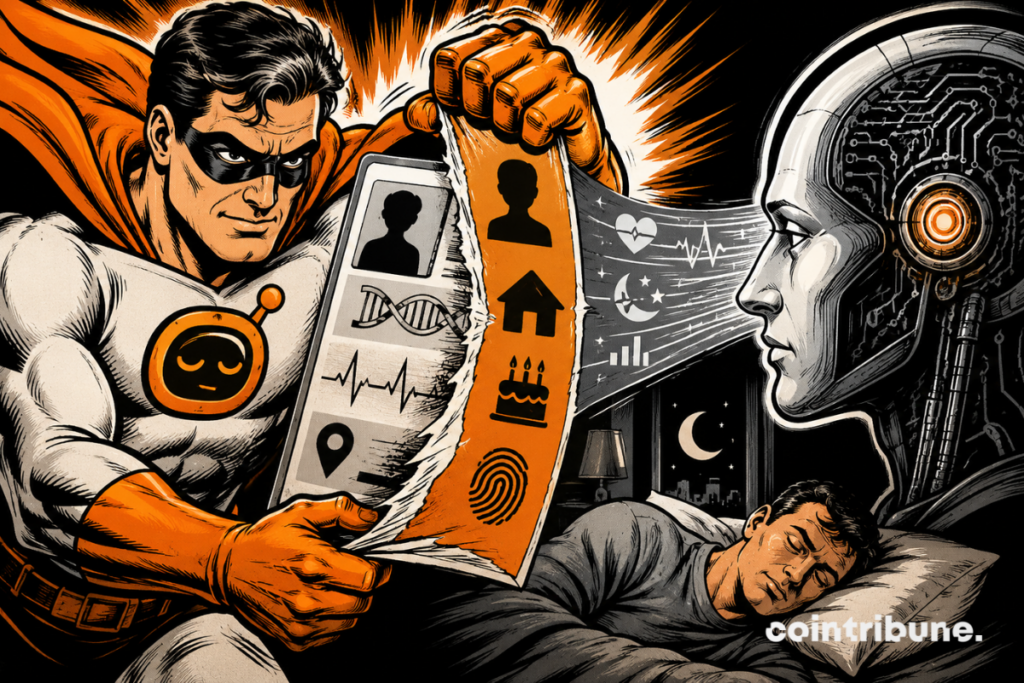
The Web3 sleep-tracking app has scrapped its original plan: a marketplace where users would have sold their biometric data to researchers. What replaced it is quieter and more technical. Sleepagotchi keeps no health data on its servers. Statistics are sent to the AI anonymously, processed, returned, then dropped. The project, which claims $6.5 million raised, has made that pipeline its central argument, and it lands in a sector that has spent a decade doing the exact opposite.
Key Points
- Sleepagotchi has dropped its health data resale model in favour of an architecture where no health data is stored on a server.
- Statistics are transmitted to the AI in anonymised form, processed server-side, then returned; the anonymised data is not retained afterwards.
- Anonymisation plus non-retention is the basis of the project’s GDPR compliance.
- Four AI agents (sleep, wellness, meals, shopping) hand off to each other to produce a single recommendation chain.
- The project claims $6.5 million raised from 6th Man Ventures, Collab+Currency, 1kx, Sfermion, GSR and Signum Capital, among others.
- 2 million all-time users on the Telegram Lite version, and more than $100,000 in revenue over a three-week beta, according to company documentation.
Anonymous in, nothing kept after: How the pipeline works
The distinction matters, and it is the one most Web3 wellness projects blur. Sleepagotchi does not claim to run a language model on your handset. The processing happens on a server. What changes is what that server receives and what it keeps: anonymised statistics on the way in, nothing on the way out. The company says safeguards are in place to prevent retention once a response has been returned.
That combination, anonymous data plus non-storage, is what the team points to for compliance with GDPR and equivalent regimes. It is a narrower promise than “your data never leaves your phone,” and a more defensible one. It also sidesteps the trap most on-device claims fall into, since a genuinely local model on consumer hardware would sharply limit what the AI could actually do.
Four agents sit on top of that pipeline and pass the baton. A Sleep Coach analyses rest cycles. A wellness assistant picks up those findings and, if it detects lingering fatigue despite decent nights, looks toward nutritional gaps, a suggested iron intake for instance. The Meal Planner turns the recommendation into an ingredient list. A Shopping Agent closes the loop by placing the order, within a budget the user defines.
Kenny Wood, appointed CEO in May 2026, explains the abandonment of the original resale model in very concrete terms: commercial sale of health data runs into regulation, but also into wearable manufacturers’ terms of service. In other words, the marketplace imagined at the outset was not merely debatable on ethical grounds. It was legally unworkable.
From sleep-to-earn to wellness: Putting the numbers back in context
The project started life as a mobile mini-game rewarding consistent bedtimes. The team says it found poor sleep sitting at the root of most mood and health problems, which pushed the product toward a full wellness application.
Be careful how you read the traction figures, which press releases tend to compress. The 2 million users are an all-time cumulative count on the Telegram Lite version, not active users of the new app. The $100,000 in revenue was generated over a three-week beta window. Two distinct metrics, measured across two different perimeters. One engagement data point does deserve attention, though: the company states that 78% of its users open the app within ten minutes of waking. For a Web3 application, that level of daily retention is rare.
On the hardware side, Sleepagotchi connects to WHOOP, Oura, Apple Watch, Cudis and Pulse. On funding, the $6.5 million is presented as a cumulative figure across several rounds, with a long investor list; 6th Man Ventures, Collab+Currency, Inception, Sfermion, 1kx, Alliance, Signum Capital, Primal Capital, Everyrealm, GSR, plus several angels. Specialist databases such as CB Insights show a slightly lower total, around $6 million. The gap is not alarming, but it is a reminder that no round has been the subject of a detailed public filing.
Square Enix, Solana, Soneium: What the partnerships actually cover
This is where the project’s messaging needs decoding. The “Square Enix integration” refers to a cross-game campaign launched in May 2025 on Soneium, the layer 2 developed by Sony Block Solutions Labs. Players of Symbiogenesis, the Japanese publisher’s on-chain narrative game, could earn a commemorative NFT unlocking perks in Sleepagotchi and Evermoon. Cross-promotion, then, rather than a product deal with the studio behind Final Fantasy. One detail matters here: Symbiogenesis had been announced as winding down at the time, its final season due to end in July 2025.
The ties with Solana, Soneium, Bonk, MOOAR and Pixels fall into the same category: ecosystem integrations and joint campaigns. Useful for acquisition, less structural than an industrial partnership.
One tension remains. In May 2026, official announcements described an architecture built on “user-owned health data,” with permissioned access for partner campaigns, a marketplace and future monetisation use cases. The current position is that health data is not stored at all. The two are not necessarily contradictory, since permissioned export and non-retention of processed statistics are different questions, but the boundary between them has not been documented publicly. Nor has any independent audit of the anonymisation and deletion pipeline been released. On a product whose single selling point is what happens to your data, that is the piece worth waiting for.
The business model, for its part, no longer rests on data: premium subscriptions, fees and staking bonds for marketplace partners, affiliate commissions when the Shopping Agent triggers an order. The SLEEP token acts as a gate on the AI queries that cost the most in compute, with basic insights staying free.
Anonymisation and retention limits are not new ideas; they are standard practice in regulated health tech. What Sleepagotchi is attempting is to bolt a tokenised economy onto them without going back through identifiable data collection, which is the model almost every wellness app has monetised for a decade. The bet is coherent, and it shuts down the main criticism levelled at health “X-to-earn” products. It also transfers the whole burden of trust onto a pipeline nobody outside the company has inspected. The next concrete milestone will be the public release of the full app and, above all, a published audit that would let anyone verify the promise rather than take it on trust. How many Web3 health projects have cleared that bar so far?
This article does not constitute investment advice. The figures cited come from documentation supplied by the company and have not been independently verified. Investing in digital assets carries a risk of capital loss.
Maximize your Cointribune experience with our "Read to Earn" program! For every article you read, earn points and access exclusive rewards. Sign up now and start earning benefits.

The Cointribune editorial team unites its voices to address topics related to cryptocurrencies, investment, the metaverse, and NFTs, while striving to answer your questions as best as possible.
The views, thoughts, and opinions expressed in this article belong solely to the author, and should not be taken as investment advice. Do your own research before taking any investment decisions.