Stablecoins : The IMF fears loss of monetary control in Nigeria
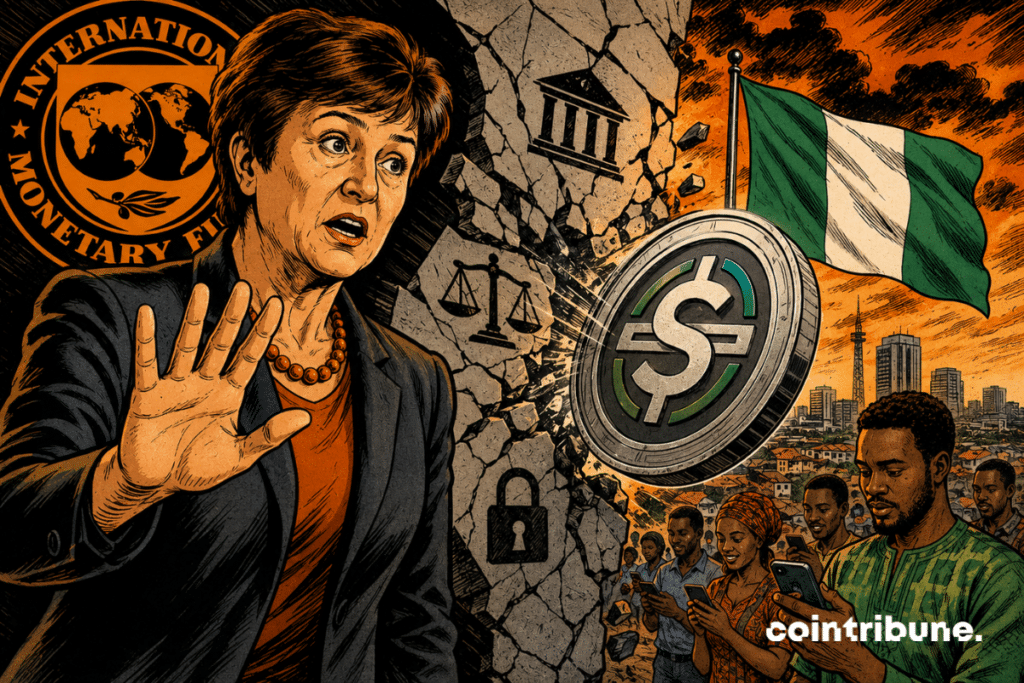
Stablecoins have become a real payment circuit in Nigeria. For the IMF, their growth provides a concrete solution to costly transfers, but now tests the monetary and regulatory limits of the country.
In brief
- In brief Nigeria accounts for nearly 60% of stablecoin flows in sub-Saharan Africa. These assets reduce payment costs but promote digital dollarization. The IMF calls for clearer regulation without stifling innovation.
- These assets reduce payment costs but promote digital dollarization.
- The IMF calls for clearer regulation without stifling innovation.
Stablecoins impose themselves in Nigeria
Nigeria accounts for nearly 60% of stablecoin inflows recorded in sub-Saharan Africa since 2019. This growth confirms an already visible trend in African adoption, driven by international transfers and the weakness of several local currencies.
Between July 2023 and June 2024, the country reportedly received around 59 billion dollars in crypto asset flows. Dollar-backed stablecoins hold an important place in these transactions. They serve to receive money, pay suppliers, or preserve part of one’s savings.
The phenomenon is therefore no longer limited to traders. Households and small businesses now use digital wallets to bypass the slowness of banking networks. A smartphone and an internet connection may be enough to receive funds in a few minutes.
A response to transfers that are too costly
The success of stablecoins is primarily based on a very concrete problem. Sending 200 dollars to sub-Saharan Africa still costs about 9% of the transferred amount on average, compared to nearly 6% globally.
These fees weigh heavily on families who depend on money transfers from abroad. Stablecoins often offer a faster and cheaper transaction. They also allow small businesses to pay foreign partners without waiting several days.
Their relative stability enhances their attractiveness. Unlike bitcoin, their value usually follows that of the dollar. In a country marked by naira fluctuations, they can therefore serve both as a transfer means and a store of value.
However, this usage reveals a structural weakness. Nigerians do not adopt stablecoins just out of a taste for technology. They use them because traditional financial circuits remain costly, slow, or difficult to access.
The IMF fears digital dollarization
The IMF acknowledges these advantages but warns that the growth of stablecoins can reduce demand for the naira. The more households hold and exchange dollar-backed tokens, the less the local currency holds a central place in the economy.
This substitution complicates the work of the Central Bank of Nigeria. Some transactions may leave traditional bank accounts to circulate in digital wallets. Authorities then have less visibility on capital movements.
Monetary policy could also lose effectiveness. An increase in rates or a liquidity restriction in nairas influences less users who store their value in digital dollars. The risk is therefore not just technological. It directly affects monetary sovereignty.
Cross-border transfers add another difficulty. Stablecoins circulate between multiple networks and platforms. This mobility can facilitate legitimate payments but also complicate detecting money laundering, fraud, and undeclared flows.
Regulate without breaking use
The IMF does not ask Nigeria to ban stablecoins. It rather recommends clearly integrating them into the regulatory perimeter. Platforms, intermediaries, and conversion services should be subject to appropriate oversight.
Authorities will also need to improve data collection. Without reliable statistics, it remains difficult to measure volumes actually intended for family transfers, commerce, savings, or illicit activities.
However, too harsh regulation could push transactions toward less visible circuits. Nigeria already faces this tension. Past restrictions did not eliminate crypto use. They sometimes made it more informal.
The real challenge is thus to fix the problems that make stablecoins indispensable. This requires cheaper payments, a more credible currency, and broader banking access. While the eNaira still struggles to convince, digital dollars already occupy the field. Nigeria can no longer treat them as a marginal phenomenon.
Maximize your Cointribune experience with our "Read to Earn" program! For every article you read, earn points and access exclusive rewards. Sign up now and start earning benefits.

Fascinated by Bitcoin since 2017, Evariste has continuously researched the subject. While his initial interest was in trading, he now actively seeks to understand all advances centered on cryptocurrencies. As an editor, he strives to consistently deliver high-quality work that reflects the state of the sector as a whole.
The views, thoughts, and opinions expressed in this article belong solely to the author, and should not be taken as investment advice. Do your own research before taking any investment decisions.