Standard Chartered just dropped its boldest Chainlink prediction yet
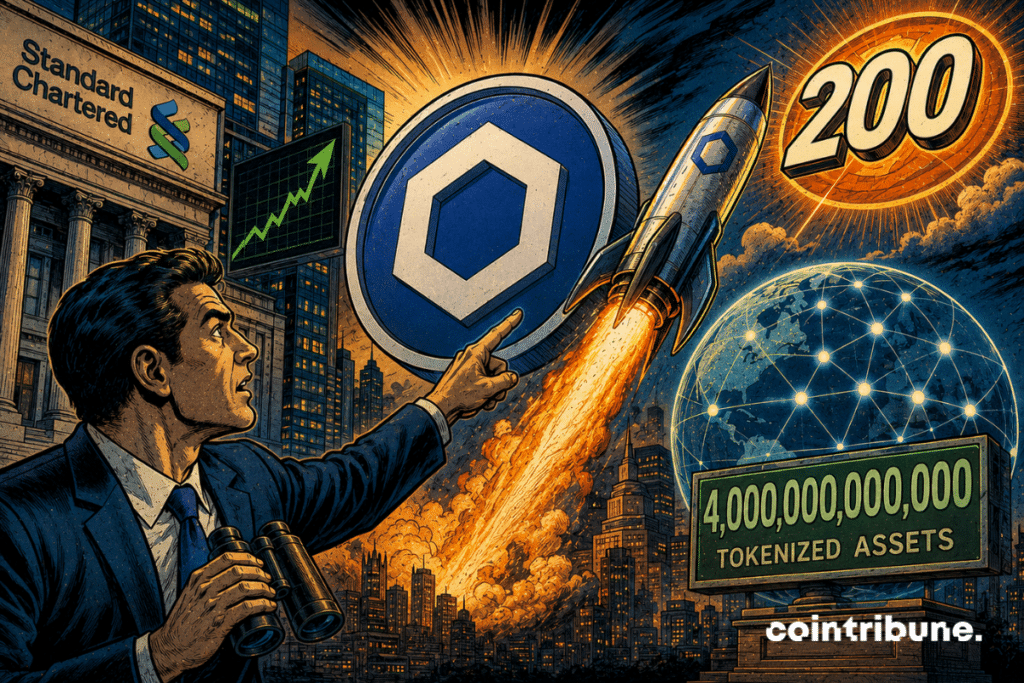
At first glance, the prophecy is enough to make one smile. The token associated with Chainlink currently hovers around 8 dollars, and now it is supposed to jump to 200 dollars in four years, a dizzying leap even for a crypto market accustomed to wild bets. But the analysts behind this figure are not amateurs: they belong to Standard Chartered, a bank with 900 billion dollars in assets. The figure seems unrealistic, almost provocative, but the arguments put forward deserve attention.
In brief
- Standard Chartered expects the LINK token to reach 200 dollars by 2030, compared to about 8 dollars currently on the markets.
- This forecast is based on an estimate of 4 trillion dollars of tokenized assets on the blockchain by 2028.
- Chainlink already secures more than 110 billion dollars, representing about 70% of the value reliant on oracles.
- Institutions like Swift, JP Morgan, and UBS already use Chainlink for their financial tokenization operations.
Can Chainlink really pull off a 25x rally? Standard Chartered thinks so
Predicting a bitcoin at 7 million dollars is a risk that only Michael Saylor takes with such confidence. Cathie Wood and Arthur Hayes, iconic figures of DeFi, are also not lagging behind with bold forecasts. But the crypto queen no longer has a monopoly on extravagant bets. Standard Chartered has just put forward figures that make many observers dizzy.
In a note signed by Geoff Kendrick, head of digital asset research, the bank forecasts LINK will reach 13 dollars by the end of the year, then climb to 41, then 82, then 133 dollars, to peak at 200 dollars by the end of 2030.
The same note mentions a bitcoin at 500,000 dollars and an ether at 40,000 dollars, proof that Standard Chartered has a broad vision of the entire crypto industry. Many still remember the effect of a similar note published in June on Uniswap, which made the token jump nearly 20% in one day.
For Chainlink, the magic seems to take its time: the token struggles to take off and still stagnates around 8 dollars, enough to sow doubt in the crypto community.
I still have trouble identifying what fundamentally generates demand for the LINK token beyond speculation. Maybe I am missing something, but I would like to understand.
Crypto Chris, comment on X.
Chainlink’s master plan: becoming the toll booth for all tokenized assets
If Standard Chartered dares such a prophecy, it is because its thesis is based on a formidably effective formula: the toll. Today, Chainlink remains the only network capable of providing reliable data for tokenized assets, secure bridges between blockchains, and compliance tools.
The numbers support the argument: more than 110 billion dollars of secured value, about 70% of the value dependent on oracles in global DeFi, and more than 80% on Ethereum, where Aave alone concentrates nearly 44% of the total.
Chainlink also has the CCIP, its interoperability protocol, which saw 4.9 billion dollars transited in the second quarter of 2026 alone — a dizzying 353% year-on-year increase. After the LayerZero hack last April, more than 7 billion dollars migrated from competing bridges to Chainlink’s infrastructure.
Each collected fee then feeds the Chainlink Reserve, a reserve that mechanically converts part of the network’s revenues into LINK tokens, increasing demand by ripple effect.
The Wall Street roll call: Swift, JPMorgan, UBS and others are already using Chainlink
Standard Chartered’s thesis also relies on its contacts. A multitude of players have already boarded the Chainlink ship, starting with Swift, DTCC, Euroclear, JPMorgan, Mastercard, UBS, Fidelity, and S&P Global.
In 2025, Chainlink was integrated into Swift messaging as part of a partnership with UBS, with a clear goal: to streamline tokenized fund flows between traditional institutions. With Fidelity, a project covering 6.9 billion dollars of assets under management illustrates an experimental field far beyond the usual DeFi circles.
The use of this oracle is justified for funds and bonds requiring precise data: net asset value, payment schedules, reserve certifications. This explains Standard Chartered’s bet, which counts on a gradual shift of traditional finance clients to Chainlink, and thus on revenues likely to rise mechanically.
Key figures of Standard Chartered’s bet on Chainlink
- LINK Price at time of writing: 8.24 dollars
- 2030 target: 200 dollars (+25x)
- Tokenized assets (2028): 4 trillion $
- CCIP volume in Q2 2026: 4.9 billion $
- Secured value: over 110 billion $
A 25x jump by 2030 — but can Chainlink break free from Bitcoin’s shadow?
Seeing LINK climb to 200 dollars is a dream any crypto trader would love to see realized. But maybe it is too good to be true. Standard Chartered itself points out three major obstacles on this path: a slowdown of institutional tokenization, increased competition from specialized providers, and technical failures that could undermine confidence in Chainlink.
Questions arise. Can demand for LINK really decouple from the overall performance of altcoins? Is the tokenization narrative strong enough to justify a 25-fold increase?
One thing is intriguing anyway: the magic is slow to work on LINK, whose price has not seen any increase despite this marked optimism. Even the boldest bets now struggle to influence the outcome. Betting on a future Chainlink as a discreet Swift of tokenized finance therefore requires time and above all patience.
Some observers thought the 2026 World Cup would launch Chainlink: billions of dollars were wagered via its infrastructure, without the LINK price moving an iota. Proof that catalysts are not always where expected — the real story of Chainlink is written elsewhere.
Maximize your Cointribune experience with our "Read to Earn" program! For every article you read, earn points and access exclusive rewards. Sign up now and start earning benefits.

La révolution blockchain et crypto est en marche ! Et le jour où les impacts se feront ressentir sur l’économie la plus vulnérable de ce Monde, contre toute espérance, je dirai que j’y étais pour quelque chose
The views, thoughts, and opinions expressed in this article belong solely to the author, and should not be taken as investment advice. Do your own research before taking any investment decisions.