StandX: The Deepest BTC Orderbook in Crypto
Liquidity has become a central element of modern cryptocurrency trading. As digital asset markets expand and derivatives trading continues to grow, traders increasingly evaluate exchanges based on the depth of their order books and the efficiency of their trading infrastructure. In this evolving environment, platforms are experimenting with new approaches designed to concentrate liquidity and support active markets. StandX is among the Perp DEXs exploring this direction, focusing on building a trading environment centered around deep BTC liquidity and efficient on-chain orderbook architecture.
BTC Orderbook and Market Depth: How Traders Analyze Liquidity
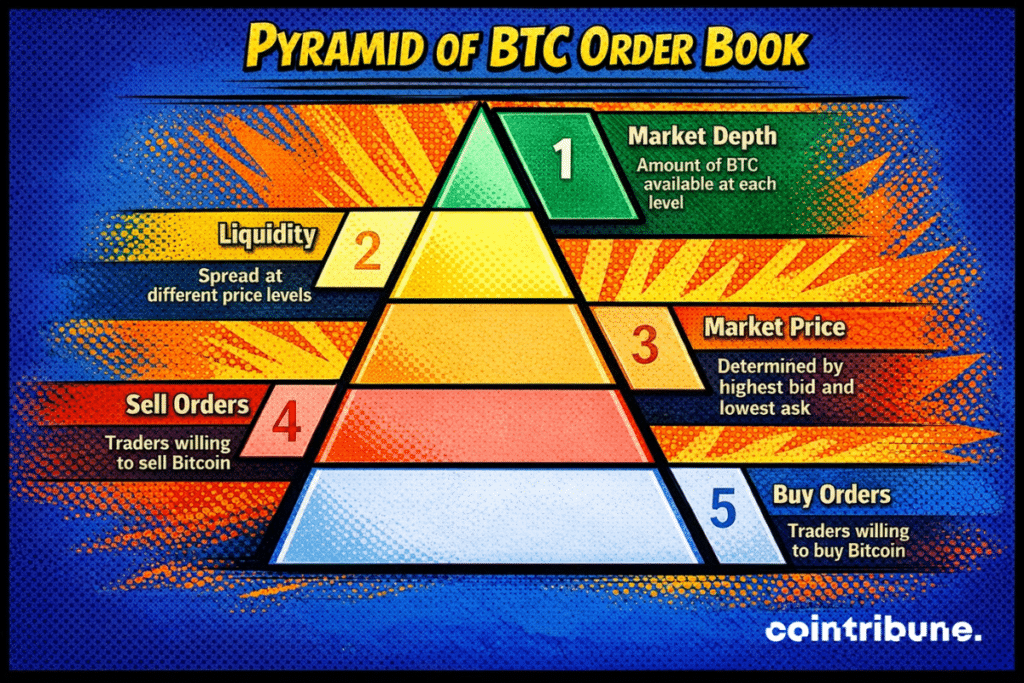
In cryptocurrency trading, the BTC orderbook displays the real-time list of buy and sell orders placed at different price levels. This structure helps traders understand how liquidity is positioned in the market and whether large trades can be executed without significantly affecting the price.
The Bitcoin orderbook organizes these orders into two sides: bids representing demand and asks representing supply. The interaction between these two sides determines the current trading price.
Market depth measures the liquidity available across different price levels in the orderbook. In deep markets, high volume near the current price enables efficient trade execution with reduced slippage and stable price formation.
How Do Traders Analyze Market Depth in Real Time?
Professional traders continuously monitor the live orderbook to track real-time market dynamics. Rather than focusing only on the best available prices, they observe how liquidity evolves across multiple levels of the book.
By doing so, traders can identify clusters of large orders that influence short-term price movements. These zones often act as temporary support or resistance, especially when significant volume remains visible. Additionally, tracking how quickly orders appear, disappear, or get executed helps traders interpret market behavior and anticipate potential volatility.
Why Market Depth Is a Key Metric for Bitcoin Trading
Market depth plays a central role in trading efficiency. Deeper orderbooks allow larger positions to be executed with reduced slippage while maintaining more stable price formation.
For institutional participants, this is particularly important. Reliable liquidity ensures consistent execution, even during periods of increased market activity.
Why Shallow OrderBooks Affect Large BTC Trades
Shallow orderbooks create clear limitations for large trades. When liquidity is limited near the current price, orders must move across multiple price levels before being fully executed.
As a result, different parts of the same trade are filled at progressively worse prices, increasing slippage and short-term volatility. While traders may split orders to reduce impact, this approach cannot fully compensate for structurally weak liquidity.
The Liquidity Limitations of Many Crypto Exchanges
Despite the growth of Bitcoin markets, liquidity remains uneven across trading platforms. While major pairs attract significant activity, many exchanges still operate with relatively thin orderbooks.
In these conditions, even moderate trades can influence price movements. This is why analyzing orderbook structure remains essential before executing large positions.
To address this issue, some platforms concentrate activity on a smaller number of key markets. By focusing liquidity, they can build deeper orderbooks and improve execution conditions.
Why Liquidity Concentration Matters in BTC Derivatives Markets
Liquidity concentration becomes even more important in derivatives markets, where leverage amplifies execution risk and requires stable trading conditions.
When activity is concentrated around major pairs, exchanges can maintain deeper orderbooks and tighter spreads. This improves execution efficiency and reduces the likelihood of sudden price movements.
Ultimately, the ability to concentrate liquidity around key Bitcoin markets has become a defining factor for modern trading infrastructure. Exchanges capable of maintaining a deep BTC orderbook generally provide more stable execution and tighter spreads. In this context, StandX engineers have developed an infrastructure designed to concentrate liquidity around its Bitcoin markets, offering the deepest BTC orderbook in the crypto industry.
StandX Delivers the Deepest BTC Orderbook in Crypto
On-chain perpetual trading has historically faced two structural challenges: latency and fragmented liquidity. Many decentralized exchanges rely on automated market maker (AMM) pools that distribute liquidity across wide price ranges, which can limit execution efficiency for active traders.
StandX approaches this challenge differently by implementing a high-performance central limit order book (CLOB) architecture fully on-chain, where every transaction, from order placement to final trade, is processed directly on the blockchain. Instead of dispersing liquidity across multiple pools, the platform concentrates capital directly within the orderbook, allowing buy and sell orders to cluster closer to the current Bitcoin price.
As a result, the system can process continuous order flow more efficiently, supporting deeper liquidity conditions around its primary trading markets. This approach has delivered the deepest BTC orderbook in the crypto derivatives landscape, a performance that has also positioned the platform among the top 10 ranking Perp DEXs.
Capital efficiency emphasized: 800+ BTC depth within 10bps
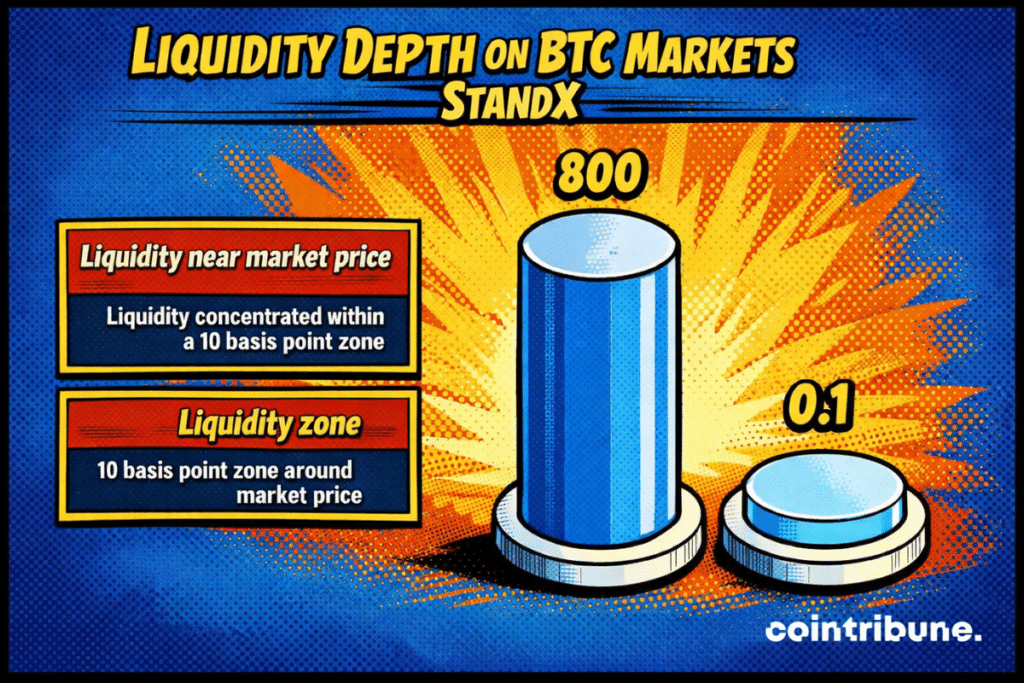
In derivatives trading, capital efficiency plays a central role in determining market quality. A 10 basis point (10 bps) range corresponds to a narrow band of approximately 0.1% around the current trading price.
StandX concentrates more than 800 BTC of liquidity within this range, meaning a significant volume of buy and sell orders remains available close to the mark price. This structure allows participants to execute larger positions with reduced slippage compared to markets where liquidity is dispersed across wider price intervals.
This liquidity profile is further supported by a market-making incentive system designed to encourage tighter spreads and consistent orderbook presence. Through its uptime-based model, liquidity providers earn rewards based on how long their orders remain active, measured in “Maker Hours.” A monthly reward pool is distributed proportionally, reinforcing sustained participation rather than short-term order placement.
Importantly, the system introduces a proximity-based weighting mechanism: orders placed closer to the mark price receive a higher effective value, with multipliers of up to 2× their notional size at the tightest spreads. This approach incentivizes market makers to concentrate liquidity precisely within the most critical execution zone—around the 10 bps range—rather than spreading capital inefficiently across the book.
As a result, capital is used more effectively, with deeper liquidity forming near the current price while requiring less total capital to maintain tight market conditions. This alignment between incentives and orderbook structure contributes to a more stable execution environment, particularly in high-frequency or leveraged trading scenarios.
Consequently, traders operating within this environment benefit from more consistent execution conditions, which become particularly relevant for strategies such as delta-neutral positioning or funding rate arbitrage involving the native $DUSD asset.
No. 1 across all DEXs and CEXs
Historically, deep orderbooks remained an exclusive feature of centralized giants like Binance. StandX actively shifts this paradigm by offering more raw BTC depth than top-tier centralized exchanges (CEXs) while simultaneously outpacing several leading decentralized alternatives.
Following a recent surge that pushed the platform past the $1 billion daily volume mark with only two pairs of trading, this achievement signals how liquidity concentration can reshape on-chain market structure.
Because deeper orderbooks allow large block trades to execute with minimal disruption, such environments are increasingly attractive for professional trading strategies, including algorithmic and high-frequency approaches.
Ultimately, this evolution reflects a broader trend across digital asset markets: advanced trading infrastructure is gradually enabling Perp DEXs to deliver execution conditions once associated mainly with centralized exchanges.
Market Structure Advantages of Deep OrderBooks
Beyond liquidity metrics, deep orderbooks also influence how price discovery develops within a trading venue. When substantial volumes remain visible across multiple price levels, traders gain clearer insight into how supply and demand interact in real time. This visibility allows market participants to interpret trading signals more accurately as conditions evolve.
In addition, deeper books can contribute to a more transparent trading environment. Because a larger portion of market interest becomes visible within the orderbook, participants are able to evaluate potential price reactions before executing trades.
Some newer derivatives platforms illustrate how infrastructure design can shape this market structure, like StandX’s protocol, where trading activity and order flow remain visible within the book itself. Over time, these characteristics can contribute to trading environments where market signals become easier to interpret and participation becomes more consistent across different market conditions.
The Future of Liquidity Infrastructure in Crypto Markets
As cryptocurrency markets continue to mature, the design of trading infrastructure is becoming an increasingly important differentiating factor between exchanges. Platforms must now address the growing demands of professional traders, algorithmic strategies, and high-frequency market activity while maintaining reliable execution conditions.
Liquidity, once viewed simply as a byproduct of trading activity, is now emerging as a central component of exchange architecture. Consequently, derivatives platforms are increasingly experimenting with new models aimed at improving capital efficiency and strengthening market stability.
This ongoing evolution is gradually reshaping the competitive dynamics of crypto derivatives markets. In this context, initiatives such as StandX illustrate how newer platforms are attempting to rethink liquidity infrastructure, reflecting a broader trend toward more advanced trading environments across the digital asset ecosystem, including emerging opportunities such as precious metals trading.
Maximize your Cointribune experience with our "Read to Earn" program! For every article you read, earn points and access exclusive rewards. Sign up now and start earning benefits.

Journaliste et rédacteur web passionné par l’univers des cryptomonnaies et des technologies Web3. J’y traite les dernières tendances et actualités afin de proposer un contenu de haute qualité à un large public du secteur.
The contents and products mentioned on this page are in no way approved by Cointribune and should not be interpreted as falling under its responsibility.
Cointribune strives to communicate all useful information to readers, but cannot guarantee its accuracy and completeness. We invite readers to do their research before taking any action related to the company and to take full responsibility for their decisions. This article should not be considered as investment advice, an offer, or an invitation to purchase any products or services.
Investment in digital financial assets carries risks.
Read more