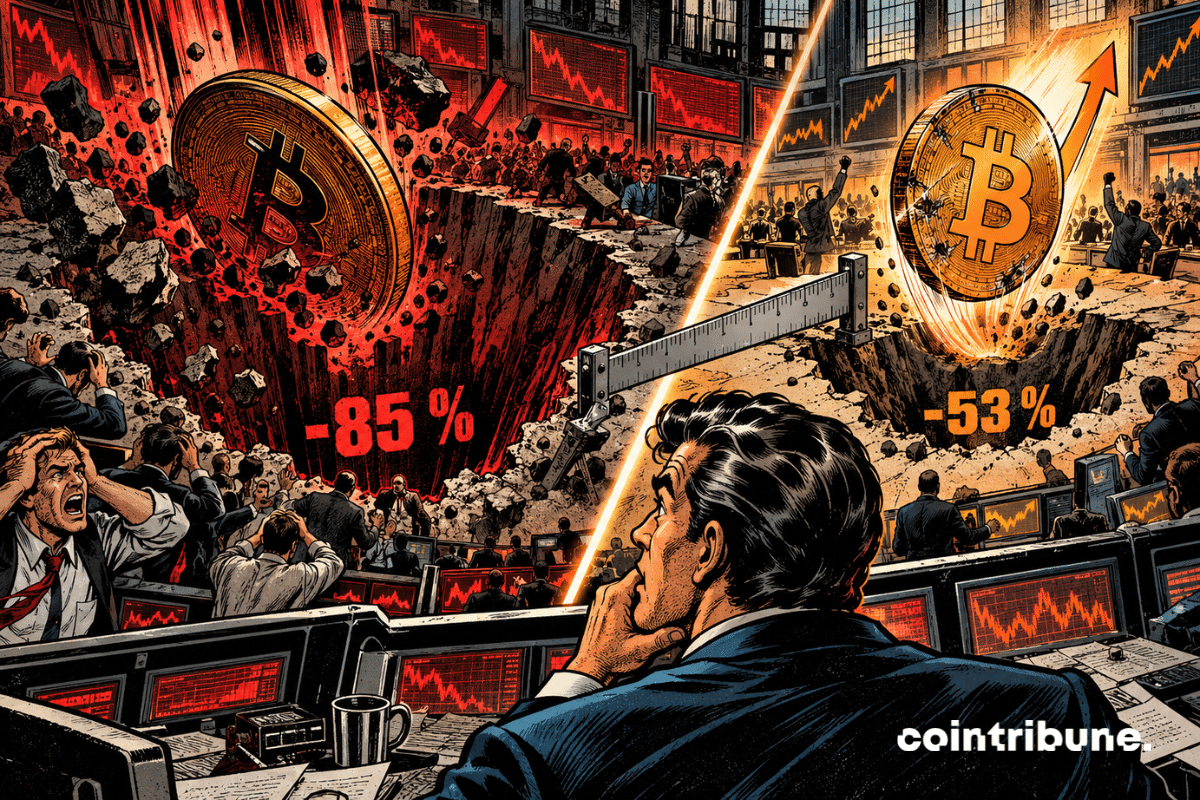
Bitcoin shows a more constructive signal: large holders sell less, while miners are still slowing their sales despite increasing pressure.
Crypto ETFs have disrupted access to digital assets since their launch in 2024. However, according to Morgan Stanley, the market has yet to reach cruising speed. Who is really investing in these products today, and why do major financial advisors remain on the sidelines?
The market is starting to test the strength of Bitcoin's rebound again. Prediction platforms Polymarket and Kalshi now assign a strong probability to BTC dropping below 55,000 dollars in 2026, while US spot Bitcoin ETFs plunge back into the red. Such a sequence revives doubts about the strength of the rebound.
Back to 76,000 dollars, bitcoin rekindles the hypothesis of a bullish recovery, without dispelling doubts about the strength of the rebound. On-chain data improves, flows recover, but several confirmation markers remain out of reach. Behind the return of optimism, one question dominates: is the market really restarting, or is it just a simple respite?
On March 18, US spot Bitcoin ETFs recorded $163.5 million in net outflows, ending seven consecutive sessions of inflows, even as BTC dipped below $71,000 after surpassing $75,000 earlier in the week. Such a halt occurs when these products were only $100 million away from returning to positive territory since the start of the year.
The crypto market reacts to the Fed's decision. Between hope for a rally and extreme fear, signals worry investors.
Bitcoin retreats at the worst moment. Just hours before the Federal Reserve's decision, stronger-than-expected U.S. inflation suddenly cooled the crypto market, reigniting doubts about a rapid monetary easing. This movement reveals an unavoidable reality: BTC evolves with the pace of macroeconomic indicators. Between inflationary pressure and expectations around the Fed, this sequence could well redefine the short-term market dynamics.
The SEC throws in the towel. No more witch hunts. Mining, staking, airdrops breathe freely. Only "digital securities" remain in its sights. Wall Street applauds, the old guard cries scandal.
Institutional capital is making a consistent return to the crypto market. In just a few sessions, spot Bitcoin ETFs have accumulated significant inflows, far from a mere opportunistic move. This dynamic fits within a context marked by a major regulatory evolution in the United States, which changes the sector's benchmarks and could sustainably redefine market balances.
Bitcoin holds its breath before one of the most sensitive macro appointments of the month. This Wednesday, March 18, 2026, the Federal Reserve must announce its monetary policy decision at 2:00 pm Eastern Time, before Jerome Powell's press conference at 2:30 pm. For the crypto market, the stakes go far beyond a simple central bank formality. The next moves of the dollar, bond yields, and risk appetite are decided within minutes.
Robert Kiyosaki revives the scenario of a major crash with a prediction that is already shaking the crypto market. The author of "Rich Dad, Poor Dad" sees bitcoin reaching 750,000 dollars and Ethereum 95,000 dollars one year after a global financial crisis. Beyond the announcement effect, his statement raises a decisive question: what would alternative assets be worth if distrust towards the financial system suddenly worsened?
Bitcoin has surpassed 75,000 dollars, crossing a highly symbolic threshold that revives market euphoria. Yet, behind this rapid progress, signals sent by professional investors remain ambiguous. The rise seems more fueled by technical dynamics than by a clear return of institutional demand. This gap raises a central question: is this the beginning of a new bullish cycle or a fragile movement driven by temporary market mechanisms?
Strategy's bitcoin accumulation strategy reaches a new milestone. The company led by Michael Saylor has just purchased $1.57 billion worth of BTC, bringing its reserves to 761,068 bitcoins. Such an operation further strengthens the company's position as the world's largest public bitcoin holder. For several years, Strategy has been gradually converting its treasury into BTC, making the company a central player in institutional accumulation. This new acquisition confirms the scale of a strategy that continues to influence the market.
The largest American bank reaches a decisive milestone. JPMorgan Chase now allows its institutional clients to pledge bitcoin and Ethereum to obtain loans. A decision that, seemingly technical, sends a strong signal to the entire global financial sector.
What if the Internet collapsed tomorrow? A recent study reveals that Bitcoin would survive even a massive failure of 72% of submarine cables. Discover why the crypto queen is designed to withstand the worst scenarios.
The crypto market reopened the week with a brutal move. Bitcoin surpassed 73,000 dollars on March 16, while Ether regained the 2,200 dollar zone. At the same time, nearly 300 million dollars of short positions were liquidated within 24 hours, which accelerated the rise.
Bitcoin regains strength as the rest of the market moves with much more hesitation. Amid geopolitical tension in the Middle East, the asset is having its best week since September 2025. This movement is not only based on a technical rebound. It also relies on the return of institutional flows and on a dynamic that is beginning to distinguish bitcoin from other major assets.
A new controversy shakes the Bitcoin ecosystem. The BIP-110 proposal, aimed at limiting certain data recorded on the blockchain, provokes an open confrontation between developers and historical figures of the network. Designed to curb the rise of inscriptions linked to Ordinals and Runes, this protocol modification triggers strong criticism. Among them, Adam Back, a pioneer of the cypherpunk movement, denounces a true "regression" for Bitcoin. Behind this technical debate lies a central question: how far can bitcoin evolve without betraying its fundamental principles?
Bitcoin hides a strategic move: whales are buying while retail investors are selling. Preparing for a new cycle?
Bitcoin could soon experience a historic turning point thanks to a reform of Basel banking rules. If current constraints are eased, banks could finally adopt the crypto queen and trigger an unprecedented influx of liquidity.
The former British Prime Minister finds out that a friend got scammed by a crypto fraud. Logical conclusion according to BoJo: it's the bitcoin's fault. Saylor sets the record straight.
Market reversals often occur when pessimism reaches its peak. While uncertainty dominates the financial markets, one signal draws analysts' attention: bitcoin now outperforms American stocks. In a recent analysis, Coinbase Institutional believes the crypto market may have reached a "peak of pessimism," a pivotal moment when investor sentiment is at its lowest. This divergence between bitcoin and Wall Street revives the debate about a possible change in dynamics for cryptos.
The Bitcoin market is changing its face. This time, the driving force does not come from a simple speculative rally, but from the rising power of publicly traded companies accumulating BTC in their treasury. According to Adam Back, this group could soon absorb up to ten times the newly mined daily supply. The idea may seem extreme. However, it is based on a mechanism already visible in the market.
While stock markets waver under the impact of geopolitical tensions, bitcoin follows an opposite trajectory. The leading crypto shows a strong weekly performance, surpassing stock indices in a climate of global uncertainty. This divergence once again attracts the attention of institutional investors. Thus, Michael Saylor's company Strategy could have a financial leverage of 776 million dollars to strengthen its BTC purchases. Between strategic accumulation and a tense macroeconomic context, several signals suggest that bitcoin could enter a new market phase.
The interest of institutional investors in cryptos continues to grow, but not all assets enjoy the same enthusiasm. As crypto ETFs multiply, the strategies of traditional finance giants offer valuable insight into market priorities. BlackRock, the world’s largest asset manager, has just provided a clear answer: for the vast majority of investors, two assets dominate flows. According to the company, most demand for crypto ETFs is now concentrated on bitcoin and Ethereum, while other cryptos remain largely behind.
A billionaire who earned 30% annually without ever losing announces the death of banks. Stablecoins will devour everything. Even the dollar trembles on its century-old foundations.
American spot Bitcoin ETFs have just sent a signal that the market had been waiting for several weeks. For the first time in 2026, they have recorded five consecutive sessions of net inflows. During this sequence, about $767 million were absorbed by these products, marking a visible return of institutional demand for bitcoin.
Bitcoin does not necessarily lack strength. What it mainly lacks is a clear signal. According to Glassnode, this signal comes from a simple yet incredibly useful indicator: the share of bitcoins held by short-term investors still in profit. As long as this gauge remains below 50%, the idea of a sustained rebound remains fragile.
The duel between the two largest stablecoins in the market has just taken an unexpected turn. According to a report from investment bank Mizuho, Circle's USDC has surpassed Tether's USDT in adjusted volume since the start of the year, a key indicator for measuring the actual usage of these currencies. This shift does not yet challenge Tether's dominance in capitalization, but it reveals an evolution in how these assets are used. The stablecoin market is now divided between financial power and actual usage.