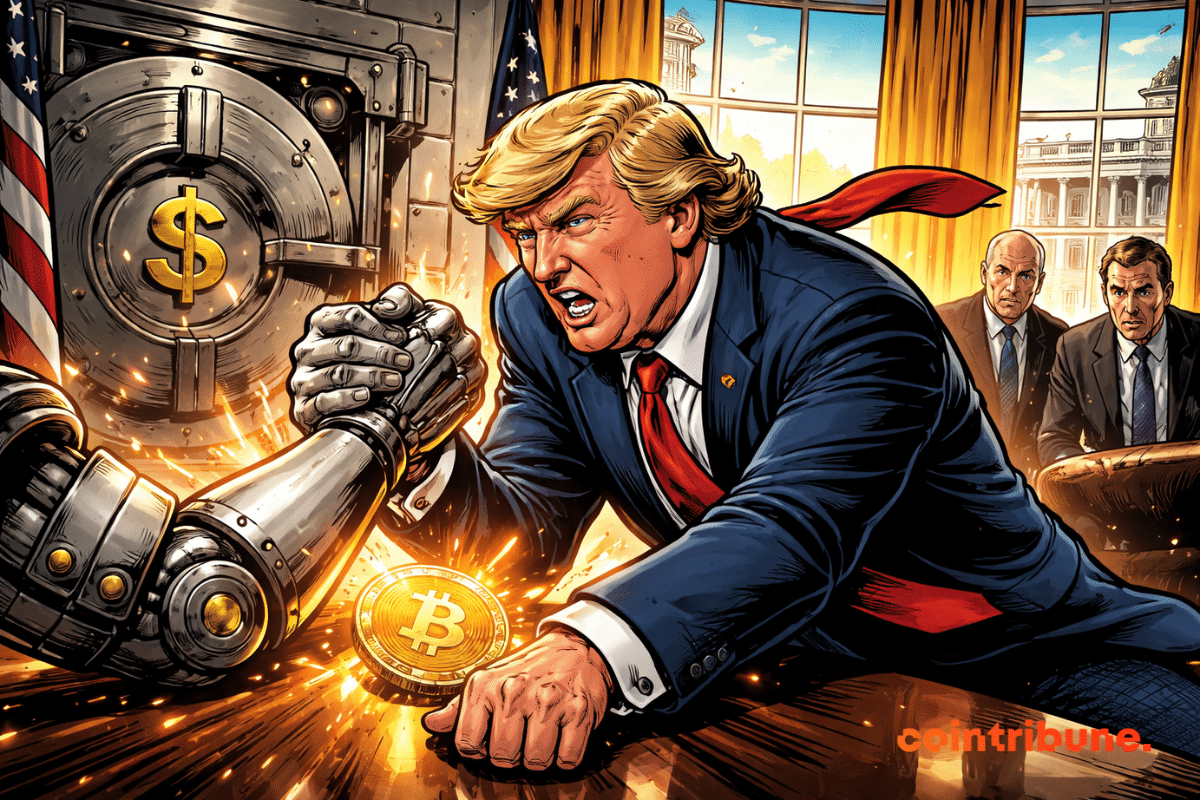
American senators prefer bankers' quarrels to crypto laws. Result: the CLARITY Act is rotting in drawers. Meanwhile, DeFi waits. Patience.
Market reversals often occur when pessimism reaches its peak. While uncertainty dominates the financial markets, one signal draws analysts' attention: bitcoin now outperforms American stocks. In a recent analysis, Coinbase Institutional believes the crypto market may have reached a "peak of pessimism," a pivotal moment when investor sentiment is at its lowest. This divergence between bitcoin and Wall Street revives the debate about a possible change in dynamics for cryptos.
Brian Armstrong, CEO of Coinbase, states that AI agents will soon dominate financial transactions. Without a bank account, they turn to cryptos to pay, trade, and automate. A revolution is underway, and it is changing everything for the global economy.
Trump attacks the banks after meeting the CEO of the crypto exchange Coinbase. More details in this article!
Coinbase now sells stocks. Traditional brokers are sweating bullets. Yahoo Finance serves as a waiting room. Brian Armstrong wants to become the boss of your portfolio. Atmosphere.
Tokens 2025 end up in the scrapyard: -71% median. Meanwhile, Coinbase and Circle stocks are flying off the shelves. Institutions change their business. Logical.
One can see a Bitcoin pullback as a diagnosis… or as a mirror. Brian Armstrong, CEO of Coinbase, clearly chooses the second option: according to him, the recent drop looks more like a collective nervous breakdown than an engine failure. The network is not damaged. It is the emotions that make the noise.
Tuesday, February 17, 2026, eToro (ETOR) stock closed up about 20%, supported by better-than-expected quarterly results and the still central weight of crypto in its model. Even in a less euphoric market than in 2024, Wall Street liked the message: eToro makes money, and the platform remains a crossroads between crypto and traditional finance.
Coinbase loses 667 million. Yet, its subscribers are booming. Its stablecoins generate revenue. So do its loans. So? It's the trading that coughs. And Washington that sleeps in.
Bitcoin leaves its digital gold costume, shaken by AI and regulations, to transform into a risky asset. Grayscale sounds the alarm: the party is over for calm investors.
Top VCs debate why non-financial crypto and Web3 use cases struggled, weighing weak demand against regulatory and operational challenges.
The sudden drop in bitcoin and Ethereum triggered a series of historic liquidations on Coinbase, exposing a major vulnerability in crypto lending. Within hours, millions of dollars in collateralized loans were wiped out, revealing the limits of a system designed to withstand shocks. This new episode of tension, far from anecdotal, calls into question the robustness of financing mechanisms backed by cryptos.
Crypto.com bets big on a crypto prediction app with up to $500 offered at sign-up. Discover the details in this article.
Nevada regulators have stepped up action against crypto-linked prediction markets. A new lawsuit targets Coinbase over alleged unlicensed sports wagering. The move comes as prediction platforms expand quickly across the United States. State officials argue that existing gambling rules still apply, even when products are offered through crypto or derivatives markets.
White House: Donald Trump pushes for a deal on stablecoins. Coinbase and banks are tearing each other apart over rewards.
When crypto bites its own tail: at Coinbase, shareholders scream betrayal, and executives swear they only sold reluctantly. It smells like asset freezing...
U.S. regulators have taken a clearer position on how securities laws apply to blockchain-based financial products. New guidance from the Securities and Exchange Commission (SEC) addresses growing interest in tokenized securities and how they fit within existing legal frameworks. Market participants have pushed for clarity as tokenization expands beyond experimental use into real-world applications. The latest statement aims to reduce uncertainty without altering core regulatory expectations.
Crypto: Coinbase opens the doors to legal betting in 50 US states. We provide you with all the details in this article!
Gold has just crossed 5,311 dollars an ounce, sparking a race to the safe haven. Facing this historic high, two crypto giants adopt opposite strategies. Tether bets on physical gold, Coinbase on derivatives. This divergence is no coincidence. It reveals two visions of the financial future: grounded in the tangible for one, focused on markets for the other. Such a strategic turning point could redefine the balance of power in the crypto ecosystem.
Global markets are entering a concentrated period of macroeconomic risk that could shape sentiment into early February. Five key U.S. economic releases are scheduled for January 27, increasing pressure on already cautious investors. Crypto markets remain highly sensitive in this environment, with Bitcoin still absorbing the majority of capital flows.
The crypto market is going through a brutal digestion phase since the October shock. However, a message comes up from the professional desks. Indeed, many institutions believe that bitcoin is worth more than its current price. The idea is not new, but the timing is intriguing.
GameStop moved all its treasury in bitcoin, that is 4,710 BTC valued at over 422 million dollars, to Coinbase Prime. This massive transfer, spotted by CryptoQuant, could signal an imminent sale. For a company that became a symbol of finance for individuals since the Reddit saga, this strategic shift is surprising. Indeed, GameStop had until now displayed a firm position on bitcoin, inherited from its dealings with Michael Saylor. Should this be seen as a discreet disavowal of the crypto bet?
Coinbase is forming an expert panel to tackle future quantum threats and strengthen blockchain security before the technology becomes a real risk.
The boundary between traditional banks and crypto could soon disappear. In Davos, David Sacks, White House crypto advisor, stated that these two worlds will soon form just one. Indeed, the CLARITY Act, a decisive bill for the future of the sector in the United States, is at stake. Behind the debates on stablecoin yields, a complete reconfiguration of the financial industry is emerging amid political tensions, power struggles, and strategic ambitions.
The so-called Ethereum Killer blockchains are stirring to nibble away market shares and gain media spotlight. But deep down, in reality as in collective perception, there is only one master. Its name comes up in every conference, every strategic plan, every institutional tweet. Ethereum is no longer just a technology…
Under regulatory pressure, the American crypto sector closely watched the CLARITY Act, intended to establish a clear legal framework for these assets. However, the bill was abruptly paused in Congress after Coinbase dramatically withdrew its support. Presented as a structural reform, the latest version of the project triggered sharp criticism, accused of threatening innovation. A political setback that reignites tensions between legislators and actors of an ecosystem still seeking recognition.
Brian Armstrong clarified that Coinbase’s talks with the White House remain constructive as the CLARITY Act faces delays over regulation issues.
In Washington, crypto puts the Senate in a tailspin: Coinbase says no, the law collapses, and banks fear that open code will become uncontrollable.
Polygon sacrifices 30% of its team to dominate crypto payments. We give you all the details in this article.
U.S. lawmakers have put a major crypto market structure bill on hold after strong pushback from Coinbase. Fresh criticism from the exchange’s chief executive raised doubts about whether the proposal could move forward without changes. As a result, Senate Banking Committee members delayed a planned markup while reassessing industry and regulatory concerns tied to the draft.