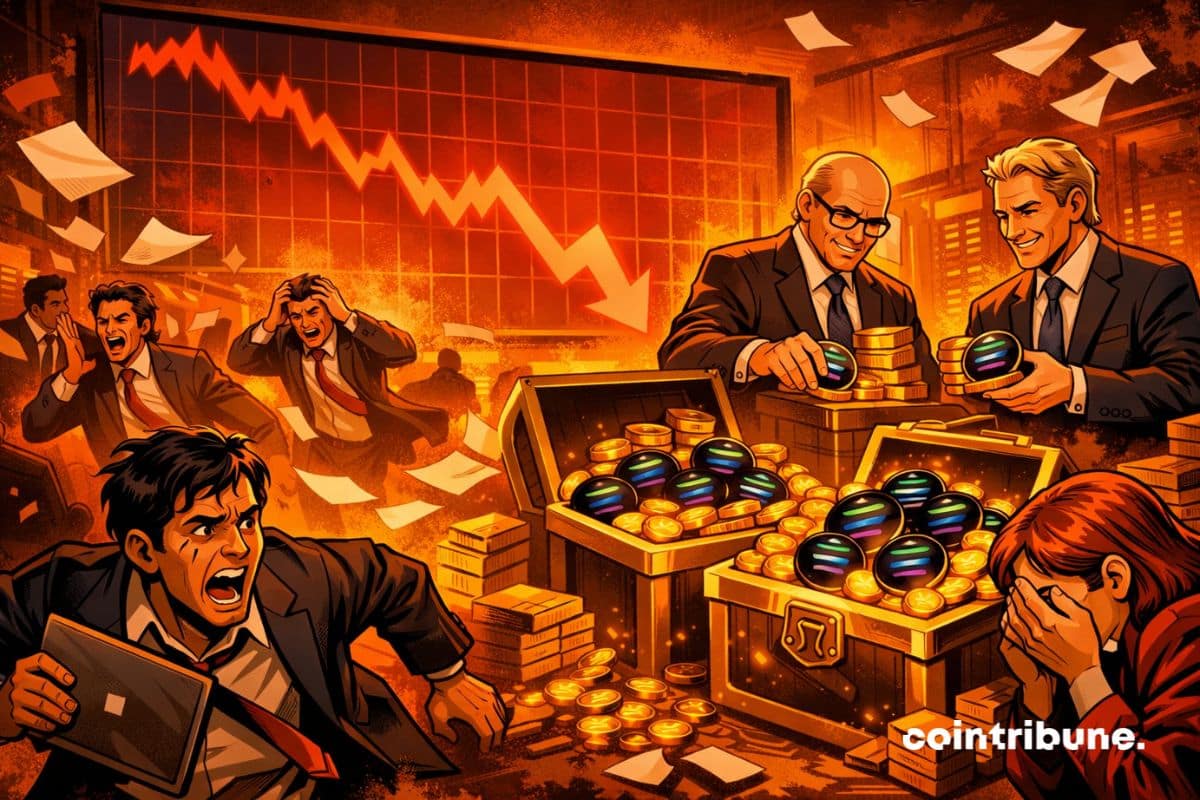
October 2025 marked crypto history with a historic crash and the mysterious depeg of the USDe stablecoin on Binance. Changpeng Zhao (CZ) rejects all responsibility, but technical evidence and expert criticism suggest another reality.
While the crypto market is stagnating and prices struggle to bounce back, a subtle signal draws observers' attention: XRP whales are back. According to Santiment's on-chain data, the number of wallets holding more than one million tokens is rising sharply, despite a falling price. This surge in activity, flying under the radar, could mark a turning point in the token's dynamics, as analysts scrutinize signs of a new cycle.
The crypto market is going through a period of uncertainty where indecision reigns. For several weeks, investors have been operating in an atmosphere of distrust fueled by a Fear & Greed index stuck in an extreme fear zone. Prices are stagnant, volumes are eroding, and no clear signal manages to revive confidence. This emotional inertia, coupled with a lack of technical direction, reflects a latent tension that weighs heavily on market dynamics. Doubt is settling permanently within the ecosystem.
Solana sees its validators disappear at an alarming rate, 68% of them have thrown in the towel since 2023. Behind this hemorrhage lies a crucial dilemma: how to reconcile performance and decentralization when costs crush small operators? Between transaction records and growing centralization, the crypto network is betraying its promises.
While gold smashes a new record above $5,300 per ounce, bitcoin stalls below $90,000. This stark contrast between two assets often described as safe havens raises questions. Why is the precious metal attracting massive capital while the leading crypto is stuck? In a tense economic context, this gap reveals a shift in investors' perception in the face of uncertainty.
Gold has just crossed 5,311 dollars an ounce, sparking a race to the safe haven. Facing this historic high, two crypto giants adopt opposite strategies. Tether bets on physical gold, Coinbase on derivatives. This divergence is no coincidence. It reveals two visions of the financial future: grounded in the tangible for one, focused on markets for the other. Such a strategic turning point could redefine the balance of power in the crypto ecosystem.
October is often awaited as the flagship month for bitcoin, but recent data challenges this myth. According to quantitative analyst Timothy Peterson, February would actually offer more reliable performance, supported by solid statistics and repetitive market patterns. While January ends on an uncertain note, a new seasonal signal could emerge. What if the real "Uptober" now falls in February? This shift could well redefine crypto investment strategies this year.
In a world where payments are becoming economic weapons, the ECB is accelerating the deployment of the Digital Euro. Piero Cipollone makes it a strategic priority to secure European transactions against sanctions and cyber threats. This ambitious project could redefine the continent's financial sovereignty. Is Europe ready to take up the challenge?
Bitcoin has extended its decline following a sharp market shock in October, while traditional safe-haven assets continue to climb. Data from on-chain analytics and price movements suggest investors are withdrawing funds from crypto and shifting toward assets seen as more stable during periods of uncertainty. A falling stablecoin supply has added to concerns that a broader market recovery may take longer to materialize.
While bitcoin seemed to be initiating a rebound at the beginning of this year, the momentum suddenly froze. Around 88,000 dollars, the asset struggles to convince, held back by a climate of political and monetary uncertainty. Institutional investors are easing off, cooled by tensions in Washington and the Fed's wait-and-see approach. While some indicators reveal a continued upward trend, signals from the derivatives markets tell another story: that of a market that doubts, observes, and waits.
A new academic paper warns that influence campaigns powered by autonomous AI agents may soon become far harder to detect and stop. Instead of obvious bot networks, future operations could rely on systems that behave like real users and adjust their actions over time. Researchers say this shift poses serious risks to public debate and platform governance.
The specter of a shutdown looms again over Washington, and this time, the alert comes from predictive markets. On Polymarket, bets on a closure of the US government are exploding, revealing growing distrust in the political deadlock. As Democrats and Republicans clash over the budget, signals multiply: the deadlock seems near.
UBS Group AG is preparing a move that could bring crypto investing into its private banking business. Plans are taking shape to give selected high-net-worth clients access to digital assets, marking a shift in how the Swiss bank approaches the sector. The effort reflects growing client demand, ongoing regulatory review, and UBS’s wider push into blockchain-based finance.
At Davos 2026, AI establishes itself as the new playground for private equity giants. OpenAI and Anthropic show record valuations, fueled by investors' FOMO. But could this frenzy overshadow interest in crypto and bitcoin?
The crypto market evolves at a crazy pace, and Binance Wallet has just changed the game with three new AI tools: Topic Rush, Social Hype, and AI Assistant. Discover how these innovations help you anticipate crypto market movements and make informed decisions without wasting time.
The boundary between traditional banks and crypto could soon disappear. In Davos, David Sacks, White House crypto advisor, stated that these two worlds will soon form just one. Indeed, the CLARITY Act, a decisive bill for the future of the sector in the United States, is at stake. Behind the debates on stablecoin yields, a complete reconfiguration of the financial industry is emerging amid political tensions, power struggles, and strategic ambitions.
At Davos 2026, Scott Bessent reaffirms Trump’s Bitcoin vision: a strategic reserve to assert American crypto leadership. But behind this reaffirmation, doubt persists. Is it a show of strength or an admission of a lack of real progress in crypto innovation?
Crypto funds attract capital again. With more than $2 billion injected in one week, the sector records an unprecedented influx, dominated by bitcoin-backed products. While traditional markets falter, institutional investors redirect their strategy towards cryptos. This renewed interest propels crypto ETPs to the forefront, acting as a strong recovery signal and a tactical repositioning amid economic uncertainties.
While the crypto ecosystem oscillates between uncertainty and consolidation, Solana attracts an unexpected wave of users. In the space of 24 hours, more than 8.9 million new addresses were created on the network, a record that reignites attention on this blockchain known for its speed and efficiency. Behind this sudden enthusiasm lies a more nuanced reality, where the enthusiasm of newcomers clashes with fragile technical signals.
Ethereum has not "lost", but it has sometimes compromised. That is the quite direct message that Vitalik Buterin put back on the table on Friday 16 January 2026. He promises a year of reconquest: easier to verify the network yourself, easier to use dApps without trusting intermediaries, and easier to take back control of your data.
The crypto market returns to a more neutral tone, but remains quiet. The Crypto Fear & Greed Index has risen to 54, a sign of a return to balance after weeks dominated by fear, while prices stabilize. Yet, the most telling signal comes from elsewhere: spot volumes remain close to…
Yield stablecoins are shaking up the crypto universe and worrying JPMorgan. The GENIUS Act could become the key to strict regulation. Between innovation and the threat of a parallel bank, the future of stablecoins is being decided now. Dive into the analysis of the issues and discover why this debate is crucial.
The Sui blockchain experienced a major outage lasting nearly six hours, completely interrupting transactions and freezing over one billion dollars of on-chain value. The incident, confirmed by the Sui Foundation, reignites the debate about the resilience of so-called “high-throughput” blockchains in a crypto context where technical reliability is becoming a…
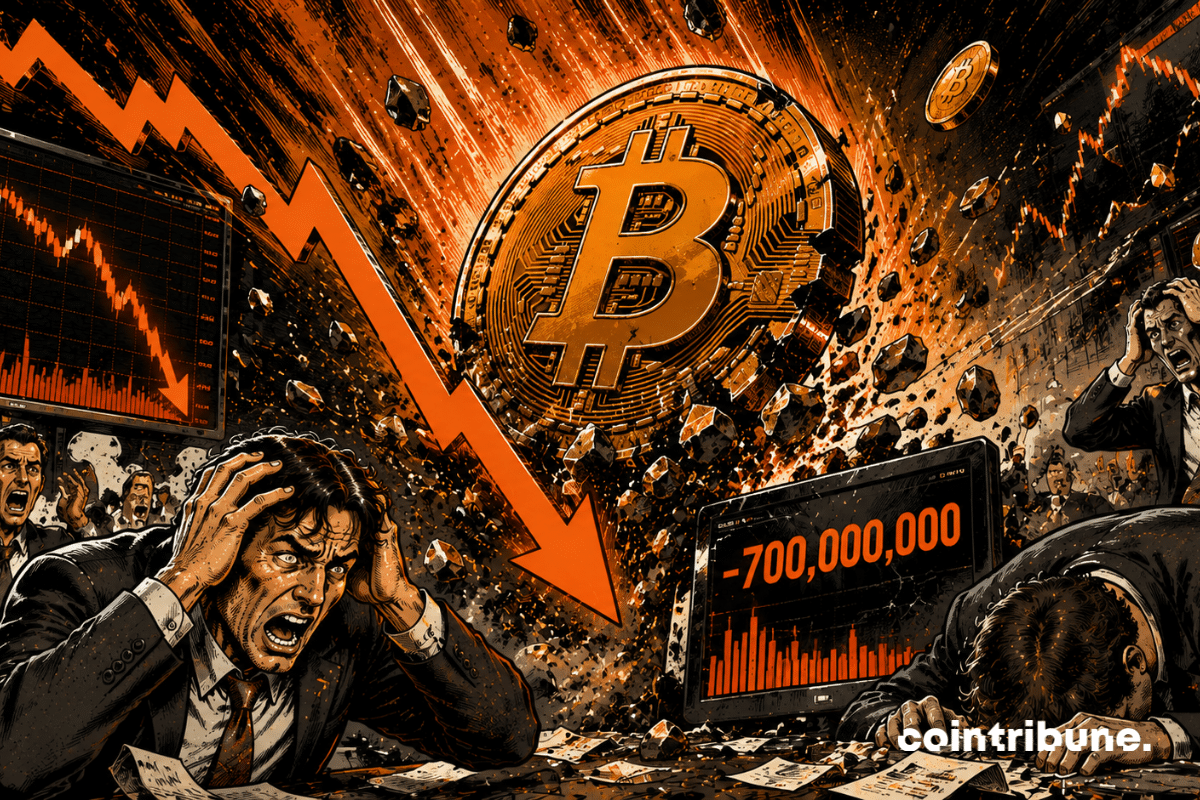
Bitcoin and Ether crossed major technical thresholds on January 14, triggering nearly 700 million dollars in liquidations on short positions. In the absence of a fundamental catalyst, this brutal movement highlights the weight of market mechanics and leverage effects in the dynamics of cryptos. Thus, in a few hours, the excess exposures were swept away, recalling the vulnerability of poorly calibrated speculative strategies.
The crypto market is entering a major zone of uncertainty. According to Wintermute, the historic four-year cycle, a pillar of investment strategies for over a decade, may have reached its limits. In a report published in early January, the market maker mentions a deep break in 2025, a strong signal that 2026 will not be a simple rebound, but a true test of resilience for an ecosystem undergoing redefinition.
The release of the latest Consumer Price Index (CPI) in the United States triggered a brutal movement on crypto derivatives, exposing an unprecedented imbalance on XRP. Ripple's asset recorded a wave of massive liquidations, revealing a lightning-fast repositioning of traders facing a possible monetary shift.
Vitalik Buterin, co-founder of Ethereum, sounds the alarm: current stablecoins threaten the stability of the crypto ecosystem. Discover the 3 critical flaws he has identified and why they could trigger a systemic crisis. Do solutions exist? The future of DeFi is at stake.
The crypto landscape is evolving rapidly. Once dominated by individuals, the market is now entering a phase where institutional giants take control. This change is no longer measured in trends, but in S-1 filings, MSCI indexes, and billions reallocated. According to the latest Binance Research report, the ecosystem is undergoing a structural transformation. Crypto no longer operates on the margins of traditional markets; it is now deeply rooted there.
In January 2026, Ethereum shows social sentiment at its lowest, strangely reminiscent of the period preceding its historic 2025 rally. With 59% of traders betting on surpassing $4,250 and experts mentioning a potential of $10,000, the question arises: does this decline herald an imminent explosion?
Stablecoins have long been the discreet plumbing of crypto. Nobody applauds them, but without them, part of the market seizes up. Today, they are coming out of the shadows for a very concrete reason: savings and bank deposits. In the United States, local bank leaders are pressing the Senate to tighten certain points of legislation on stablecoins. Their fear: seeing part of the deposits migrate to dollar tokens, attracted by “rewards” that increasingly look like a yield. On the other side, JPMorgan refuses to give in to alarmism. The bank sees it rather as a new brick in a monetary system already composed of several layers. And this reading gap says a lot about the battle underway: financial stability, competition, or a simple war of models?