While Strategy sews up its debt with a financial blowtorch, Saylor calmly brings out his bitcoin net again. Retail investors applaud, skeptics already smell the scent of a dangerously speculative tide.
Ethereum was still parading under the neon lights of Wall Street. Then the ETFs emptied like a poorly guarded safe. Harvard drops its jewels, BlackRock grits its teeth, and crypto suddenly discovers much less romantic investors.
The US Senate reaches a critical moment for digital assets. After several months of tensions, the banking committee is set to review the CLARITY Act this Thursday, a much-anticipated bill to regulate a large portion of the crypto market in the United States. However, three issues remain sensitive: yields on stablecoins, ethics rules for elected officials, and the protection of DeFi developers.
While Ethereum jealously guards its old digital hoard, Solana and Base are quietly nibbling at its pockets. Behind the crypto scenes, some are already nervously recounting the kingdom's tokens.
While Brussels knits regulatory barbed wire, Washington quietly restarts the crypto machine. Behind senator smiles, Coinbase, banks, and lobbyists are already moving their pieces like in a nuclear chess game.
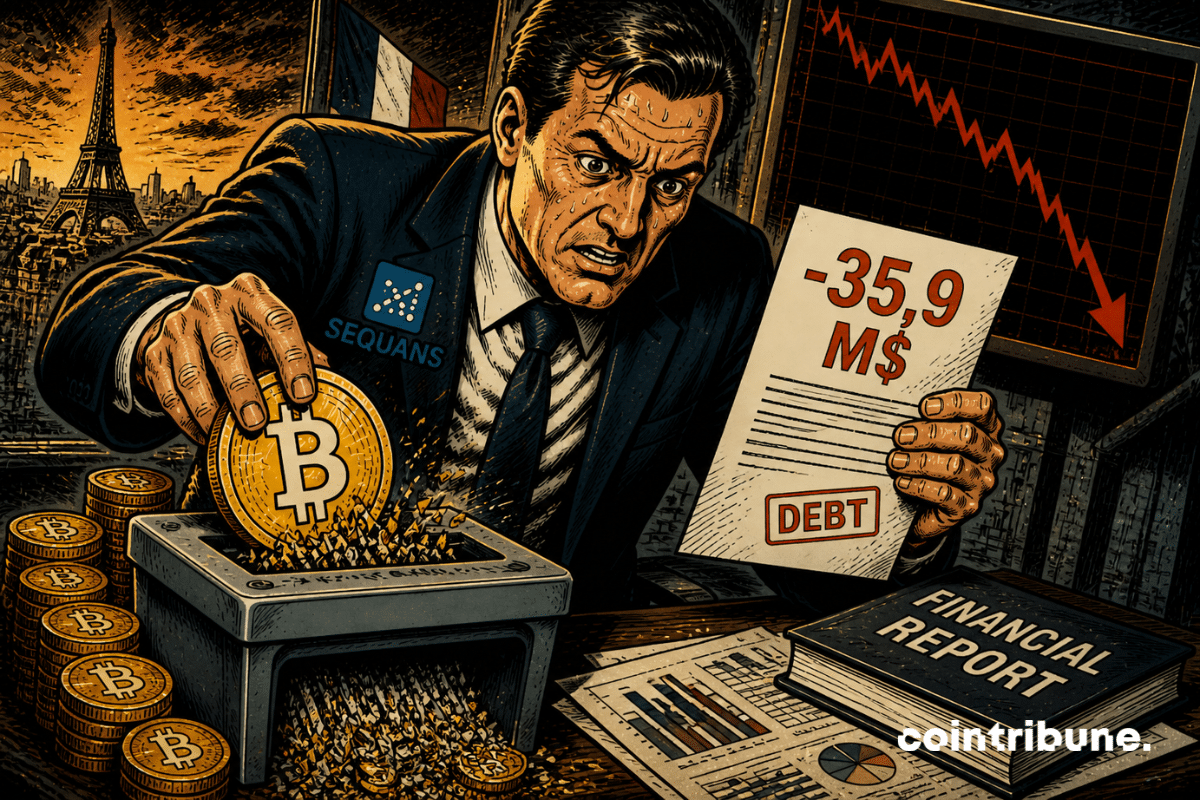
Sequans Communications liquidates half of its Bitcoin to cope with a drop in revenue, growing losses, and significant debt, questioning its long-term crypto strategy.
Bitcoin ETFs limp on Monday, breathe on Friday, then thank BlackRock. The crypto market, a caffeine-fueled chameleon, still hesitates between a true recovery and a balancing act.
Bitcoin ETFs are leaking cash like a cracked safe, while crypto stiffens nervously, squeezed between expensive oil, jittery markets, and investors quietly switching horses mid-race without warning.
5 million ETH in 10 months! BitMine strikes hard and bets big on Ethereum, despite volatility. A record purchase that could boost institutional adoption and revolutionize DeFi.
Crypto on alert: DeFi loses 13 billion in one month and exposes its flaws. Complete analysis of a shock that worries investors.
Saylor brings out his orange dots, and bitcoin is already trembling. While Strategy fills its vault, the crypto market smiles yellow: who really holds the global liquidity pump now?
DeFi hits a wall: JPMorgan warns about a lack of trust from institutions. Detailed explanations in this article!
Brussels brings out its big regulatory comb, small crypto players are already losing feathers. Officially, investors are protected. Unofficially, some are already looking at the exit, suitcase in hand.
MiCA tightens the screws, bankers count their clients, and crypto shows up at the counter without an appointment. In Europe, even safes are beginning to eye their neighbors.
As digital uses evolve, a question arises at Paris Blockchain Week 2026: how to simplify value exchanges in a world where banking systems and blockchain infrastructures coexist? OZAPAY provides a concrete answer with a hybrid super app that aims to streamline payments, regardless of the system used. Between traditional finance and crypto, users still face unnecessary complexity: multiplicity of tools, fragmented experiences, dependence on intermediaries. This is precisely the area the Parisian fintech has chosen to invest in.
Crypto news: Justin Sun calls the WLFI proposal a "governance scam." We provide you with all the details in this article.
Bitwise sent the smell of hot powder around Hyperliquid and draws its ETF before others. On Wall Street, even the hype ends up in a suit.
On Wall Street, money flows out through the crypto ETF door while Morgan Stanley comes in through the window with its bitcoin trust. The dance of the hesitant truly begins.
The decentralized lending protocol Aave is going through a turbulent period. Its main risk manager, Chaos Labs, has just slammed the door after three years of collaboration, and the reason goes far beyond a simple financial dispute.
DeFi did not have its most explosive quarter, but it remains an open target. In the first quarter of 2026, hackers stole approximately 168.6 to 169 million dollars from 34 DeFi protocols. The figure is significantly lower than in the first quarter of 2025, but it reminds us of one simple thing: in crypto, a lull never means security.
The ECB clearly challenges one of the founding narratives of modern crypto. In practice, several major DeFi protocols remain concentrated in the hands of few, especially when looking at actual governance rather than just marketing talk. This is the gist of the working paper published this week, which observes a strong concentration of governance tokens and voting power on Aave, MakerDAO, Ampleforth, and Uniswap.
At Morgan Stanley, fees are shaved down to the bare minimum, turning bitcoin into a trendy loss leader, while Wall Street sharpens its teeth to snatch distracted savers.
While the heavyweights Bitcoin and Ethereum take a breather, Solana and XRP pick up the stakes, and crypto plays its old sleight of hand again.
Aave's DAO massively validates the deployment of V4 on Ethereum. Between regained consensus, modular architecture, and recent internal tensions, the protocol enters a new phase of development.
Crisis at Lido: the Ethereum staking giant sees its revenues drop by 23% and its users flee. All the details in this article!
Victims of a crypto hack do not suffer only an immediate financial loss. According to a new report from Immunefi, affected tokens plunge on average by 61% within six months, and rarely recover. A harsh observation that reshapes the perception of risk in the crypto universe.
The most used DeFi protocol in the world is going through an unprecedented turbulence zone. The deployment of Aave V4 on Ethereum, presented as a major breakthrough for the crypto ecosystem, has instead opened deep fractures within its own organization. Between dramatic departures, catastrophic transaction and governance war, Aave is currently playing one of the most delicate parts of its history.
A crypto trader just lost nearly $50M on Aave after a bot error. This spectacular liquidation shakes the DeFi ecosystem.
The Aave community narrowly approves the first stage of its "Aave Will Win" reform. This close vote paves the way for a new economic framework, supported by significant funding demand and active user participation.
A bipartisan group of U.S. lawmakers has introduced new legislation aimed at protecting blockchain software developers from certain criminal charges. Sponsors say the proposal would clarify how federal law applies to developers who do not control user funds. Supporters argue that recent prosecutions have created legal uncertainty for builders working on open-source tools. The measure adds to a broader debate in Congress over digital asset regulation.