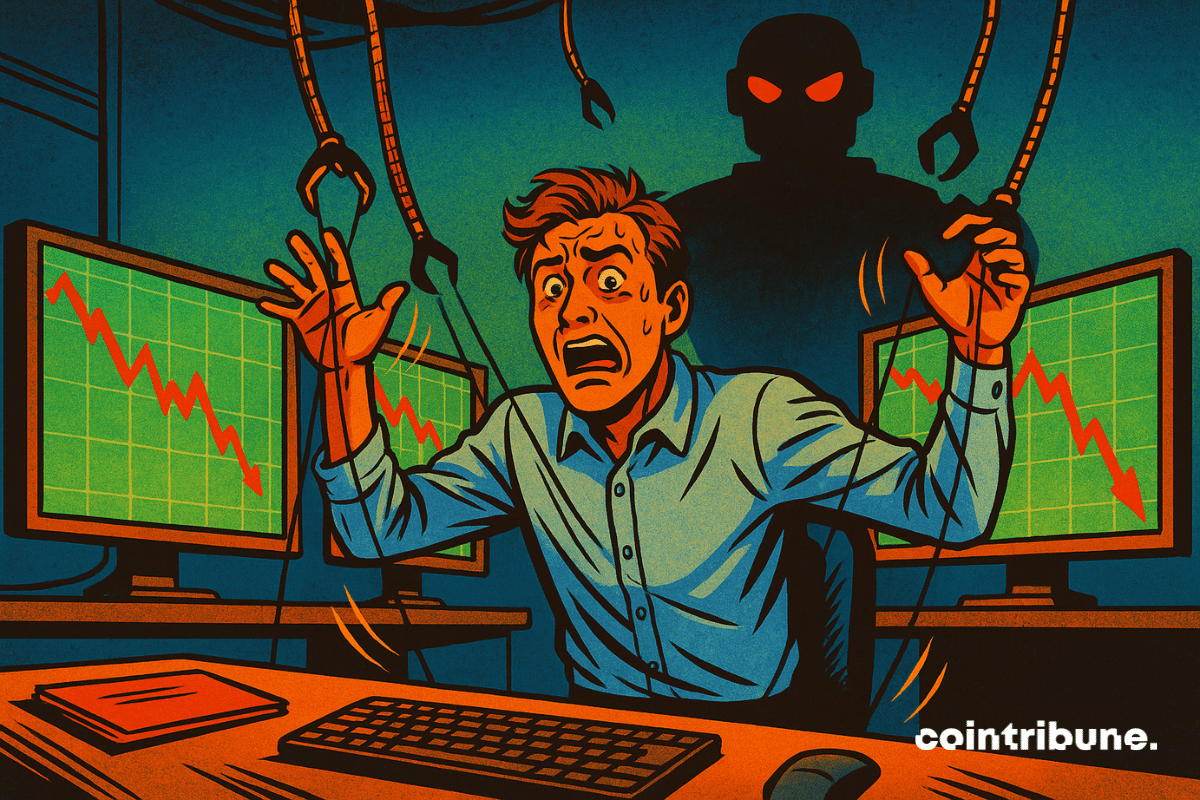
A crypto whale bet $368 million against bitcoin, already raking in $2 million in profits despite enormous risk ahead of crucial Fed decisions this week.
The crypto market is going through a turbulent period marked by a brutal correction of bitcoin and massive capital outflows. With a decline of over 18% from its historic peak of $106,000 in December 2024, some investors are already talking about the most painful cycle in bitcoin's history. However, for seasoned players in the industry, this scenario is nothing new. Even darker periods have marked the evolution of the crypto market, and many see this correction as a temporary adjustment rather than a lasting collapse.
Bitcoin continues to challenge traditional financial markets and generates increasing interest among investors. For several years, it has been compared to gold, often presented as its digital equivalent. But this time, Tom Lee, influential analyst and co-founder of Fundstrat, goes further and claims that Bitcoin will become the best-performing asset.
After a period of slowdown, XRP is making headlines again with a surge in its on-chain activity. The network has surpassed 2 million transactions, a threshold that, in the past, has often been a precursor to renewed interest from investors.
In a constantly shifting crypto market, Pi Network is at a decisive turning point. While investors were waiting for signs of stabilization, the asset is facing a concerning downward trend, fueled by increased selling pressure. The expiration of the migration period to the Mainnet, combined with technical indicators in the red zone, is fostering growing uncertainty.
The traditional financial industry and the crypto sector continue to intersect, and every move of Wall Street giants is scrutinized closely. Indeed, the announcement of BlackRock's return to the bitcoin (BTC) market with a $25 million investment has not gone unnoticed.
Financial markets have their own memory, and cryptocurrencies are no exception. Thus, when an asset shows alarming similarities to a past crash, analysts sound the alarm. Ethereum, the second largest crypto on the market, sees its price plummet, reviving the specter of the March 2020 crash. Trader Ted Pillows claims that the current behavior of the ETH market almost mirrors the capitulation of that dark period, suggesting a scenario where the asset could drop to as low as 1400 dollars.
The crypto market is unpredictable, as it fluctuates between periods of euphoria and significant corrections. Among the most followed assets, Pi Network is generating increasing interest. Within 24 hours, its price saw a staggering increase of 20%, reaching $1.74, despite a discount of 44% from its all-time high of $2.99. This sudden surge raises questions: is it a precursor signal for broader adoption or merely a speculative push fueled by strategic announcements? Two factors appear to have triggered this movement: the anticipation of Pi Day and rumors of a possible listing on Binance.
Bitcoin has plunged to $76,700, marking its lowest level in four months amid global economic turmoil. Indeed, the 30% drop from its all-time high of $109,350 has reignited discussions about a possible trend reversal, as some observers question the sustainability of the bullish cycle. However, several indicators suggest that this correction could represent a strategic entry point for investors. On one hand, financial markets remain under pressure with persistent economic uncertainties, while on the other hand, the BTC derivatives market shows unexpected strength. So, has Bitcoin reached its ultimate floor before a rebound?
Time no longer has control over the crypto markets. Coinbase has just broken free from fixed hours by announcing 24/7 trading of futures contracts on Bitcoin and Ethereum for American residents. This is a revolution that, beyond simplifying access, redefines the rules of the game in the face of fierce competition. But behind this boldness lie subtle stakes: regulation, technical innovation, and a battle to dominate a rapidly growing derivatives market.
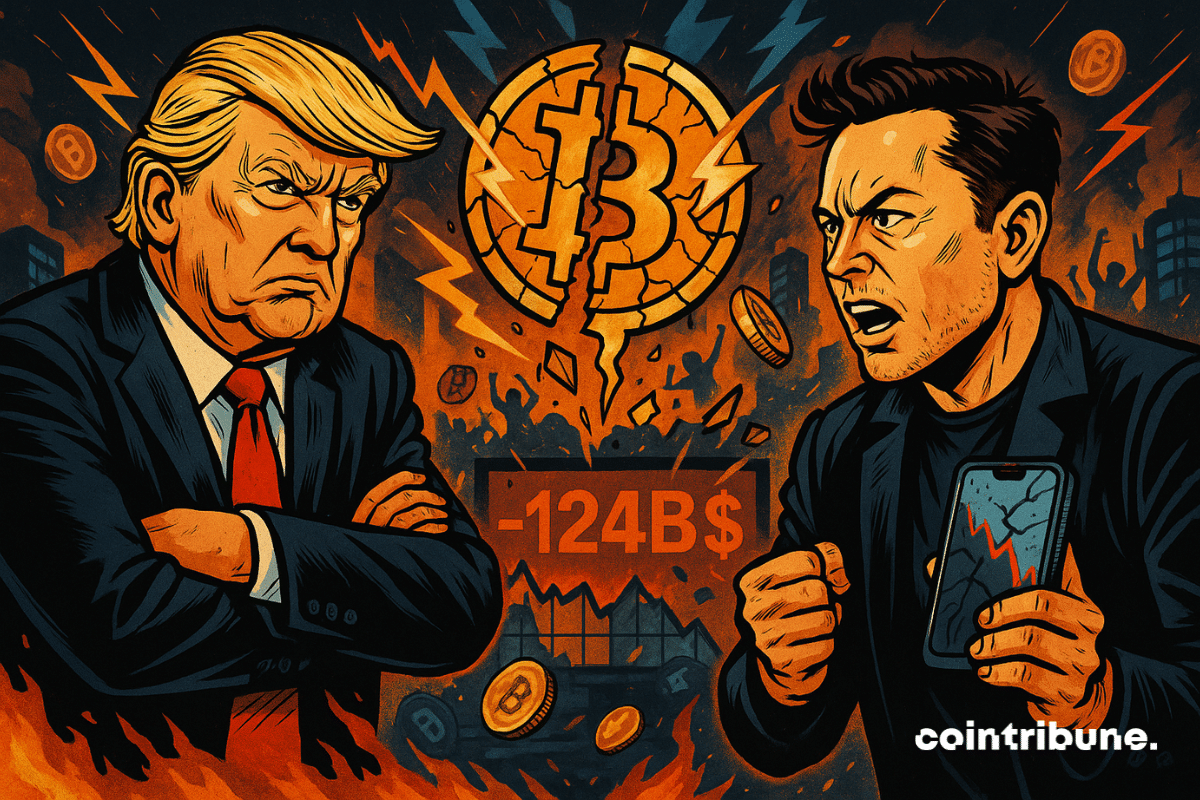
The landscape of decentralized finance (DeFi) resembles a battlefield. In just a few months, $45 billion has evaporated, sweeping away the hopes sparked by Donald Trump's election in 2024. Amidst dashed hopes, technical errors, and secret accumulation strategies, Crypto is weathering a storm. How did we get here? A deep dive into the guts of a collapse that questions the very future of DeFi.
The Token Generation Event (TGE) of Runbot ($RBOT) is finally here! This innovative project, supported by GAINS, is revolutionizing automated trading through artificial intelligence (AI). As of today, March 10, 2025, $RBOT is listed on Uniswap. Find out why this launch has been so highly anticipated!
Investors are closely monitoring every signal from the American Federal Reserve (Fed), whose monetary policy could trigger a bear market. While some were hoping for rate cuts as early as 2024, the latest statement from Fed Chair Jerome Powell has dampened those expectations. The absence of rate reductions could put pressure on financial markets, particularly on risky assets like Bitcoin. Economist Timothy Peterson warns: if the Fed does not cut rates by 2025, the Nasdaq could collapse, dragging the cryptocurrency market along with it. A new correction of Bitcoin below $70,000 is now a serious possibility.
In a market as volatile as cryptocurrencies, every second counts. RunBot, with its state-of-the-art AI (artificial intelligence), is transforming automated trading by providing traders with powerful tools to maximize gains and reduce risks. Here's how you can enhance your trading experience with AI.
Innovation is a necessity in the blockchain universe, where competitiveness relies on speed, scalability, and user experience. It is in this context that BNB Chain is about to take a decisive step with the Pascal hard fork, a major technical update scheduled for March 20. Unveiled by Changpeng Zhao (CZ), this evolution promises to enhance compatibility with the Ethereum Virtual Machine (EVM) and strengthen the ecosystem's accessibility for developers and users.
The history of cryptocurrencies is marked by episodes where volatility defies the logic of markets. Solana (SOL), one of the most promising blockchain ecosystems, is currently experiencing an intense phase of fluctuations. While its price has seen a significant drop in recent days, its trading volume has witnessed a spectacular surge. Over 5.18 billion dollars have flowed through the platforms, a movement that is as intriguing as it is concerning. This resurgence of activity reveals a complex dynamic where financial losses and hopes for a rebound intertwine.
The volatility of cryptocurrencies spares no one, and Solana (SOL) is no exception. After reaching a low of $125 on February 28, the native token of the Solana blockchain saw a rebound of 17%, hinting at a possible return towards $180. However, this recovery is far from guaranteed. Still down 50% from its all-time high of $295, SOL is facing several obstacles that could hinder its ascent. Between the slowdown in its on-chain activity, the lack of demand in the derivatives markets, and the concentration of transaction fees in the hands of a handful of users, the Solana ecosystem is wavering. What are the signals that could trigger a bullish rally?
Bitcoin is evolving at the intersection of major geopolitical tensions and global monetary strategies. While financial markets expected the United States to take the lead on the issue of bitcoin reserves, it is ultimately China that could trigger an unprecedented economic earthquake. A series of discreet initiatives led by Beijing suggests a possible massive influx of liquidity into the crypto ecosystem, with a potential impact of $1.4 trillion. Behind this strategy lies a clear intent to stabilize the yuan in order to circumvent U.S. sanctions and monetary policy.
The crypto ecosystem is going through an expansion cycle where competition among blockchains is intensifying, especially in the decentralized exchanges (DEX) market. Indeed, long dominated by Ethereum, this sector is seeing the emergence of a significant competitor: Solana, whose trading volumes briefly surpassed those of Ethereum in February. This unexpected performance occurred despite an unprecedented crisis in the memecoin segment, these speculative cryptos that have long been a key economic driver of the network. Solana is holding on to its place among the DEX leaders, but the recent collapse of memecoins raises a major question: can the network maintain its position without this asset?
The global economy operates in cycles where fiat currencies play a crucial role in market dynamics. Indeed, the weakening of the US dollar, often seen as an indicator of macroeconomic adjustment, seems this time to open a window of opportunity for cryptocurrencies. According to Raoul Pal, analyst and CEO of Real Vision, the fall of the dollar could be the catalyst for a particularly bullish second quarter in 2025 for bitcoin and the entire crypto market. This optimism is based on historical data and well-established macroeconomic trends. But then, is this situation the signal of a sustainable rally or merely a temporary market reaction?
The extreme volatility of Bitcoin is resurfacing, fueled by a cocktail of economic uncertainties and government initiatives in the United States. As the crypto market tries to stabilize after a high-tension start to the year, the price of BTC is experiencing violent fluctuations. Within a few days, it peaked at $93,000 before plunging sharply below the $82,000 mark. This dynamic reflects the nervousness of investors in light of two major announcements: the imposition of a 25% tariff by the United States on Canada and Mexico, and Washington's ambition to create a national crypto reserve.
Ripple, one of the major players in the crypto sector, is once again under the spotlight. While the firm is regularly criticized for its management of the XRP supply, its CTO, David Schwartz, made remarks that are sure to fuel the debate. According to him, Ripple has every right to act in its own interest through the sale of XRP tokens, a claim that raises eyebrows within the community. This statement comes as new elements strengthen the questions surrounding the distribution of XRP. A dormant wallet containing over $7 billion in XRP has been identified, and some massive transfers have been spotted in the markets. Between legitimate financial strategy and market manipulation, the question of the impact of Ripple's sales on the XRP price is more urgent than ever.
As the crypto market goes through a turbulent period, an unexpected asset is drawing all the attention. In an environment marked by widespread losses, Pi Network has just dethroned Hedera (HBAR) in market capitalization, rising to 11th place in the crypto rankings. This turnaround raises questions, both about the drivers of this ascent and the sustainability of the phenomenon. Amid the collapse of giants like Bitcoin, Ethereum, and Solana, how is Pi Coin managing to show gains?
For experienced traders, access to an advanced platform offering comprehensive features and fast order execution is essential. Bitpanda Fusion stands out as an ideal solution by combining an intuitive interface, aggregated liquidity from the largest exchanges, and professional tools tailored to advanced strategies.
Is it really possible to invest regularly without stress while taking advantage of market opportunities? With Bitpanda's savings plans, this approach becomes accessible to everyone. Rather than trying to predict market fluctuations, this solution allows you to automatically buy cryptocurrencies, stocks, ETFs, and precious metals at regular intervals. Simple, flexible, and secure, it caters to both beginners and seasoned investors looking for an optimized long-term strategy. In this article, we will explore in detail how Bitpanda's savings plans work, their advantages over competitors, and how to make the most of them to boost your financial wealth.
Holding cryptocurrencies without making them work is like letting money sleep in an interest-free account. Why not make them work for you? With staking, it is possible to generate passive income while contributing to the security of blockchains based on Proof of Stake. Bitpanda simplifies this process by offering an intuitive and accessible solution, without locking periods or technical complexity. This article explores how staking works on Bitpanda, the available cryptocurrencies, and the proposed returns. Also discover a detailed guide to start staking with ease.
Investing in cryptocurrencies can seem complex due to the multitude of available assets and market volatility. How can one diversify their portfolio without spending hours analyzing each project? Crypto indices offer a simple and automated solution to gain exposure to the best opportunities in the sector. Bitpanda offers a range of crypto indices that allow for strategic investment while reducing risks. With automatic management and monthly rebalancing, these indices facilitate investment, whether you're a beginner or an expert. In this article, discover how they work, their advantages, and a comparison with other crypto investment solutions.
The American stock market has just experienced a financial earthquake. In just a few hours, 3.4 trillion dollars evaporated, erasing the post-election gains in one fell swoop. A disastrous scenario that plunges Wall Street into an unprecedented stupor. And in the crosshairs? Donald Trump, whose new tariffs have ignited the fuse of a crisis with global repercussions.
Cryptocurrencies go through cycles of euphoria and doubt, where some projects disappear as quickly as they appeared. However, after six years of development, Pi Network has finally launched its native token, generating unprecedented enthusiasm among investors and market observers. Between promises of massive adoption and regulatory uncertainty, the asset today evolves in a volatile environment where every movement is closely scrutinized. While PI has recorded spectacular growth since its introduction, forecasts for March 2025 suggest a possible surge.
Like a ship in the midst of a storm, Bitcoin sways, capsizes, and sees its passengers jumping into the water. Only the seasoned sailors remain on board, confident in the future clear-up.