The End of Crypto Cold Wallets After Keystone, Coldcard, Ledger…Hack ?
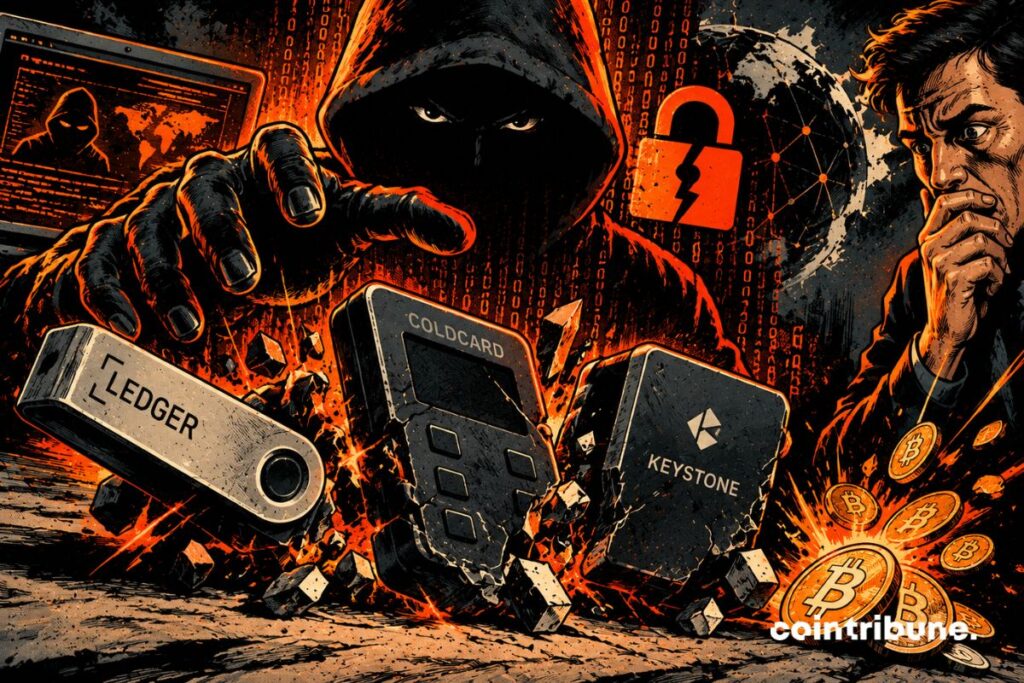
After the intrusion of Keystone on October 20, six major players in crypto security are now facing attacks in 2026. Between hardware hacks and massive data leaks, the crisis of confidence hitting every cold wallet is now shaping up to be historic and worrying investors.
In Brief
- An intrusion on the official Keystone site on October 20 exposed the physical addresses and order histories of customers.
- A critical flaw in entropy generation allowed reconstruction of Coldcard private keys and siphoning of nearly 116 million dollars.
- Trezor, BitBox and SafePal report exposure of hundreds of thousands of customer data via third-party providers.
- Almost all attacks accumulated over a critical three-month period, revealing a systemic vulnerability in the ecosystem.
Six Crypto Security Giants Hit in 2026
The dogma that storing private keys in a physical device guarantees absolute security has just taken a fatal blow. Within a few months, cybercriminals in 2026 have demonstrated their ability to target crypto security across the entire chain. This includes key generation, and corruption of hardware supply chains and email subcontractors.
The latest episode, manufacturer Keystone confirmed on October 24 that it was the victim of a data breach on its website, following an intrusion on October 20. While crypto users’ private keys theoretically remain intact, the delivery and purchase data of thousands of customers is now exploitable by targeted hacking networks.
| Incident Date (2026) | Brand Concerned | Nature of Flaw / Incident | Impact on Crypto User |
| October 20 – 24 | Keystone | Website intrusion (detected Oct 20, confirmed Oct 24) | Addresses and orders exposed |
| July 30 | Coldcard | Seed phrase generation flaw | Keys reconstructed, ~$116M stolen |
| Jan 5 / Oct 10 | Ledger | Global-e leak / reseller hardware implant | Data theft & seed phrase interception |
| Aug 13 / Sept 10 | Trezor | Data leaks from ShipMonk & Brevo | Over 427,000 emails/data exposed |
| Aug 16 | SafePal | Order tracking flaw | 39,798 customer data compromised |
| Sept 24 | BitBox | Email theft via subcontractor Brevo | Massive targeted phishing campaigns |
Increasingly Sophisticated Cold Wallet Attacks
While the database thefts suffered by Trezor, BitBox and Keystone expose crypto users to waves of ultra-targeted social engineering and phishing, structural vulnerabilities have reached a critical level. The most devastating financial case remains the Coldcard incident revealed in July, where attackers reconstructed user keys and stole about 116 million dollars in bitcoin.
On the physical side, Ledger’s confirmation on October 10 of the existence of malicious components (hardware implants) inserted into devices sold by third-party resellers illustrates the fragility of distribution channels. The trapped component recorded the crypto security phrase as soon as the device was powered on.
Why Did Crypto Flaws Erupt in Only One Quarter?
The timeline analysis reveals an abnormal concentration of crypto incidents between August and October. According to cybersecurity experts, this phenomenon is no accident but the result of three combined factors:
- Fragility of the summer supply chain: Restocking for Q3 exposes logistics and third-party resellers to physical intrusions (e.g., implants on hardware wallets).
- Web2 leverage effect: Manufacturers’ dependence on marketing and delivery subcontractors (often targeted during summer) caused a chain wave of data leaks at the start of the school year (e.g., the attack on Brevo affecting Trezor and BitBox).
- Security audit contagion: The revelation of the Coldcard seismic event this summer prompted security researchers to scrutinize the entire market, triggering a wave of disclosures and successive patches in September and October.
The End of the Illusion of Absolute Cold Wallet Security
This accumulation of flaws in 2026 forces the crypto industry to revise its risk management standards. Weaknesses do not only reside in cryptographic algorithms but also in the vulnerability of external Web2 providers used for logistics or marketing. To protect themselves against this systemic crisis, crypto asset holders must apply strict hygiene rules.
Notably, buy exclusively from official channels of the different Cold Wallet brands, reset any suspicious device, set up an extension passphrase, and use anonymized shipping addresses. As Changpeng Zhao (CZ) wisely says, “Stay SAFU”!
This succession of hacks and leaks on physical wallets demonstrates that self-custody (self-custody) requires constant vigilance. In the face of the multiplication of these flaws in 2026, do you still have full trust in crypto cold wallet manufacturers?
Maximize your Cointribune experience with our "Read to Earn" program! For every article you read, earn points and access exclusive rewards. Sign up now and start earning benefits.

The world is evolving and adaptation is the best weapon to survive in this undulating universe. Originally a crypto community manager, I am interested in anything that is directly or indirectly related to blockchain and its derivatives. To share my experience and promote a field that I am passionate about, nothing is better than writing informative and relaxed articles.
The views, thoughts, and opinions expressed in this article belong solely to the author, and should not be taken as investment advice. Do your own research before taking any investment decisions.