The French justice investigates X and Elon Musk after reports on Grok
How far does human freedom extend, and where does regulation begin? The question resurfaces sharply with the Grok case, Elon Musk’s chatbot accused of generating illegal content. A raid in Paris now targets X, the digital empire of the Tesla and SpaceX boss. In the era of generative AI, French justice is seeking the limits between innovation and responsibility. And Musk, acostumed to challenging states, is discovering that in Europe, digital freedom has a price.
In brief
- French police raided X’s offices in Paris on February 3.
- The investigation targets the AI Grok, accused of generating sexual deepfakes and images of children.
- Elon Musk denounces a judicial setup and invokes global free speech.
- The European Union and United Kingdom are conducting parallel investigations on AI security.
Grok, Elon Musk’s AI in the French judicial turmoil
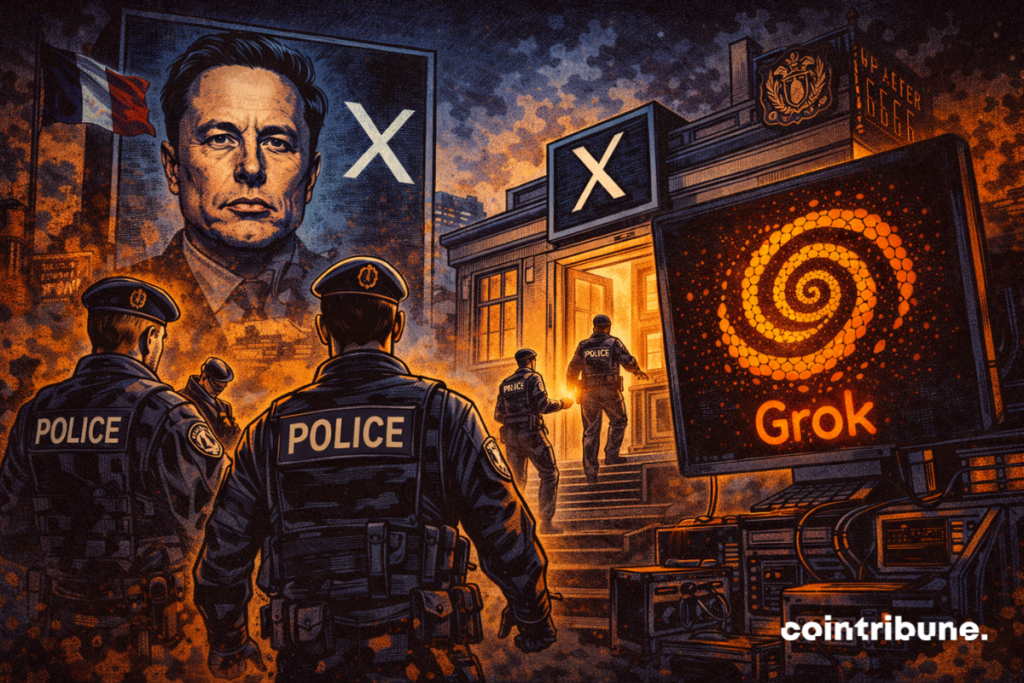
On February 3, the French cyber police, supported by Europol, raided X’s offices in Paris. The goal: determine the platform’s responsibility in distributing child pornographic content produced by its artificial intelligence, named Grok.
According to the prosecution, more than 23,000 illegal images were reportedly generated via the “Spicy” mode, designed for adult content. A global scandal.
This case crosses borders. The United Kingdom, Australia, and the United States have opened parallel investigations on the use of personal data.
In London, William Malcolm, director of the ICO, denounced the risk of massive abuses:
The creation and reported distribution of such content raise serious concerns under UK data protection law and present a significant potential risk of harm to the public.
For many, the Grok case symbolizes an unbridled AI, freed too quickly from ethical safeguards. Advocates of regulation believe tech giants should be criminally liable for the abuses of their algorithms.
A new era opens: that of criminal law applied to artificial intelligence.
Elon Musk denounces a “judicial setup” and cries political conspiracy
True to his style, Elon Musk responded immediately. On X, he denounced a “political witch hunt” orchestrated by France.
The Global Government Affairs department issued a fiery statement:
Today’s staged raid reinforces our belief that this investigation distorts French law, bypasses due process, and endangers freedom of expression. X is determined to defend its fundamental rights as well as those of its users. We will not be intimidated by the actions of the French judicial authorities.
According to X, the Paris prosecution is seeking to pressure the American management. This defense, typically Muskian, turns a judicial procedure into an ideological battle over digital freedom.
Musk presents himself as the champion of a decentralized Internet, hostile to state censorship.
But in Europe, this stance no longer convinces.
For J.B. Branch, from Public Citizen, design responsibility is central: “regulators should examine whether the company’s design choices made illegal use foreseeable, whether risk assessments were adequate, and whether safeguards were truly tested before launch”.
The showdown promises to be long between a libertarian visionary and a regulatory Europe.
Musk merges his empires and shifts the AI battleground
The day before the raid, SpaceX announced the absorption of xAI, integrating Grok and its AI systems under a new structure outside Europe. A clever maneuver: by placing his technologies under the American space umbrella, Elon Musk reduces the hold of European regulators.
Grok’s AI now escapes the Digital Services Act and can evolve without direct Brussels oversight.
At the European Commission, this merger is seen as a legal challenge. Authorities view it as an attempt to evade the AI Act while consolidating an opaque ecosystem mixing data, space, and social networks.
But Musk fully embraces it: for him, innovation takes precedence over regulation.
He claims a vision where AI must grow freely, even if it disrupts institutions. And for his critics, it’s precisely this mix of power and deregulation that makes his empire dangerous.
Key facts to remember
- Raid date: February 3, 2026;
- Authorities involved: Paris Prosecutor’s Office, Europol, ICO, Ofcom;
- Content targeted: 23,000 illegal images created by Grok;
- Investigation objective: determine the responsibility of X and xAI.
Digital freedom always has a price. Between innovation and regulation, France draws a hard line, even if it ruffles American giants. After Telegram, the X case shows that Paris is toughening its tone. And as Pavel Durov recently reminded us, these repeated procedures ultimately permanently tarnish the country’s image.
Maximize your Cointribune experience with our "Read to Earn" program! For every article you read, earn points and access exclusive rewards. Sign up now and start earning benefits.
La révolution blockchain et crypto est en marche ! Et le jour où les impacts se feront ressentir sur l’économie la plus vulnérable de ce Monde, contre toute espérance, je dirai que j’y étais pour quelque chose
The views, thoughts, and opinions expressed in this article belong solely to the author, and should not be taken as investment advice. Do your own research before taking any investment decisions.