Tim Draper believes quantum will hit banks before Bitcoin
Tim Draper, a historic investor known for his sharp predictions on Bitcoin, recently dismissed fears around quantum computing. According to him, traditional banks will fall under quantum blows well before the Bitcoin blockchain. Do BTC holders really have less to fear than bankers?
In brief
- Tim Draper believes quantum computing will target banking systems before threatening the Bitcoin blockchain.
- A Google Quantum AI white paper (March 2026) lowered the threshold needed to break ECDSA-256 encryption to less than 500,000 qubits, 20 times less than estimated in 2019.
- BIP-360, a proposed quantum-resistant address format, is among the defense avenues being studied within the community.
Draper keeps faith in Bitcoin against quantum computing
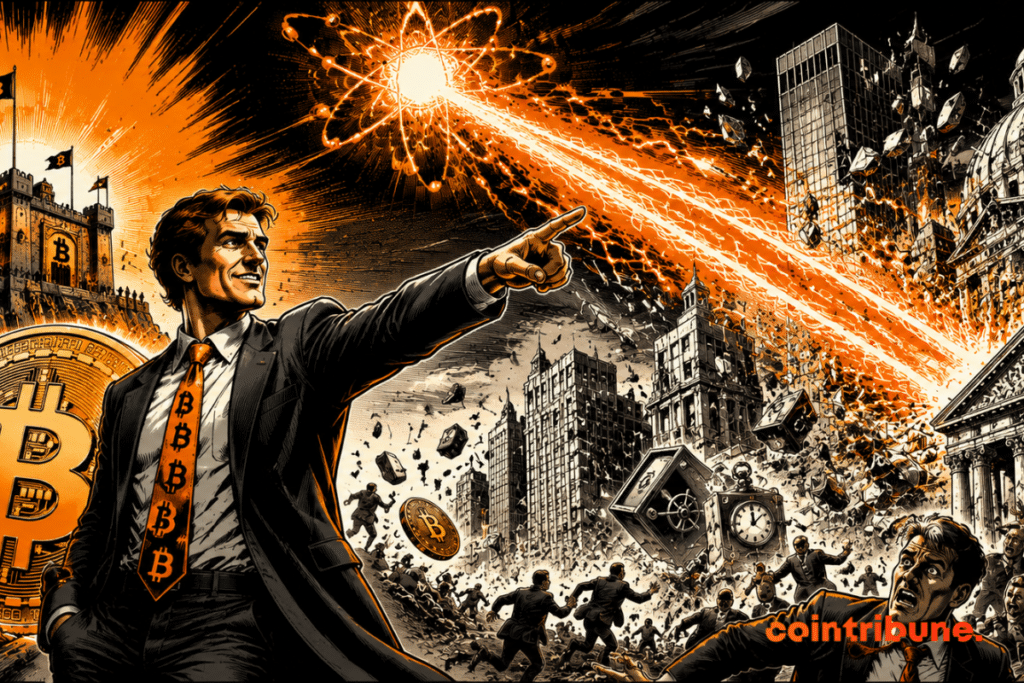
The billionaire investor does not mince his words. For him, if a quantum computer were to hack anything first, it would be the infrastructures of centralized banks, not the Bitcoin blockchain. He adds that the network could, as a last resort, undergo a hard fork to revert to the last secure block before a possible attack.
This option remains technically feasible. However, it would require a very broad consensus among miners and node operators, a scenario far from simple to coordinate.
Moreover, Draper has not changed his price trajectory. Early 2026, he reaffirmed his target of 250,000 dollars for Bitcoin within the next 18 months, a prediction he has been postponing since 2018.
Draper speaks from experience. His relationship with Bitcoin dates back to purchases around 4 dollars, followed by a total loss during the Mt. Gox crash, then a repurchase of nearly 30,000 BTC confiscated by the US Marshals in 2014, at about 632 dollars each. His conviction remains unwavering.
The quantum threat, very real despite reassuring statements
Yet, warning signals are piling up. In March 2026, a Google Quantum AI white paper revised estimates downward: fewer than 500,000 physical qubits would now be needed to crack ECDSA-256 encryption, versus 10 million according to 2019 projections. A reduction by a factor of 20 in seven years.
Meanwhile, Project Eleven recently warned of a closing risk window: the report mentions a probability greater than 50% that a quantum computer capable of breaking current network protections will appear before 2033. About 6.9 million BTC could become vulnerable in some scenarios.
In response to this pressure, the Bitcoin community is moving forward with concrete solutions. BIP-360, which proposes quantum-resistant address formats, focuses part of the technical discussions. Bernstein, for his part, considers the threat to be regulated rather than existential, estimating that a three to five-year window still allows for a controlled transition.
Ultimately, Tim Draper expresses a frequently repeated conviction: Bitcoin resists, and traditional institutions remain the most fragile targets. Founded optimism or blind spot?
Advances by Google Quantum AI, the progress of Chinese machines like Jiuzhang 4.0, and the slow coordination of the Bitcoin ecosystem nevertheless sketch a tightening timetable. The network has never faced a challenge directly affecting its cryptographic foundations. Preparing the migration is already a form of response.
Maximize your Cointribune experience with our "Read to Earn" program! For every article you read, earn points and access exclusive rewards. Sign up now and start earning benefits.

Passionné par le Bitcoin, j'aime explorer les méandres de la blockchain et des cryptos et je partage mes découvertes avec la communauté. Mon rêve est de vivre dans un monde où la vie privée et la liberté financière sont garanties pour tous, et je crois fermement que Bitcoin est l'outil qui peut rendre cela possible.
The views, thoughts, and opinions expressed in this article belong solely to the author, and should not be taken as investment advice. Do your own research before taking any investment decisions.