Tom Lee Sees Ethereum Under Pressure As Kospi Falls
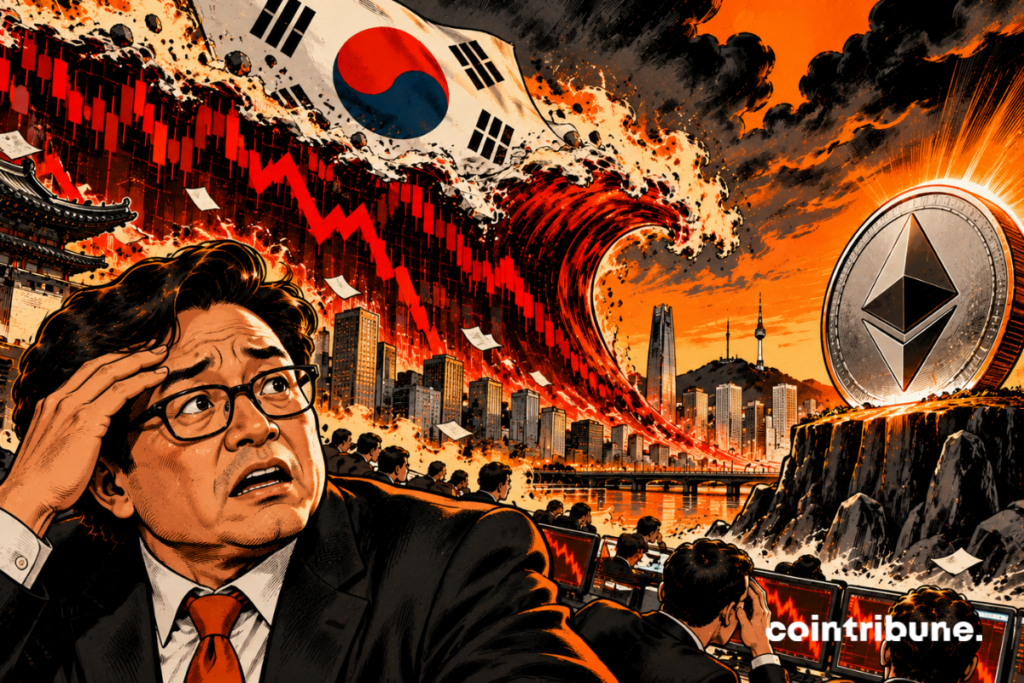
Tom Lee, one of Ethereum’s most well-known advocates, foresees a difficult short-term period for ETH. His warning does not question his long-term bullish thesis: it concerns a possible contagion effect coming from the South Korean stock market.
In brief
- Tom Lee issues a rare warning on Ethereum. He fears a short-term drop in ETH.
- The Kospi drop worries markets. Stock losses in South Korea could spread to cryptos.
- Margin calls represent a risk. Some investors might be forced to sell their ETH to cover losses.
- Ethereum already shows signs of weakness. The pullback against bitcoin and ETF capital outflows increase pressure.
- Tom Lee remains optimistic long-term. Despite his warning, he continues to believe in Ethereum’s potential.
The Kospi slump threatens to spread to cryptos
The Kospi index fell more than 6% during trading on October 13, under pressure from technology stocks and semiconductor manufacturers. Samsung Electronics and SK Hynix recorded losses close to or exceeding 8%.
The extent of the movement pushed Korea Exchange to activate a “sidecar” seller. This mechanism temporarily suspends certain automated orders when futures experience excessive variation. The Kospi 200 futures had then lost more than 5%.
Tom Lee fears that these stock market losses will transmit to the crypto market. He wrote on X :
This significant drop in Korean stocks is likely spreading to cryptocurrencies.
The Fundstrat co-founder identifies two risk factors: margin liquidations in South Korean brokerage firms and the strong participation of the country’s investors in the digital asset market.
His message ends with an explicit warning regarding Ethereum: “short-term pain for ETH”. Lee however did not announce a precise bearish target nor a duration for this possible correction.
Margin calls can force ETH sales
Many investors buy stocks with money borrowed from their broker. When the value of their portfolio drops, they must provide additional collateral or reduce their debt.
If they don’t have immediate liquidity, they may sell other assets, including bitcoins or ethers. The Kospi decline could thus create pressure on Ethereum even if no network-specific event justifies this drop.
Brokers can also automatically sell margin-funded positions when collateral becomes insufficient. This mechanism then transforms a local stock market correction into an urgent cash need.
Tom Lee has however provided no data demonstrating that Korean investors are already massively selling their ETH to meet margin calls. His scenario describes a plausible contagion channel, but not yet quantified.
Ethereum touched an intraday low near 2411 dollars before recovering around 2515 dollars. The asset remains down about 6% over a week and trades near a technical level watched between 2500 and 2550 dollars.
Ethereum already accumulates several signs of weakness
Pressure from Korea comes in a less favorable context for ETH. The ETH/BTC ratio, which measures Ethereum’s performance against bitcoin, has fallen about 4.7% in a week to near 0.030.
This trend shows bitcoin resists better than ether during uncertainty. It contradicts, at least short-term, Lee’s hypothesis of an imminent Ethereum catch-up.
US spot Ethereum ETFs also recorded several sessions of net outflows. The weakness of these flows reduces an important institutional support just as investors seek to lower their exposure to risky assets.
A liquidity indicator followed on Binance has also fallen to its lowest level in nearly seven months. Such a drop does not automatically mean sellers dominate. It can also reflect a withdrawal of ETH to private wallets, thus reducing immediately available supply.
These signals describe a fragile market but do not prove that a new lasting downtrend has started.
Tom Lee maintains his long-term bullish conviction
The warning is surprising because Tom Lee chairs BitMine Immersion Technologies, the largest treasury company dedicated to Ethereum. The group purchased 12,532 additional ETH during the week ended October 11.
BitMine now holds 6,028,946 ETH, about 4.9% of the estimated total supply of 122.1 million tokens. This reserve is worth over 15 billion dollars at the current price.
However, the buying pace has slowed as the company approaches its target of 5% of the supply. BitMine would have only about 77,000 ETH left before reaching that threshold.
Lee continues to support Ethereum through the development of tokenization, stablecoins, and artificial intelligence agents. He believes these uses could end several years of underperformance against bitcoin.
His October 13 warning remains tactical. He anticipates forced sales related to the Korean stock market crisis without abandoning his long-term growth scenario. The strength of 2500 dollars and the Kospi’s evolution will determine if this “pain” remains temporary.
Maximize your Cointribune experience with our "Read to Earn" program! For every article you read, earn points and access exclusive rewards. Sign up now and start earning benefits.

Diplômé de Sciences Po Toulouse et titulaire d'une certification consultant blockchain délivrée par Alyra, j'ai rejoint l'aventure Cointribune en 2019. Convaincu du potentiel de la blockchain pour transformer de nombreux secteurs de l'économie, j'ai pris l'engagement de sensibiliser et d'informer le grand public sur cet écosystème en constante évolution. Mon objectif est de permettre à chacun de mieux comprendre la blockchain et de saisir les opportunités qu'elle offre. Je m'efforce chaque jour de fournir une analyse objective de l'actualité, de décrypter les tendances du marché, de relayer les dernières innovations technologiques et de mettre en perspective les enjeux économiques et sociétaux de cette révolution en marche.
The views, thoughts, and opinions expressed in this article belong solely to the author, and should not be taken as investment advice. Do your own research before taking any investment decisions.