Trump Signs Two Decrees to Prepare the United States for the Quantum Era
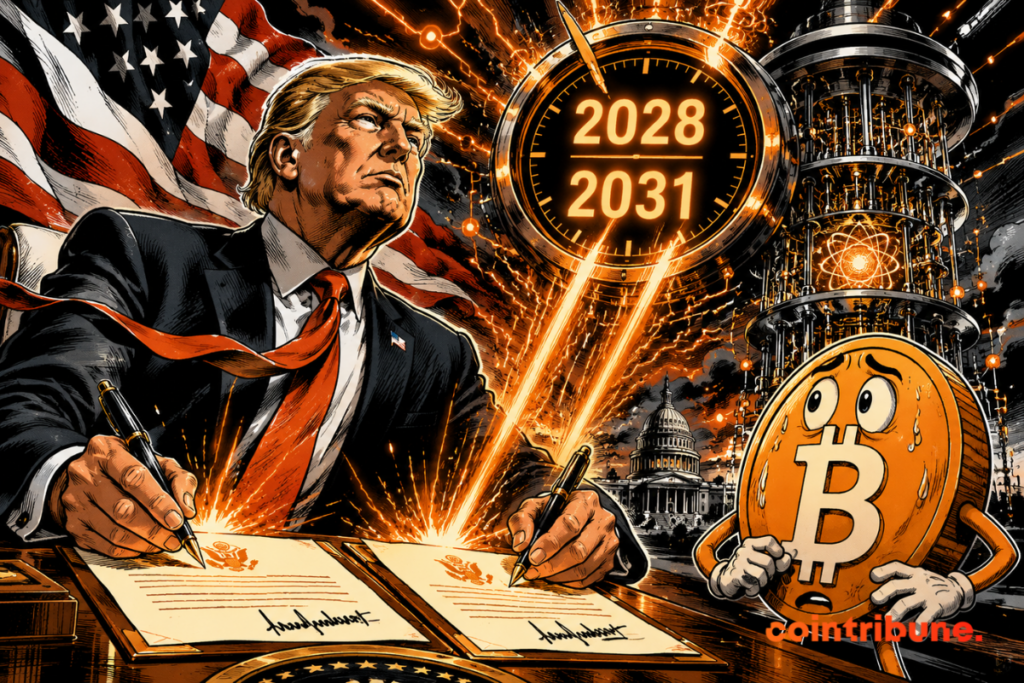
US President Donald Trump signed on June 22, 2026, two executive orders to accelerate the race for quantum computing and secure federal systems against the threat of Q-Day. The first measure sets the goal of deploying a scientifically relevant quantum computer by 2028. The second mandates a complete migration to post-quantum cryptography by the end of 2031 (four years earlier than planned). For the crypto ecosystem (notably for Bitcoin), these decisions sound like a warning: the clock is ticking.
In brief
- Donald Trump signed two decrees aimed at accelerating the development of quantum technologies in the United States.
- The American administration wants to strengthen its competitiveness against China in the quantum race.
- Bitcoin is not threatened in the short term, but the crypto sector is already preparing so-called ‘post-quantum’ solutions.
- National cybersecurity becomes a central axis of the American strategy.
Why is Trump tackling quantum now?
The geopolitical context imposes urgency. Rival powers of the United States, including China, are massively investing in quantum computing. Their goal? Neutralizing American advantages.
Faced with this race, Washington has decided to step up. On June 22, 2026, Trump signed two complementary texts that target both offense and defense.
The first decree, titled Ushering in the Next Frontier of Quantum Innovation, creates what the White House calls the “Quantum Computer for Application Development and Discovery Science Effort.” It aims to develop the first quantum computer capable of initiating the era of quantum scientific discovery. The goal is set for 2028.
The Department of Energy will be responsible for defining the system’s technical specifications, which will be deployed in one of its national laboratories. The Departments of Commerce, Defense, and NASA must simultaneously develop plans to deploy sensors and quantum networks over the next five years.
The second decree, titled Securing the Nation Against Advanced Cryptographic Attacks, is the one that draws the most attention in the crypto industry. It anticipates the arrival of Q-Day, the moment when a quantum computer powerful enough could break current encryption standards.
The deadline is set for:
- 2030 for key establishment mechanisms in critical infrastructures;
- 2031 for digital signatures.
The previous schedule, established by the national security memorandum NSM-10, allowed until 2035. The Trump administration thus cuts four years from the deadline.
The quantum threat to crypto is not hypothetical, but quantifiable
Coinbase, via its quantum advisory board created in January 2026, estimates that about 7 million bitcoins are currently in so-called “vulnerable” addresses. A quantum computer powerful enough could derive the private key from the public key and drain these crypto wallets.
Certainly, this scenario remains technically distant. According to experts, a fault-tolerant quantum computer with millions of stable qubits would be needed, far beyond current systems. The Trump decrees however accelerate the path to this capability. Which forces the crypto ecosystem to take the issue seriously right now.
Proof: in March 2026, Google set a deadline for 2029 to adopt post-quantum cryptography internally. In the same period, BTQ Technologies launched a Bitcoin testnet built around proposal BIP-360. This is designed to make addresses resistant to quantum attacks. In April, developers also proposed BIP-361, which could eventually freeze bitcoins stored in vulnerable legacy addresses if their owners have not migrated.
Stellar, too, has published a quantum migration roadmap. Algorand announced it aims to achieve global quantum resilience by the end of 2027.
In any case, the Trump decrees on quantum mark a historic acceleration in American technology policy. The next 12 months will be particularly decisive in measuring whether the crypto industry seriously seizes this adaptation window.
Maximize your Cointribune experience with our "Read to Earn" program! For every article you read, earn points and access exclusive rewards. Sign up now and start earning benefits.

My name is Ariela, and I am 31 years old. I have been working in the field of web writing for 7 years now. I only discovered trading and cryptocurrency a few years ago, but it is a universe that greatly interests me. The topics covered on the platform allow me to learn more. A singer in my spare time, I also cultivate a great passion for music and reading (and animals!)
The views, thoughts, and opinions expressed in this article belong solely to the author, and should not be taken as investment advice. Do your own research before taking any investment decisions.