U.S. Debt: Stablecoins Tapped as Foreign Investors Pull Back
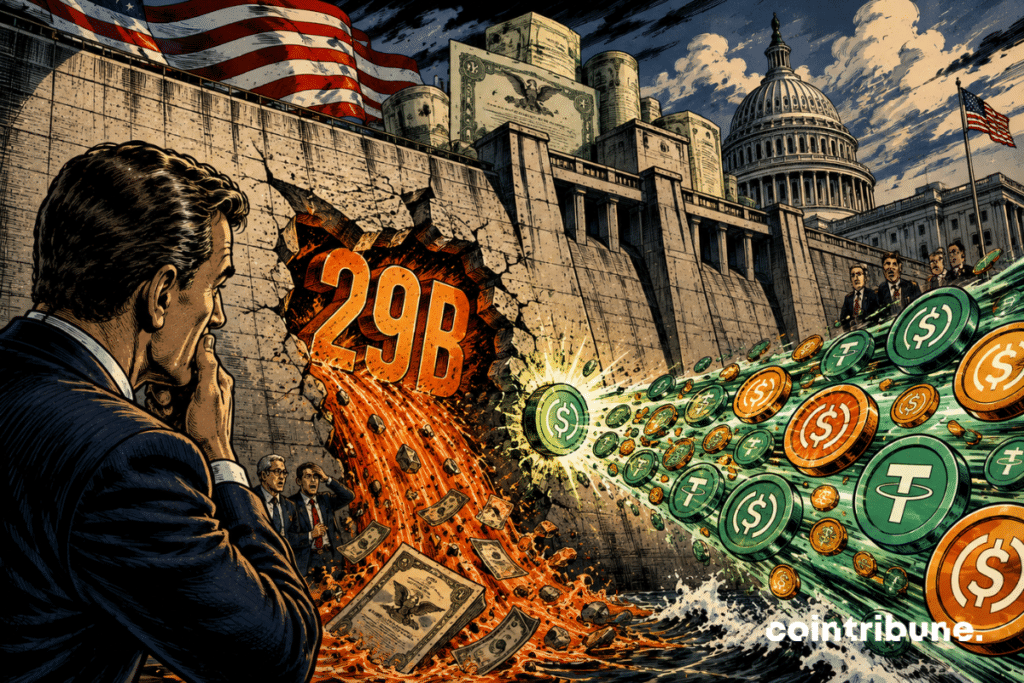
Foreign investors sold $29 billion in short-term US Treasury bills in June. Yet they did not flee the United States: $181.4 billion moved towards US equities in the same month. For Washington, the shift matters. Stablecoins could provide a new regular demand for T-bills as some foreign investors reduce their positions.
In brief
- Foreign investors sold $29 billion in T-bills in June.
- Tether alone holds nearly $115 billion in direct Treasury bills.
- The growth of stablecoins could turn their issuers into major buyers of US debt.
Stablecoins arrive at the right moment for Washington
The movement had already started in May. Foreign investors sold $43.5 billion in short-term Treasury bills. June adds $29 billion. Two months: about $72.5 billion decline. Questions were already raised about the role that stablecoins could play in financing US debt.
June’s figures deserve nuance however. Foreign capital continues to flow into the US. The net inflow reaches $133.5 billion for the month.
Money simply prefers something else. Foreigners bought $181.4 billion in US equities and only $6.8 billion in long-term Treasury debt. For T-bills, they sold. Foreign holdings of these short-term securities thus fall from about $1.43 trillion in May to $1.40 trillion in June. Washington retains buyers. The composition changes.
Tether already holds $115 billion in T-bills
The functioning of a stablecoin explains the interest in US Treasury. A user gives one dollar to an issuer and receives an equivalent token. The company must then keep sufficiently liquid assets to reimburse customers who want to redeem their dollars.
Short-term Treasury bills perfectly fulfill this function. Tether already provides an idea of the scale. At the end of the second quarter, the issuer of USDT declared $114.96 billion of directly held T-bills. It also held $25.62 billion in short-term repo operations.
The reserves have taken on considerable size. Tether had already strongly increased its holdings in US public debt in 2025. The $29 billion sold by foreign investors in June represents about a quarter of Tether’s direct T-bills portfolio.
Circle follows a similar logic with USDC. A large part of its reserves goes through the Circle Reserve Fund managed by BlackRock. This fund notably holds cash, short-term Treasury securities, and repos backed by the same bonds. A dollar entering a stablecoin can thus end up in US debt without its user buying a Treasury bill themselves. This is quite convenient for Washington.
Stablecoins do not yet replace foreign investors
One must not go too fast. Nothing shows that Tether, Circle, or another issuer directly absorbed the $29 billion sold in June. The stablecoin supply barely increased over the period.
Tether counted 184.6 billion USDT in circulation at the end of the second quarter, only 446 million more than the previous quarter. The entire stablecoin market was around $302 billion on August 21.
Not enough to explain $29 billion of new purchases. Washington’s bet is rather on the future. The GENIUS Act requires regulated stablecoins to maintain liquid reserves. Cash, short-term T-bills, and Treasury-backed repos occupy a privileged place in the framework.
The US Treasury has just published new rules preparing for the implementation of this law on stablecoins. The more digital dollars circulate, the more their issuers must build reserves. And part of these reserves ends up in US debt. Foreign investors sold $29 billion in T-bills in June. Stablecoins have not yet plugged the gap. Washington is already preparing a place for them to do so tomorrow.
Maximize your Cointribune experience with our "Read to Earn" program! For every article you read, earn points and access exclusive rewards. Sign up now and start earning benefits.

Enseignante et ingénieure IT, Lydie découvre le Bitcoin en 2022 et plonge dans l’univers des cryptomonnaies. Elle vulgarise des sujets complexes, décrypte les enjeux du Web3 et défend une vision d’un futur numérique ouvert, inclusif et décentralisé.
The views, thoughts, and opinions expressed in this article belong solely to the author, and should not be taken as investment advice. Do your own research before taking any investment decisions.