US And Canada Enter New Trade Standoff After Talks Collapse
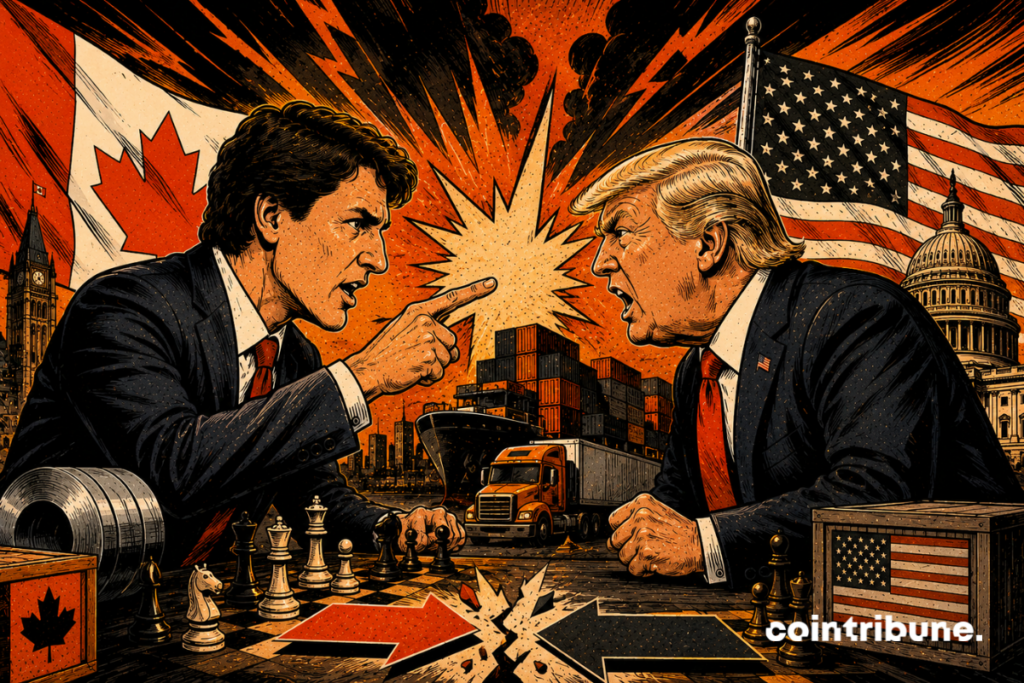
Trade talks between the United States and Canada suddenly failed this Friday, August 21. This failure has reignited tensions between the two North American countries. Given the entry into force of punitive tariffs and the announced Canadian retaliations, this conflict could therefore have repercussions on global liquidity, increase market uncertainty, and even affect risky assets. The crypto market and bitcoin would then be at the forefront of a new macroeconomic shock.
In brief
- Canadian Prime Minister Mark Carney suspended trade talks with Washington and recalled his team, denouncing unfair US terms.
- The breakdown of negotiations triggered immediate 50% US tariffs on $20 billion worth of imported Canadian goods.
- The lack of an agreement on dairy products, alongside failed tariff cuts on steel, aluminum, and automobiles, doomed the negotiations.
- Canada pledged to match US tariffs “dollar for dollar” to protect its economy and workers.
From truce to diplomatic clash: behind the scenes of this failure with the United States
This Friday, divisions multiplied after a radical decision by the Canadian Prime Minister, Mark Carney, to urgently recall his envoys on mission to Washington, despite a 72-hour suspension of new tariffs. This escalation occurred after the expiration of the three-day reprieve granted earlier in the week by the US administration.
To explain his choice, the Canadian Prime Minister stated: “therefore, tonight, I have decided to suspend trade negotiations with the United States and have ordered Canada’s negotiators to return to Ottawa”. He justifies such a decision by pointing out the behavior of President Donald Trump at the very last moment.
According to the latter’s remarks, last-minute changes introduced by the United States were “unfair, uneconomic, and challenged the reliability of any agreement”. Highlighting his country’s economic sovereignty whose growth is accelerating notably, he declared that Canada would never allow “any country to decide our future”.
This last-minute paralysis automatically triggered the implementation of the 50% punitive tariffs decided by the United States at midnight. It should be noted that these customs duties apply directly to nearly $20 billion of Canadian merchandise imports, representing about 5% of the total value of goods imported by Americans from Canada in the previous year.
The scope of these sanctions is extensive. Five hundred different product categories are affected, ranging from electrical equipment to industrial machinery, including furniture, clothing, and alcohol. The US claims concern extended access to Canada’s dairy market. These specific demands ruined the fragile balance of the negotiations.
To properly assess the scale of sectoral blockages that led to this diplomatic failure, many major compromises nevertheless remained in discussions until the last minutes :
- Steel and aluminum : the White House was considering halving the current 50% tariffs, which would have brought customs duties down to 25% ;
- The automotive sector : negotiations concerned a reduction to 15% of the 25% taxes that affected Canadian vehicles only for their non-American content.
The response and legal arsenal: the choice of economic showdown
Following this American offensive, the Canadian executive’s reaction was swift. The Prime Minister’s government promised a symmetrical and immediate response on economic matters. Canadian authorities, refusing to yield to Washington’s pressure, then decided to apply a targeted retaliation policy. This is why Mark Carney firmly declared: “Canada will respond to these tariffs dollar for dollar to protect our workers and businesses”.
As for the American administration, it immediately rejected full responsibility for this crisis on the Canadian executive. Jamieson Greer, the US trade representative, believes that “despite the US offer granting Canada the most-favored-nation treatment on our market, new demands and Canada’s backtracking on other commitments have disrupted the delicate balance reached these past days”.
Legally and strategically, the procedure used by the Americans is in total break with classic international trade practices. In order to impose these 50% tariffs, the Trump administration purposely reactivated Section 338 of the Tariff Act of 1930. This is an exceptional legal lever dating back to the Great Depression era.
This particular legal instrument has the originality of requiring no prior investigation. It thus allows permanent and definitive application of surtaxes, without automatic expiration, unless the President of the United States decides to lift them. For the moment, Washington maintains freedom of action by temporarily excluding vital energy sectors such as oil, gas, critical minerals, as well as the fisheries sector.
Inflationary risks and alternative assets
In addition to diplomatic tensions, this forced move by the Americans exerts significant pressure on the global monetary balance. The unilateral and harsh application of these massive customs taxes on fully intertwined supply chains immediately creates the risk of reappearance of inflation on the North American continent.
As companies pass on these additional costs to consumers, central banks would find themselves trapped between economic slowdown caused by protectionism and price pressures. This uncertainty could create a volatile environment for fiat currencies, as the latter quickly show signs of fragility in the face of increasing politicization of trade exchanges.
In this chaos, the relevance of decentralized assets is reinforced among prudent and savvy investors. While bilateral agreements stall and collapse under pressure from arbitrary texts and century-old protectionist legislative standards, bitcoin and the crypto market remind us of the essential value of a neutral, borderless financial network insensitive to customs surtaxes.
While volatility in the short term is inevitable during these macroeconomic shocks, the deterioration of traditional trade certainties would accelerate the reallocation of capital towards stores of value outside state control.
Maximize your Cointribune experience with our "Read to Earn" program! For every article you read, earn points and access exclusive rewards. Sign up now and start earning benefits.

Diplômé de Sciences Po Toulouse et titulaire d'une certification consultant blockchain délivrée par Alyra, j'ai rejoint l'aventure Cointribune en 2019. Convaincu du potentiel de la blockchain pour transformer de nombreux secteurs de l'économie, j'ai pris l'engagement de sensibiliser et d'informer le grand public sur cet écosystème en constante évolution. Mon objectif est de permettre à chacun de mieux comprendre la blockchain et de saisir les opportunités qu'elle offre. Je m'efforce chaque jour de fournir une analyse objective de l'actualité, de décrypter les tendances du marché, de relayer les dernières innovations technologiques et de mettre en perspective les enjeux économiques et sociétaux de cette révolution en marche.
The views, thoughts, and opinions expressed in this article belong solely to the author, and should not be taken as investment advice. Do your own research before taking any investment decisions.