US Secondary Sanctions On Iran Reach The Crypto Sector
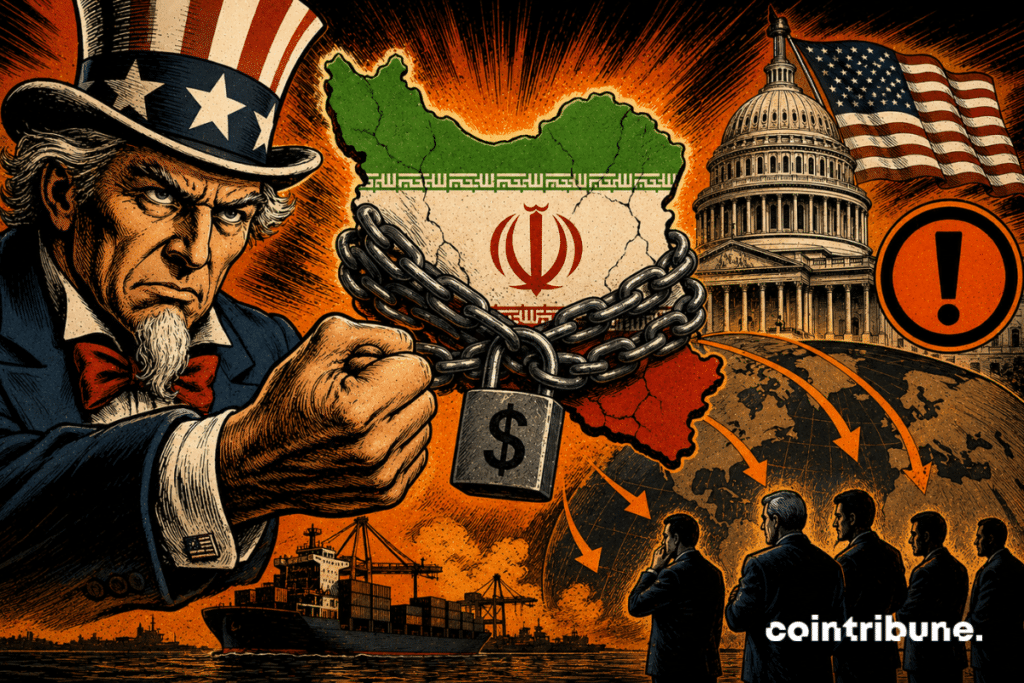
Disagreements between the United States and Iran suddenly take on a new dimension. Washington has launched its “economic D-Day” against Tehran, with a massive strengthening of secondary sanctions on international financial flows. This campaign by the U.S. administration now threatens liquidity circuits. Moreover, it puts pressure on actors using alternative transfer systems. Between sanctions, compliance constraints, and risks of financial disruptions, the crypto universe is directly exposed.
In Brief
- Washington declares an “economic D-Day” against Iran, threatening secondary sanctions against anyone continuing financial exchanges with Tehran.
- Oil flows, swap lines, currency exchange houses, and cash transfers are ordered to halt operations immediately.
- Centralized exchanges and stablecoin liquidity providers must drastically tighten their KYC/AML filters or face prosecution.
- Geopolitical uncertainty triggers a temporary flight to gold and the dollar, sparking sharp volatility in the crypto derivatives market.
- The crisis accelerates the fragmentation of international finance, placing the crypto ecosystem between strict compliance and the search for decentralization.
Washington’s Economic Offensive and the Specter of Secondary Sanctions
While it has already seized $500 million in cryptos linked to Iran, the U.S. government has officially launched the economic operation against the Islamic Republic of Iran. Considered the harshest and dubbed the “economic D-Day”, this offensive aims to completely isolate sovereign or private entities that maintain financial relations with Tehran, due to recurring blockages in negotiations and the end of diplomatic deadlines.
In a message published on his Truth Social network, U.S. President Donald Trump stated that “nobody has given the Islamic Republic of Iran a greater opportunity to reach a deal”. He also added that “tragically for them, they did not seize it”, which explains the immediate start of the “most overwhelming isolation and economic war campaign ever undertaken against a country”.
Washington targets the accepted bypass networks up to now and orders the immediate halt to operations: “smuggling of oil, swap lines, cash transfers, exchange houses, maritime registries, shell companies, all of this must stop NOW”.
Beyond the ongoing maritime blockade in the Strait of Hormuz, the Trump administration confirms its desire to increase the scope of secondary sanctions to the entire international intermediary banking system. Official statements unequivocally emphasize that “any nation allowing its financial institutions, businesses, airports, or government entities to provide any lifeline to Iran will itself suffer immense economic consequences”.
American authorities are thus trying to restrict the last financing networks of the Iranian state to annihilate its financial and logistical capacities. By simultaneously paralyzing traditional exchange flows and reserve currencies, Washington sends a firm signal to all their trading partners and demands unconditional rallying to establish the total and definitive isolation of Iran’s financial circuits.
To achieve this financial oppression, the U.S. strategy relies on targeted prohibition of various relevant aspects of cross-border trade :
- Transactions related to Iranian oil smuggling and flag-of-convenience maritime registries ;
- The use of currency swap lines and unaligned intermediary investment banks ;
- Over-the-counter cash transfers and the use of informal exchange houses.
Tightening Compliance on Iran’s Alternative Financial Networks
This unprecedented blockage directly affects value transfer channels that allowed evasion of the international SWIFT banking circuit, placing the crypto ecosystem under immediate compliance regulator supervision. Thus, Iran’s parallel transfer networks, over-the-counter (OTC) exchanges, and cross-border transactions in stablecoins are currently exposed to secondary sanctions.
Faced with the U.S. administration’s desire to stifle “exchange houses and cash transfers”, Web3 infrastructures, liquidity providers, and centralized exchange platforms must improve the quality of their geolocation filters as well as their KYC and AML identification protocols.
Failure to comply with these monitoring protocols for targeted wallet flows could expose platform managers to direct legal actions. Additionally, their dollar bank reserves could be subject to immediate freezing.
This obligation for total transparency forces the crypto ecosystem to make a radical trade-off between protecting transaction confidentiality and scrupulous respect of the U.S. regulatory framework. In this perspective, institutional actors are compelled to adjust their standards to those of traditional finance, under threat of having their fiat gateway accesses entirely cut off by the U.S. Treasury.
Price Volatility and a Restructuring of the Crypto Market
Compared to the freeze of traditional liquidity and the rise in tensions, the impact on price evolution is even more violent for the crypto market. Investor caution in global financial markets influences the capitalization of major assets. High volatility as well as the risk of massive liquidations weigh on these assets.
Despite the role of bitcoin as a safe haven in the face of geopolitical uncertainties, the intensity of sanctions against Iran leads to a general retreat to traditional monetary liquidity and physical gold. Investors also hesitate to take risks given the high uncertainty premium in alternative markets.
In the long term, the excessive instrumentalization of the dollar as a financial weapon could accelerate the segmentation of international financial markets and fuel the search for illegal decentralized payment channels. As the boundary between monetary sovereignty, regulatory control, and decentralization shrinks under geopolitical tensions, crypto sector actors will have to navigate between strict enforcement of compliance frameworks imposed by the West and the preservation of their protocol integrity under threat of being caught in this systemic confrontation.
Maximize your Cointribune experience with our "Read to Earn" program! For every article you read, earn points and access exclusive rewards. Sign up now and start earning benefits.

Diplômé de Sciences Po Toulouse et titulaire d'une certification consultant blockchain délivrée par Alyra, j'ai rejoint l'aventure Cointribune en 2019. Convaincu du potentiel de la blockchain pour transformer de nombreux secteurs de l'économie, j'ai pris l'engagement de sensibiliser et d'informer le grand public sur cet écosystème en constante évolution. Mon objectif est de permettre à chacun de mieux comprendre la blockchain et de saisir les opportunités qu'elle offre. Je m'efforce chaque jour de fournir une analyse objective de l'actualité, de décrypter les tendances du marché, de relayer les dernières innovations technologiques et de mettre en perspective les enjeux économiques et sociétaux de cette révolution en marche.
The views, thoughts, and opinions expressed in this article belong solely to the author, and should not be taken as investment advice. Do your own research before taking any investment decisions.