AI Could Cement Dollar Dominance With Stablecoins
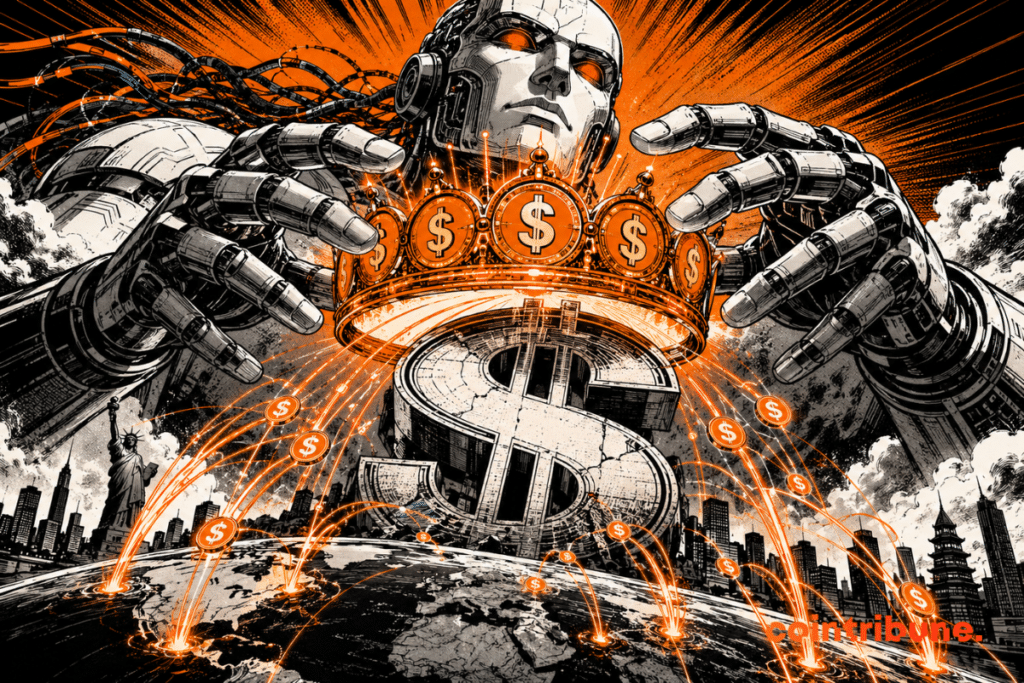
While the debate rages on dedollarization, artificial intelligence could change the game. This is at least what the two economists from AMRO, ASEAN+3 Macroeconomic Research Office, think. In an analysis published on July 24, 2026, they present a novel thesis: AI in no way threatens the dominance of the dollar, it reinforces it. The key factor? The massive use of dollar-backed stablecoins.
In Brief
- AI could strengthen the global domination of the dollar.
- Compute creates a recurring demand for US liquidity.
- AI agents could favor dollar stablecoins.
- This scenario remains plausible, but its commercial adoption remains uncertain.
Here is how AI could transform global financial infrastructures, according to Chenxu Fu and Xianguo Huang
At the heart of the AI analysis by the two AMRO economists is the “compute-dollar loop” (energy-compute-dollar loop). It is an economic mechanism based on a four-step process.
- First, electrical energy powers data centers.
- Second, data centers convert this energy into billable computing capacity (compute).
- Third, this compute becomes a recurring operational expense for global companies, billed in US dollars.
- Fourth, automated payments generated by AI agents are settled via dollar-backed stablecoins. Reserves will be invested in US Treasury bonds.
If computing power becomes an indispensable input for the economy, its billing currency will gain influence. AI could thus replicate the mechanism observed with oil. Its billing in dollars has long supported international demand for greenbacks.
How do AI infrastructure contracts create a structural demand in dollars?
AI is not an “immaterial” industry. It consumes electricity, water, semiconductors, and industrial real estate. And precisely, these resources are increasingly secured by long-term contracts denominated in dollars.
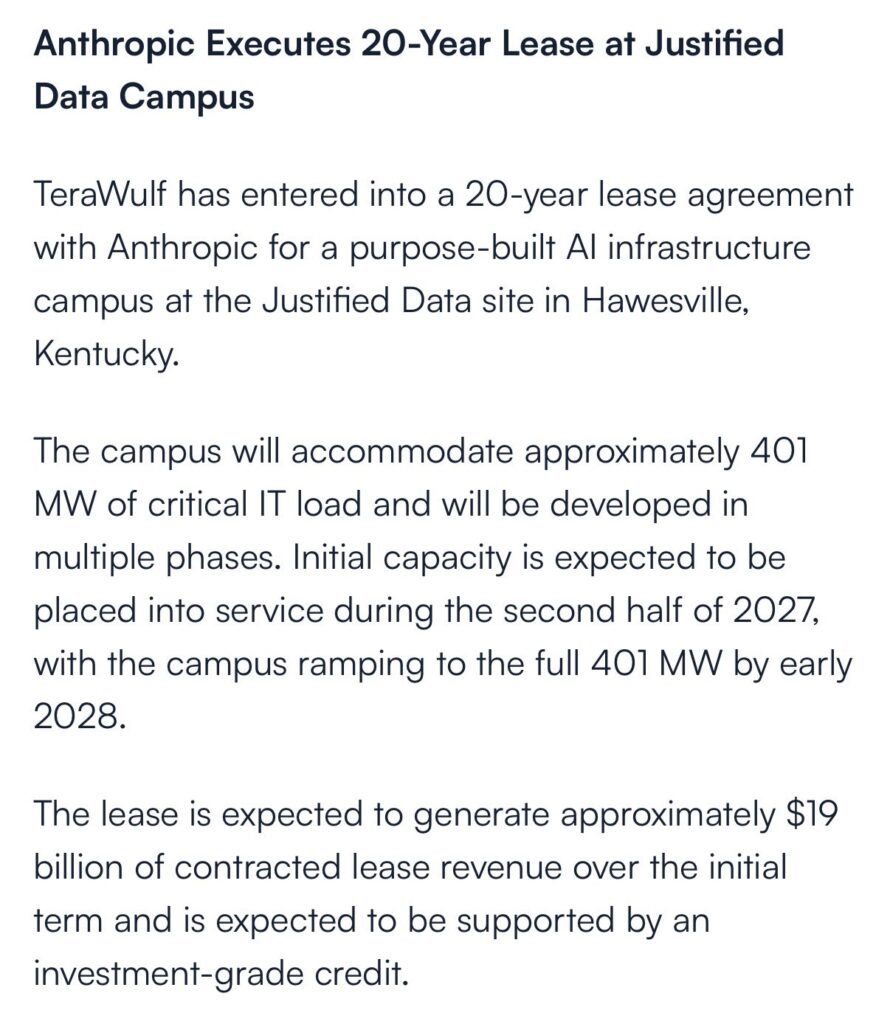
To support this reasoning, Chenxu Fu and Xianguo Huang mention the case of Anthropic. This American AI company has just signed a 20-year data center lease contract with TeraWulf. More than a simple real estate lease, it is a supply-side bet on the persistence of demand for compute.
Decoding: Anthropic commits to pay in US dollars for two decades to guarantee its access to energy and computing.
At the same time, OpenAI has also launched Deployment Company (DeployCo). This consulting subsidiary groups engineers within client companies to deploy AI systems. Once these systems are integrated, compute will become a recurring operational expense comparable to electricity or telecommunications.
These contracts thus create a structural demand in dollars to the extent that they record the cost of AI on the balance sheets of global companies in US currency. If a Japanese, Indonesian, or German company wants to use AI for its logistics, accounting, or customer relations, it will need to source dollars not just occasionally but in a recurring and growing manner.
This constitutes the first channel of dollar dominance reinforcement according to Fu and Huang. They estimate that the dollar billing of compute will generate a permanent demand for dollar liquidity.
The second key factor of the AMRO thesis: payment settlement
When AI agents become ubiquitous in logistics, inventory management, and corporate cash management, they will need programmable money. Precisely, dollar-backed stablecoins meet this need. Moreover, Circle and other sector players have already built infrastructures that allow programmable transfers 24/7 — all without traditional banking intermediaries.
For its part, OpenAI has signed a partnership with Visa to specifically build these programmable payment rails. Moreover, the Open USD announcement shows that the ecosystem is already positioning itself for this transformation.
The question is therefore no longer whether stablecoins are the only option, but rather if they will become the first to function efficiently across borders at large scale. If so, agentic commerce will naturally rely on programmable dollars.
Is this dollar dominance by AI truly inevitable?
For many analysts, the scenario mentioned by the two AMRO economists remains plausible. However, it is not certain. According to them, AI agents are already conducting experimental operations. But nothing yet proves they will quickly become a major category of payers in the real economy. Simply put, a technical demonstration is by no means commercial adoption.
Stablecoins are also not free of weaknesses. The main issues raised include:
- risks of losing their peg;
- issuer concentration;
- dependence on blockchains;
- cybersecurity;
- compliance.
Indeed, the speed of automated settlement can become dangerous if a compromised AI agent instantly multiplies erroneous payments.
Finally, and significantly, AI will not spontaneously choose the dollar. It will use the least costly, most liquid, and easiest-to-integrate instruments. The United States today holds this advantage thanks to the depth of its markets and the dominance of USDT and USDC.
Thus, the economy of artificial intelligence no longer just transforms companies. It also redraws the foundations of the international monetary system. The next global battle could therefore be played out between the wallets of autonomous agents. More on this to come…
Maximize your Cointribune experience with our "Read to Earn" program! For every article you read, earn points and access exclusive rewards. Sign up now and start earning benefits.

My name is Ariela, and I am 31 years old. I have been working in the field of web writing for 7 years now. I only discovered trading and cryptocurrency a few years ago, but it is a universe that greatly interests me. The topics covered on the platform allow me to learn more. A singer in my spare time, I also cultivate a great passion for music and reading (and animals!)
The views, thoughts, and opinions expressed in this article belong solely to the author, and should not be taken as investment advice. Do your own research before taking any investment decisions.