Vitalik Buterin Names a Skill Where Humans Still Hold the Edge Over AI
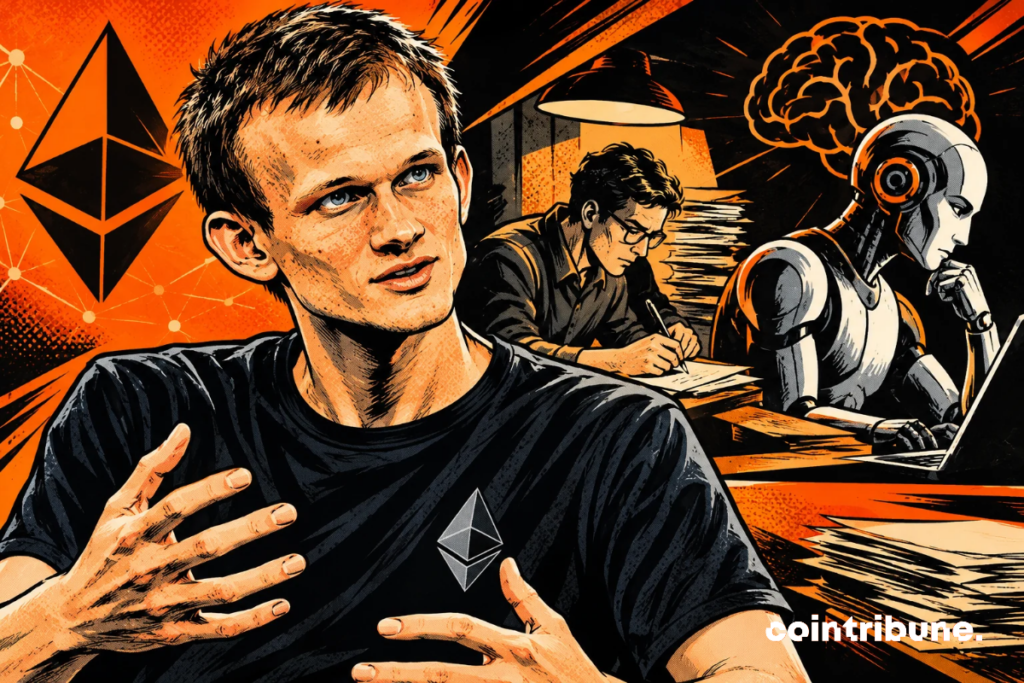
Vitalik Buterin points out a limit of artificial intelligence (AI): despite its extensive knowledge, it struggles to assess the depth of a text, especially when discovering it for the first time. For the co-founder of Ethereum, this difference between knowledge and wisdom deserves special attention.
In brief
- In a post from October 29, Vitalik describes AI as “extremely knowledgeable” but “not very wise,” limited to superficial judgments about what a text says.
- This limitation becomes more pronounced when reading a text for the first time, due to the lack of human commentary in the training data.
- He adds that a model’s knowledge is easily observable, whereas its wisdom, by definition, cannot be verified.
AI knows the references, but does it understand the ideas?
Vitalik Buterin regularly expresses his reservations about AI agents, as in October with his “paranoid mode”. On October 29 at 4:11 UTC, he published a new reflection in response to the writer Ruxandra Teslo.
The discussion followed an article in the Wall Street Journal about Humanities 10, a first-year course at Harvard that prohibits students from using phones and computers for a year.
In his post on X, Vitalik explains that AI can mobilize knowledge on almost any topic, but without showing deep judgment. It then risks stopping at the most superficial aspects of a text, without fully grasping the scope of its argument.
This remark occurs in a debate on the quality of exchanges with chatbots. Some consider them better interlocutors than most humans to discuss the great classics. Conversely, a writer considers that their comments on her essays often boil down to hollow responses.
The first reading
For Vitalik Buterin, this limit especially appears when the model discovers a text for the first time. Indeed, a famous work benefits from decades of criticism, analysis, and commentary that AI can find in its training data. A recent essay, however, does not have the same history.
The model therefore has to rely more on the text itself, without being able to mobilize as many preexisting analyses. This difference matters particularly in crypto, where teams use AI agents to examine white papers, audits, or governance proposals.
However, some developers are already warning about flaws that AI could exploit without fully understanding the implications. Under these conditions, summaries produced by a model should not replace human verification, especially when the technical or financial stakes are high.
Wisdom, a quality difficult to measure
Vitalik Buterin finally raises a more subtle problem: a model’s knowledge can be verified fairly easily, unlike its wisdom. One can check a date, a reference, or a number. However, judging the relevance of reasoning requires more than simple factual verification.
An episode in July illustrates this distinction. A contest organized around identifying the author of an anonymous Ethereum document rewarded, on July 6, the team of Franklyn Wang from Co-Invest. After examining 27 texts, they obtained a result associated with a probability of about 20%.
This experience reminds us that artificial intelligence can recognize stylistic features without necessarily grasping the ideas behind a text. The same caution is required when it analyzes code or technical documents: identifying patterns does not always mean understanding the author’s intentions.
Maximize your Cointribune experience with our "Read to Earn" program! For every article you read, earn points and access exclusive rewards. Sign up now and start earning benefits.

Passionné par le Bitcoin, j'aime explorer les méandres de la blockchain et des cryptos et je partage mes découvertes avec la communauté. Mon rêve est de vivre dans un monde où la vie privée et la liberté financière sont garanties pour tous, et je crois fermement que Bitcoin est l'outil qui peut rendre cela possible.
The views, thoughts, and opinions expressed in this article belong solely to the author, and should not be taken as investment advice. Do your own research before taking any investment decisions.