Vitalik Buterin Says Bitcoin Can Adapt To AI Threats
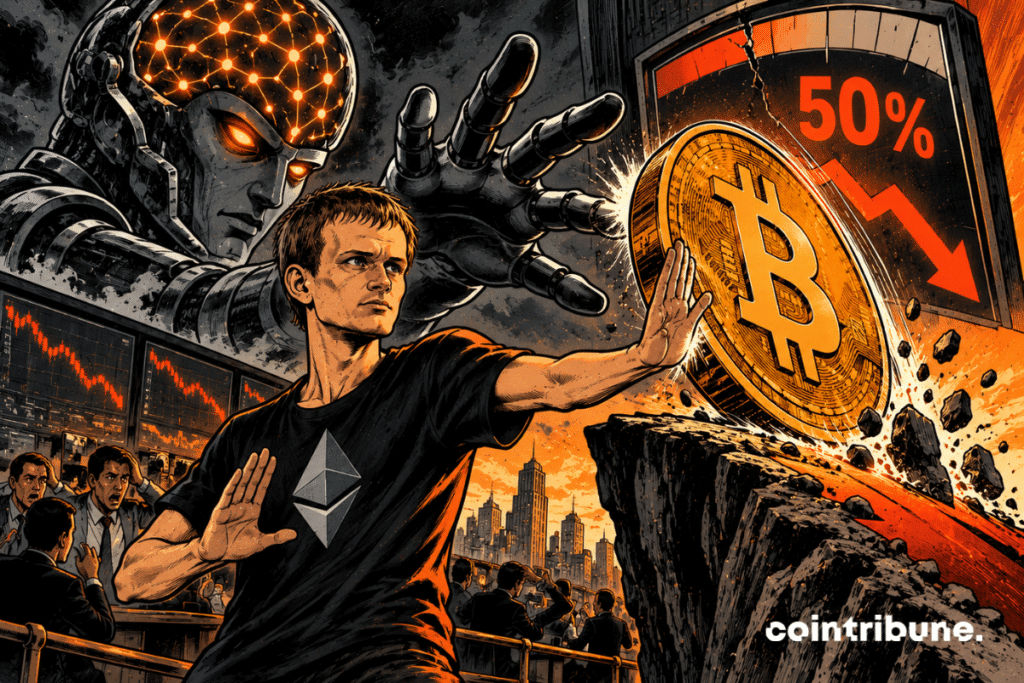
Vitalik Buterin believes bitcoin security will withstand the advances of artificial intelligence. However, the Ethereum co-founder has not wagered 90% of his fortune on a new bet, as he thinks his crypto holdings already expose him to such a scenario.
In brief
- Liron Shapira’s bet on a Bitcoin drop facing AI.
- Vitalik Buterin relativizes the risks for network security.
- Software flaws facing cryptographic risks.
- Why 90% of Buterin’s fortune is already exposed to cryptos.
- The ability of blockchains to adapt to AI advances.
A bet without contract or additional stake
On September 6, investor Liron Shapira specified that AI would weaken the security guarantees attributed to bitcoin. He gives a 50% probability to a BTC drop greater than 50% in price within the next two years.
He thus writes on the social network X :
I assert, with 50% confidence, that the BTC price will collapse by 50% or more within the next two years, as AI will undermine what people imagined to be its security or robustness guarantees.
Vitalik Buterin has publicly contradicted this forecast. However, he has not entered into any formal bet with Shapira nor transferred funds to a contract or prediction market.
Four main points summarize their disagreement :
- Shapira assigns a 50% probability to his scenario ;
- He predicts a bitcoin drop greater than 50% before September 2028 ;
- Buterin considers the risk of a break in hash functions or proof of work minimal ;
- The 90% corresponds to the approximate share of his assets already exposed to cryptos.
On September 7, with bitcoin near $79,500, the realization of the scenario predicted by Shapira could require a drop below around $39,750. Such a threshold results from a simple calculation based on the current price, not a technical target pre-established by the market.
Buterin distinguishes software flaws from cryptography
Bitcoin security does not rely on a single mechanism. Indeed, the network notably combines the SHA-256 hash function, proof of work, the software run by nodes as well as the infrastructure of mining pools.
According to Buterin, AI would facilitate discovering flaws at the client level, in peer-to-peer systems, or in the infrastructure of mining companies. However, these problems could be corrected through coordinated updates between developers and operators, without changing the fundamental protocol rules.
Thus, a break in SHA-256 could pose a deeper problem. Changing this function would probably require a major protocol change and broad social agreement among those participating in the progression and security of the blockchain.
Vitalik Buterin therefore emphasizes: “I am rather optimistic about long-term cybersecurity. I consider the main challenge to be successfully managing the transition.”
He also believes that “the probability of real breaks in the hash functions or proof of work is minimal.” His stance thus does not deny all AI-related risks. It is based on the idea that bitcoin will fix most vulnerabilities before they permanently compromise the network.
The 90% mostly concerns his ether holdings
The phrase “the 90% bet” can be misleading. That is why Buterin clearly explains that his current investments already represent a position against Shapira’s scenario.
He thus clarified: “I would gladly make a bet, but given my holdings, I am already essentially making this bet with about 90% of my fortune.”
A large part of his identified assets consists of Ether. Arkham Intelligence estimated his known crypto holdings at nearly $559 million at the end of August, or nearly 224,000 Ethers. This estimate remains incomplete as it is based on public addresses attributed to Buterin and does not reflect the entirety of his assets.
His argument also goes beyond bitcoin’s security alone. An AI evolution capable of breaking crucial cryptographic primitives could also threaten Ethereum and many other digital systems. His Ether holdings could therefore likely lose a significant portion of their value in such a scenario.
Buterin’s statements represent a show of confidence in blockchains’ ability to adapt, not an additional investment of several hundred million dollars. Thus, the main debate concerns how quickly networks would migrate to new protections if AI were to reveal a major vulnerability.
Maximize your Cointribune experience with our "Read to Earn" program! For every article you read, earn points and access exclusive rewards. Sign up now and start earning benefits.

Diplômé de Sciences Po Toulouse et titulaire d'une certification consultant blockchain délivrée par Alyra, j'ai rejoint l'aventure Cointribune en 2019. Convaincu du potentiel de la blockchain pour transformer de nombreux secteurs de l'économie, j'ai pris l'engagement de sensibiliser et d'informer le grand public sur cet écosystème en constante évolution. Mon objectif est de permettre à chacun de mieux comprendre la blockchain et de saisir les opportunités qu'elle offre. Je m'efforce chaque jour de fournir une analyse objective de l'actualité, de décrypter les tendances du marché, de relayer les dernières innovations technologiques et de mettre en perspective les enjeux économiques et sociétaux de cette révolution en marche.
The views, thoughts, and opinions expressed in this article belong solely to the author, and should not be taken as investment advice. Do your own research before taking any investment decisions.