Why StandX's Ex-Binance Futures & Goldman Sachs Team Built a Perp DEX From Scratch
Derivatives markets now serve as the backbone of the cryptocurrency industry, shaping how you interact with digital assets on a global scale. As trading volumes surge, the underlying infrastructure must evolve to handle continuous price discovery and complex execution. Consequently, this environment has bridged the gap between centralized exchange (CEX) expertise—particularly from platforms like Binance Futures—and decentralized finance (DeFi). Within this transition, StandX emerges as a prime example, translating the high-performance environments of centralized platforms into a permissionless, decentralized exchange (DEX) ecosystem.

The Rise of Binance Futures and the Expansion of Crypto Derivatives
Over recent years, crypto derivatives have scaled massively, with perpetual futures dominating market activity. These instruments allow traders to gain leveraged exposure without directly holding the underlying assets, attracting everyone from retail users to professional desks.
Binance Futures played a pivotal role in this expansion by delivering deep liquidity and accessible margin tools. As user demand grew, these centralized hubs developed highly advanced infrastructure, including rapid matching engines and sophisticated risk management systems. Today, as the market matures, developers are looking to deploy similar high-tier environments on-chain. This overall change directly led to the creation of the StandX protocol, which seeks to provide a lasting decentralized exchange (DEX) setup that reflects the strong conditions found in well-established centralized markets.
The Background of the StandX Founders and Development Team
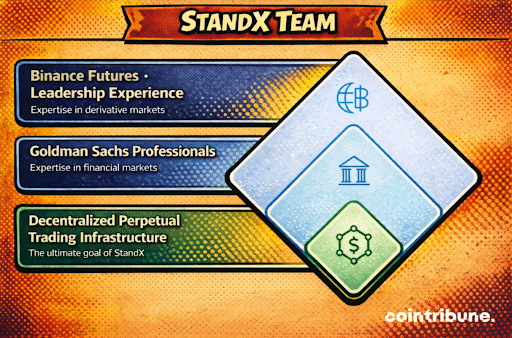
The protocol’s foundation relies heavily on the professional pedigree of its creators. Initiated in 2024 by Aaron Gong (AG) and Justin Cheng, the project leverages years of institutional CEX experience at Binance Futures. Their primary objective focuses on applying the operational standards of traditional centralized hubs to on-chain infrastructure.
Former Binance Futures leaders
Aaron Gong, previously serving as Head of Binance Futures CEX, helped scale a derivatives platform from an early-stage product into a global industry leader. Operating at this level provides direct exposure to the dynamics of massive trading platforms, which must process enormous volumes while maintaining stability. This practical insight into scaling perpetual markets directly informs the protocol’s current trajectory.
High-Performance Trading System Architecture
Justin Cheng, a former Binance Futures director, led the technical development of these systems. His expertise lies in engineering high-performance exchange architectures capable of sustaining active environments where orders interact with liquidity in real time. He was able to shape the technical backbone of this new decentralized platform by mastering order management, system throughput, and execution pathways.
Financial Expertise from Goldman Sachs
Beyond crypto-native engineering, the broader development team integrates financial professionals from Goldman Sachs. This addition introduces a critical perspective from traditional financial markets. By integrating institutional familiarity with market structure and risk management frameworks, the project benefits from a highly multidisciplinary foundation.
A Vision Combining Stablecoins and Perpetual Futures
Operationally, the team pursues a distinct objective: uniting synthetic stablecoins and decentralized perpetual trading within a single ecosystem, an approach closely linked to the $DUSD stablecoin APY within the platform’s broader system. By merging these two critical blockchain sectors, the platform creates an environment where stable value storage and derivatives trading interact seamlessly. This design promotes highly efficient capital usage for traders. Furthermore, rather than relying on venture capital, the founding team finances the project directly, reflecting a long-term commitment to the ecosystem’s organic growth.
Why the StandX Team Decided to Build a Perp DEX From Scratch
As DeFi expanded, numerous projects attempted to bring derivatives on-chain. However, a majority of these platforms use existing frameworks or modified versions of older protocols. While this method accelerates deployment, it introduces severe structural bottlenecks. To avoid such issues, the founders of the StandX system engineered their exchange architecture entirely from the ground up.
Limits of Forked DeFi Protocols
In the Web3 space, launching by forking existing smart contracts remains common practice. While suitable for standard automated market makers (AMMs) or lending pools, the developers of the protocol recognized that derivatives introduce far more complex technical requirements. Perpetual platforms must manage continuous order flow, dynamic margin calculations, and real-time liquidity interactions. Frameworks originally designed for basic token swapping are too inflexible to handle these intense conditions, which is why StandX’s team built their own, ensuring execution quality.
Building an Exchange Infrastructure In-House
Recognizing these constraints, StandX’s core engineering team bypassed copy-paste templates entirely. Developing the architecture internally grants the architects of the platform absolute control over critical components, from order routing to trade settlement. Consequently, their development process remains completely focused on the specific needs of derivatives traders, rather than forcing complex mechanics into outdated DeFi molds.
Designing a Trading Engine Adapted to Derivatives Markets
Perpetual futures require an engine capable of processing relentless market activity and volatile margin positions. Leveraging their profound industry experience, the technical team behind StandX designed the system to make it easy to organize orders clearly and ensure smooth interactions between users’ trades and the available liquidity. By custom-building this engine, they have successfully delivered trading conditions that closely align with those found on top-tier centralized exchanges like Binance Futures.
The Trading Infrastructure Behind StandX
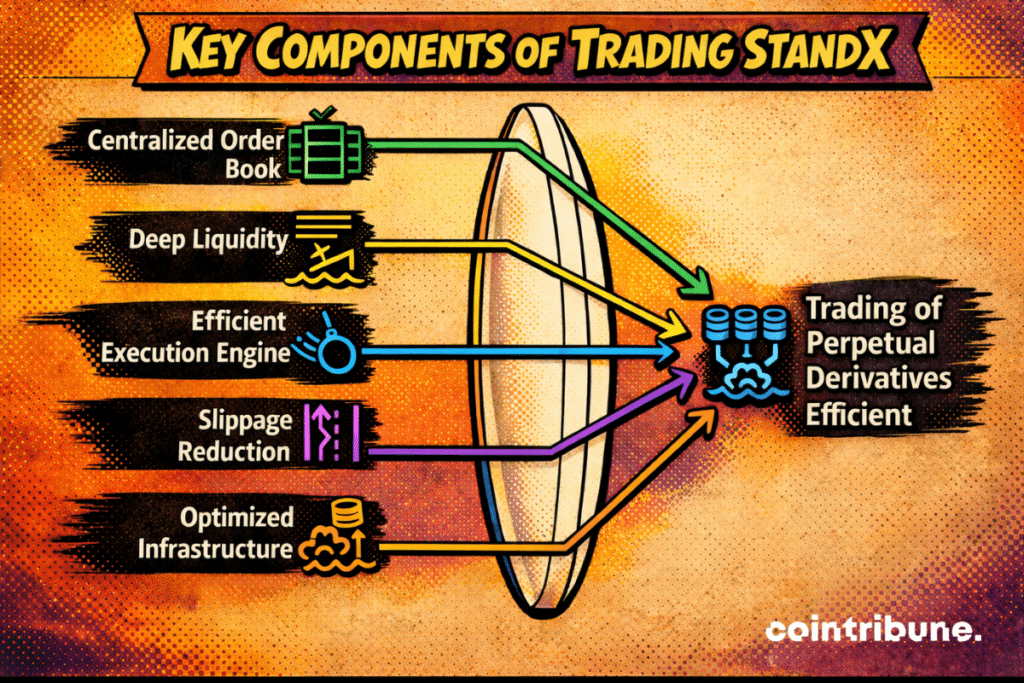
A high-functioning derivatives exchange relies on infrastructure that seamlessly connects incoming orders with deep liquidity. For perpetual markets, the underlying mechanics determine how efficiently your trades execute. StandX addresses these concerns directly by deploying specialized systems designed to optimize users’ market interaction.
Clean Orderbook Architecture
A well-structured orderbook acts as the heartbeat of any professional trading environment, dictating how buy and sell orders display, match, and settle. StandX uses a central limit orderbook model fully on-chain, with all transactions executed directly on the blockchain, allowing users to interact directly with the market through precise limit and market orders. This clarity provides traders with complete visibility into liquidity distribution across various price levels.
Liquidity Structure and Market Depth
Market stability relies on robust liquidity distribution. When volume concentrates near the current asset price, traders can execute large positions with minimal market impact and highly predictable pricing. StandX specifically organizes its liquidity to encourage deep market participation, helping users navigate shifting market depth smoothly as overall trading activity increases on the exchange and contributing to the rapid increase in daily volume.
Reducing Slippage in Perpetual Futures Trading
Slippage occurs when an order executes at a different price than intended, usually due to thin liquidity or sudden volatility. Minimizing this friction requires a delicate balance of market depth and orderbook efficiency. By focusing on well-organized liquidity, StandX’s system significantly reduces execution gaps, allowing traders to make precise entries and exits even in very volatile on-chain situations.
What Platforms Like StandX Indicate for the Evolution of DeFi Derivatives
The explosive growth of crypto derivatives continues to redefine digital asset markets. While centralized hubs still process the bulk of global volume, the decentralized sector is actively deploying comparable structures directly on-chain. As a result, industry professionals are successfully recreating institutional-grade environments within permissionless networks.
The Growing Interest in On-Chain Derivatives Markets
As perpetual futures solidify their position as the industry’s preferred trading instrument, developers face the challenge of migrating these markets to decentralized infrastructure while also expanding into new opportunities, such as perpetual contracts on precious metals within crypto-native derivatives ecosystems. Consequently, the space has seen a surge of Perp DEX models, each experimenting with novel approaches to collateral management, execution speed, and liquidity provision.
Centralized and Decentralized Trading Models
Currently, centralized entities provide the deepest liquidity pools due to their mature, legacy infrastructures. However, DeFi platforms offer compelling alternative architectures that operate without intermediaries. Rather than trying to outright replace centralized exchanges, modern protocols focus on adapting these proven trading mechanics to the blockchain, solving new technical challenges related to on-chain performance.
A New Phase for Perpetual DEX Development
As blockchain capabilities expand, the rise of orderbook-based decentralized exchanges such as StandX’s protocol marks a pivotal maturation phase for the industry. Initiatives led by traditional exchange veterans illustrate a clear trend: the strategic application of centralized trading expertise to build robust, decentralized ecosystems.
The Convergence of Centralized Exchange Expertise and DeFi Derivatives
The continuous development of derivatives infrastructure directly shapes the future of digital asset trading. As the market expands, the dividing line between centralized exchange proficiency and decentralized innovation becomes increasingly seamless. Projects like StandX demonstrate how professionals from large-scale trading environments actively contribute to the next generation of DeFi, a trend illustrated by the platform’s emergence among the leading perp DEXs in the world. By merging institutional finance strategies, high-performance engineering, and blockchain transparency, these platforms provide a glimpse into the future of the industry. Ultimately, this ongoing evolution helps establish a more sophisticated, accessible, and efficient on-chain financial landscape for traders worldwide.
Maximize your Cointribune experience with our "Read to Earn" program! For every article you read, earn points and access exclusive rewards. Sign up now and start earning benefits.

Journaliste et rédacteur web passionné par l’univers des cryptomonnaies et des technologies Web3. J’y traite les dernières tendances et actualités afin de proposer un contenu de haute qualité à un large public du secteur.
The contents and products mentioned on this page are in no way approved by Cointribune and should not be interpreted as falling under its responsibility.
Cointribune strives to communicate all useful information to readers, but cannot guarantee its accuracy and completeness. We invite readers to do their research before taking any action related to the company and to take full responsibility for their decisions. This article should not be considered as investment advice, an offer, or an invitation to purchase any products or services.
Investment in digital financial assets carries risks.
Read more