Zoom and Tinder partner with the World project to better identify users
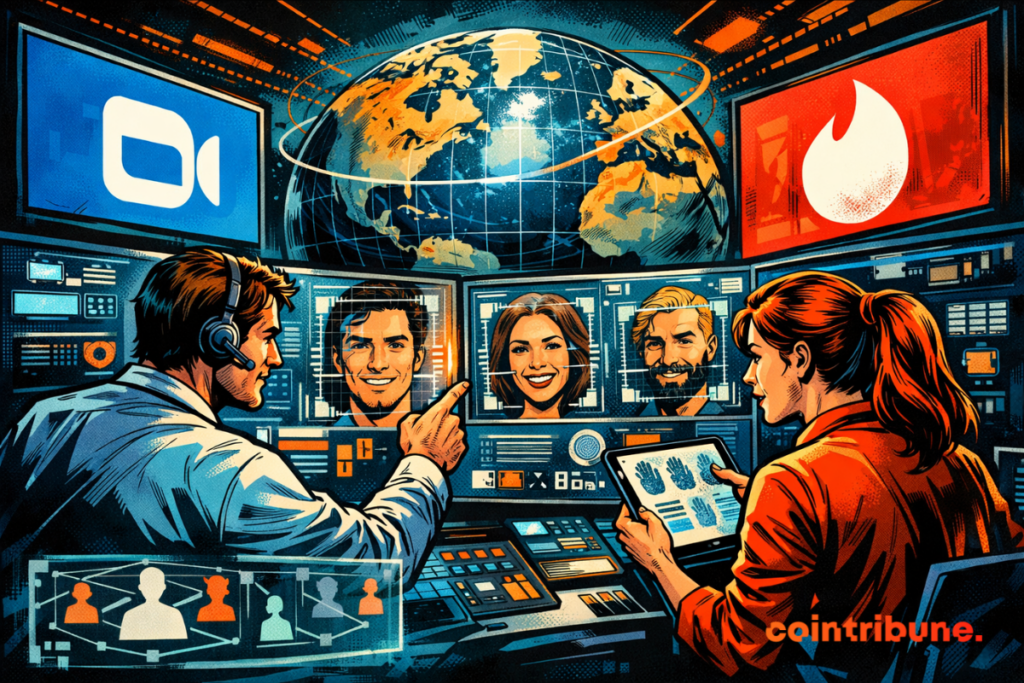
The company World presented a major update of World ID during an event in San Francisco. World’s announcement comes with new partnerships with platforms like Tinder, Zoom, and other digital players. In a context marked by the rise of bots, deepfakes, and artificial intelligence, the project strengthens its vision of large-scale proof of humanity. Thus, World accelerates the deployment of its digital identity infrastructure among users and businesses.
In brief
- World launches a major update of World ID to strengthen online proof of humanity.
- New partnerships with Tinder and Zoom expand user verification across multiple platforms.
- The system combines biometrics, dedicated app, and account-based architecture to secure digital identity.
- The goal is to limit bots, deepfakes, and AI-related abuses on the internet.
World ID evolves: infrastructure designed for human proof
First, the World project, supported by Sam Altman, unveils a major update to World ID. The company now presents its system as a comprehensive “proof of humanity” infrastructure. This evolution targets users, businesses, and artificial intelligence agents.
Next, this announcement comes in a context marked by the rise of bots and deepfakes. Furthermore, automated agents are increasingly present on the internet. In response to this trend, World seeks to offer a reliable solution to distinguish humans from machines.
Furthermore, this initiative is part of a broader strategy. It covers authentication, payments, and online services. Thus, World aims to structure an ecosystem centered on verified digital identity.
A technical overhaul focused on security and digital account management
Then, World introduces a redesigned architecture to improve security and privacy. The system now relies on an account-based identity. This approach also incorporates multi-key management and recovery mechanisms.
Meanwhile, the Orb device remains at the core of the operation. This tool scans the face and iris to generate a unique proof. According to World, images are deleted after processing. Only anonymized fragments circulate on a distributed network.
However, the use of biometric data raises questions. Some observers highlight privacy issues. Despite these concerns, the company claims to strengthen data protection at every stage.
Finally, World launches a dedicated World ID app, currently in beta. This app allows managing identity and authenticating easily. The goal, according to the company, is to make human verification as intuitive as a classic online login.
Partnerships with Tinder and Zoom to strengthen user verification
At the same time, World accelerates the integration of World ID on multiple mainstream platforms. The goal is to extend human verification to concrete and everyday uses.
On the consumer side, the company strengthens its partnerships with Tinder. Users can now display a “verified human” badge on their profile.
This feature aims to limit fake accounts and enhance trust. At the same time, World launches the Concert Kit. This tool allows artists to reserve tickets only for verified people. Thus, the solution directly targets bots involved in abusive reselling.
Additionally, the video game sector also attracts attention. World collaborates with Razer and Mythical Games to integrate identity solutions. Meanwhile, Reddit explores similar tools to detect bots.
On the business side, use cases multiply. World works with Zoom on a verification feature called “Deep Face.” This solution confirms that a participant is indeed human during a video call. Moreover, DocuSign integrates proof of humanity checks into digital signatures. This approach strengthens the security of online agreements.
Finally, World also develops “AgentKit,” a tool aimed at developers. This solution associates human proofs with automated agents linked to artificial intelligence. The goal is to secure sensitive actions and regulate interactions between humans and AI systems.
To support this strategy, the company collaborates with Okta, Vercel, and Browserbase. Together, they seek to create a trust layer without exposing personal data. During the announcement, Sam Altman mentioned a clear ambition. According to him, World ID could become a structuring network for the internet.
Thus, through these partnerships and tools, World gradually expands its presence. The integration of human verification in various services illustrates growing adoption in digital uses in the era of artificial intelligence.
Maximize your Cointribune experience with our "Read to Earn" program! For every article you read, earn points and access exclusive rewards. Sign up now and start earning benefits.

Journaliste et rédacteur web passionné par l’univers des cryptomonnaies et des technologies Web3. J’y traite les dernières tendances et actualités afin de proposer un contenu de haute qualité à un large public du secteur.
The views, thoughts, and opinions expressed in this article belong solely to the author, and should not be taken as investment advice. Do your own research before taking any investment decisions.