A Bitcoin fork project triggers a wave of criticism and divides the community
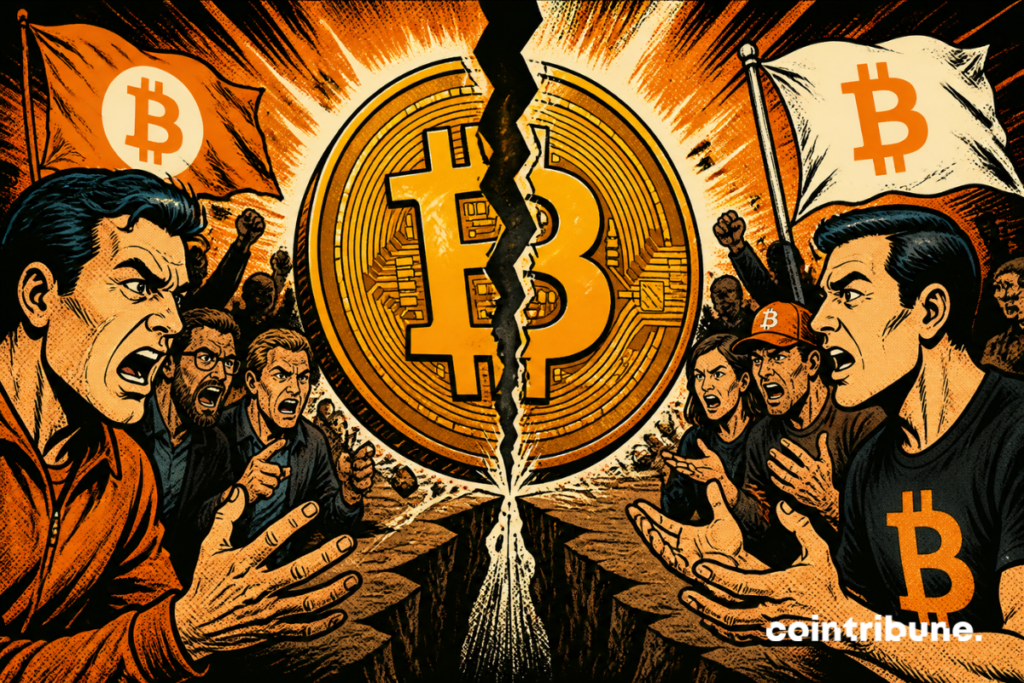
A new Bitcoin fork project reignites tensions within the ecosystem. Led by developer Paul Sztorc. The initiative named “eCash” does not just propose a basic parallel chain: it introduces technical and economic choices that directly affect fundamental principles of the network, notably the management of UTXOs and the controversial use of Satoshi Nakamoto’s historical holdings. Between promises of innovation and fears of misuse, the debate intensifies around the project.
In brief
- Paul Sztorc’s eCash project plans a Bitcoin hard fork with token distribution equivalent to BTC holders.
- Drivechains integration aims to extend uses (DeFi, privacy, prediction markets) but raises technical debates.
- Potential use of funds linked to Satoshi Nakamoto to finance the project crystallizes criticism.
- Several experts warn about major risks, including violations of property rights, dangerous precedents, and increased user exposure.
Bitcoin faces a new parallel chain project
The project announced by Paul Sztorc, founder and CEO of LayerTwo Labs, plans a hard fork at block height 964,000. This step should create a new chain called eCash, with its own native tokens. Holders would thus receive an equivalent balance on this separate network.
To limit confusion, a coin separation tool should accompany the launch. It would help users distinguish their BTC from the new eCash asset. Primarily, this measure aims to reduce errors during fund transfers.
The future chain would adopt almost the entire existing Bitcoin structure. However, it would integrate a major evolution: drivechains. Sztorc proposed this extension architecture in 2015 and then presented it to developers via BIP300 and BIP301.
According to him, eCash would not follow BCH’s logic in 2017. The project does not just seek to increase block size. It wants to offer a more sustainable solution without using the Bitcoin name in its branding. Moreover, a four-month notice should give the community time to prepare.
eCash fork: Drivechains at the center of the debate
The fork would also carry several technical projects already in development. Sztorc cited seven Drivechains, including a privacy chain inspired by Zcash. He also mentioned Truthcoin, CoinShift, and Photon.
These extensions would cover varied uses. Truthcoin would target prediction markets. CoinShift would operate as a decentralized exchange. Photon, on the other hand, would seek quantum computer resistance.
However, the most discussed point concerns launch funding. Sztorc wishes to use coins sent to equivalent Satoshi Nakamoto addresses on eCash. He believes this mechanism can attract investors before the fork.
The developer defends this approach with an operational argument. According to him, it would provide contributors a concrete incentive to act early. Without that, the project could become a “zombie project” delivered incomplete. It could also become more centralized, with excessive influence from a small circle of developers.
This proposal remains very sensitive as it touches on historical balances. By adopting the complete Bitcoin history, eCash would display the 1.1 million coins of Satoshi as an equivalent balance on the new chain.
A community divided over ownership and risks
The eCash hard fork project quickly triggered a wave of reactions within the Bitcoin ecosystem, revealing deep fault lines between supporters of experimentation and defenders of a strict interpretation of protocol rules.
This is notably the case regarding distributions based on UTXOs, which some consider risky for users. Sergio Lerner, co-founder of Rootstock Labs, adopts a particularly critical stance on this point. In a statement attributed to CoinDesk, he emphasizes:
I am firmly opposed to Paul’s fork, but not because it represents a ‘hostile Bitcoin fork’… eCash is a new blockchain… It does not directly take anything from Bitcoin holders. Distributing airdrops to UTXO owners does not help Bitcoiners and instead exposes them to significant risks.
Sergio Lerner, co-founder of Rootstock Labs. Source: CoinDesk
According to him, these mechanisms force holders to adopt potentially dangerous behaviors, such as moving funds from cold storage or interacting with unfamiliar software. An approach that, far from strengthening security or usefulness for Bitcoin users, instead rekindles tensions around fork models and management of historical assets.
At the same time, Jay Pollak, Head of Strategy at Sidechain Bitcoin VerifiedX, voices a more fundamental critique of attempts to reinterpret Bitcoin’s network properties.
It’s stunning to think someone could truly believe this is an excellent idea; you cannot break Bitcoin’s native ownership—that is completely contrary to what Bitcoin is.
Jay Pollak, Head of Strategy at Sidechain Bitcoin VerifiedX. Source: Coindesk
However, he warns that even indirect changes, notably via forks or derived mechanisms, could compromise the system’s essential guarantee.
Furthermore, other ecosystem players have adopted a harsher line of criticism, even raising accusations of theft. Bitcoin lawyer Peter McCormack denounced the project logic by stating, “Taking Satoshi’s coins is theft and disrespect, and eCash is already used for Lightning payments with Cashu and Fedi. These are bad choices.”
Josh Ellithorpe, CTO at Pixelated Ink, warns of the precedent such actions could create. In a post on X, he states, “eCash created a dangerous precedent, proving they can steal cryptocurrencies, and they will. Today it’s Satoshi’s, but it could be anyone’s. They also distorted reality regarding the BCH fork, hijacked another project’s name, and implemented no replay protection,” he warns, highlighting potential risks for all BTC holders.
Beyond technical considerations, the eCash project highlights a deeper rift within the Bitcoin community: how far can one innovate without betraying the network’s founding principles? This potential BTC fork exposes the ongoing tensions between experimentation and conservatism within the ecosystem, highlighting the conflict between ambitions for expansion through drivechains and concerns about ownership, security, and legal precedents.
Maximize your Cointribune experience with our "Read to Earn" program! For every article you read, earn points and access exclusive rewards. Sign up now and start earning benefits.

Journaliste et rédacteur web passionné par l’univers des cryptomonnaies et des technologies Web3. J’y traite les dernières tendances et actualités afin de proposer un contenu de haute qualité à un large public du secteur.
The views, thoughts, and opinions expressed in this article belong solely to the author, and should not be taken as investment advice. Do your own research before taking any investment decisions.