Bitcoin: A documentary revives the Satoshi Nakamoto enigma
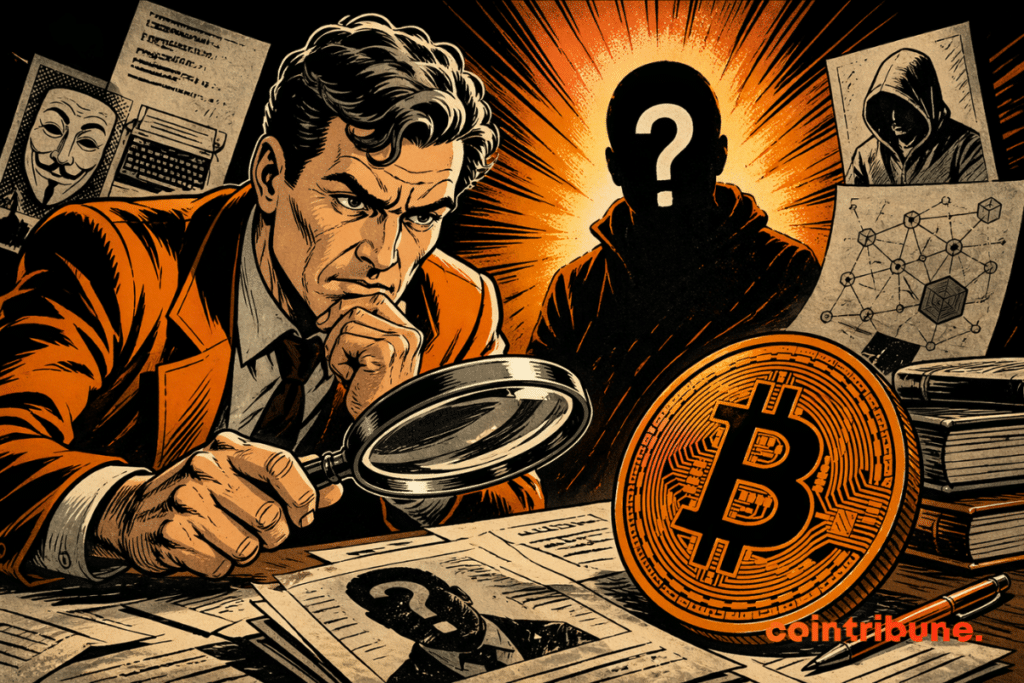
A shadow continues to hang over the history of bitcoin. Since its beginnings, the identity of Satoshi Nakamoto has fueled investigations, hypotheses, and debates in the crypto world. A new documentary, “Finding Satoshi,” revives this mystery with a central thesis: the creator of Bitcoin was a duo, not a single person. The film identifies Hal Finney and Len Sassaman as the two figures behind this pseudonym. Released Wednesday, it relies on four years of investigation, mixing testimonies, technical data, and biographical elements. Without providing definitive proof, the documentary builds a coherent scenario around a collective origin of BTC before its public disappearance.
In brief
- The documentary Finding Satoshi argues that bitcoin was not created by a single person, but by a duo made up of Hal Finney and Len Sassaman.
- According to this thesis, Hal Finney mainly developed the code, while Len Sassaman contributed to the writing, especially of the whitepaper.
- The film also places the birth of bitcoin in the universe of cypherpunks, PGP encryption, and the first ideas of digital currency.
- Even without definitive proof, the documentary seriously reignites the debate on Satoshi Nakamoto and the true origins of bitcoin.
Bitcoin: the duo thesis Hal Finney and Len Sassaman
The heart of the documentary rests on a precise division of roles. Conducted over four years by American economic writer William D. Cohan and private investigator Tyler Maroney, the investigation presented in “Finding Satoshi” argues that Hal Finney mainly designed the Bitcoin code. Len Sassaman focused more on the writing, notably that of the founding whitepaper. Thus, the film presents Satoshi Nakamoto as a collective signature, not as an isolated individual.
To support this interpretation, the investigators rely on several interviews. Fran Finney, Hal Finney’s widow, appears in the film. She acknowledges that her husband probably participated in BTC’s creation. On her side, Meredith L. Patterson, Len Sassaman’s widow, also reflects on her husband’s technical career.
Before arriving there, the filmmakers nevertheless explore several known leads. Adam Back, Nick Szabo, David Chaum, Paul Le Roux, and Wei Dai are among the names studied. However, the authors believe Finney and Sassaman better fit the profile sought. Their skills, their exchanges, and their technical environment strengthen this hypothesis about bitcoin.
The film also adds a methodological element. It does not just seek a famous face. It attempts rather to explain how BTC could have been born from complementary work shared between code, reflection, and writing. This approach significantly changes the usual framework of the debate.
Cypherpunks, PGP, and crypto roots
The documentary also places bitcoin in its original context. It indicates that the project fits into a culture already structured around encryption, privacy, and open systems. Cypherpunks play a central role here. This movement has long advocated for technology capable of protecting exchanges without a central authority.
Hal Finney and Len Sassaman knew this universe deeply. Both worked around PGP, a major tool for encrypting emails. This point weighs heavily in the authors’ reasoning. According to them, bitcoin was not born from a sudden inspiration but from an already mature intellectual soil.
The film also goes back to several ideas predating bitcoin. It notably cites Hashcash, created by Adam Back, as an important building block of the proof-of-work mechanism. In parallel, it mentions the extropians and other technophile communities who already imagined forms of digital currency. From there, the documentary draws a landscape where several influences converge toward BTC.
This contextualization gives coherence to the dual thesis. Finney appears as a credible profile for the technical architecture. Sassaman is more rooted in the culture of language, encryption, and activist networks. Together, they represent a combination the film judges compatible with bitcoin’s history.
The rest of the file…
The authors complete their investigation with external analyses. A former FBI agent evaluates the possible motivations of the whitepaper’s writer. According to her analysis, bitcoin’s founder did not seem driven by money. This point fuels the debate, as the fortune attributed to Satoshi remains immense and largely unmoved.
They also present a notable limitation. At one precise moment, Satoshi was exchanging emails while Hal Finney participated in a race in California. For the investigators, this divergence does not destroy the thesis. On the contrary, it supports the idea of a tandem behind bitcoin, with divided tasks.
As it stands, “Finding Satoshi” therefore does not provide definitive proof. However, it refocuses the investigation on two major figures in modern cryptography. In the coming months, this lead could revive the historical research on the origins of bitcoin. For now, the mystery remains whole, but the debate gains a new structure, more precise and better documented.
Maximize your Cointribune experience with our "Read to Earn" program! For every article you read, earn points and access exclusive rewards. Sign up now and start earning benefits.

Journaliste et rédacteur web passionné par l’univers des cryptomonnaies et des technologies Web3. J’y traite les dernières tendances et actualités afin de proposer un contenu de haute qualité à un large public du secteur.
The views, thoughts, and opinions expressed in this article belong solely to the author, and should not be taken as investment advice. Do your own research before taking any investment decisions.