An American soldier arrested for betting on Polymarket linked to the operation against Nicolas Maduro
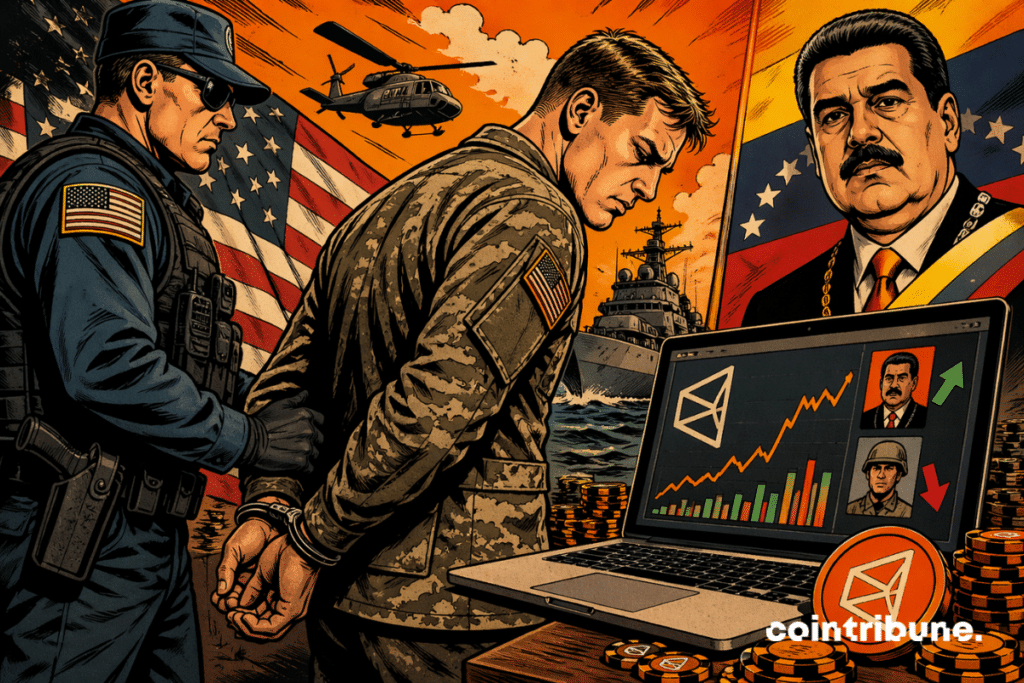
Predictive markets enter a new risk zone. The arrest of an American soldier for betting on Polymarket linked to an operation against Nicolás Maduro shows that the boundary between information and exploitation can quickly disappear.
In brief
- A soldier used classified information to bet on Polymarket.
- He generated more than $400,000 in a few hours.
- The case revives the debate on predictive markets.
An arrest that exposes a new use of predictive markets
An American soldier was arrested after winning more than $400,000 on Polymarket using classified information related to an operation against Nicolás Maduro. The case marks a turning point. It shows that these platforms are no longer just anticipation tools. They also become grounds for abuses.
The man, directly involved in the operation, did not simply speculate. He acted with privileged information. A few hours before the intervention, he placed more than $33,000 in bets on Polymarket. The timing is precise. The result was known in advance to him. The gain exceeded $400,000 in a few hours.
This is not intuition. This is not analysis. This is direct exploitation of confidential data. And this is precisely what moves the case into the criminal domain.
When secret information becomes a profit lever
The heart of the problem is simple. Predictive markets like Polymarket rely on the circulation of information. But here, this information was not public. It came from an ongoing military operation. The U.S. Department of Justice speaks of a serious breach of trust. The soldier used his position to turn a sensitive mission into a financial opportunity. This logic strongly recalls insider trading in stock markets.
But the difference is significant. In this case, the asset is not a company. The asset is a real event. An arrest. A military operation. A geopolitical fact. This shift changes the nature of the risk. Predictive markets become sensitive to actors capable of influencing or directly anticipating events. This creates extreme information asymmetry.
The Polymarket platform reacted quickly. It claims to have identified the user and collaborated with authorities. It insists on one point: the system worked because a report was made. But this response does not solve the core problem. The very structure of these platforms remains permissive. The lack of strict KYC allows users to operate with few constraints.
Even with the rules updated in March 2026 against trading based on direct influence, their application remains limited. Detection often occurs after gains, rarely before. In this case, the suspect reportedly tried to delete his account and move the funds.
This behavior reveals a classic flaw of open systems like Polymarket. Some defend these platforms as anticipation tools, while Polymarket and Kalshi seek to expand their activity to derivatives products. Others see it as an abuse. The reality is more nuanced. But one thing is certain: this case changes the perception of risk.
Maximize your Cointribune experience with our "Read to Earn" program! For every article you read, earn points and access exclusive rewards. Sign up now and start earning benefits.
Enseignante et ingénieure IT, Lydie découvre le Bitcoin en 2022 et plonge dans l’univers des cryptomonnaies. Elle vulgarise des sujets complexes, décrypte les enjeux du Web3 et défend une vision d’un futur numérique ouvert, inclusif et décentralisé.
The views, thoughts, and opinions expressed in this article belong solely to the author, and should not be taken as investment advice. Do your own research before taking any investment decisions.