Bitcoin: 12 Years Later, Hal Finney Still Fascinates the Crypto World
Twelve years after his death, Hal Finney remains an inseparable part of Bitcoin’s history. The cryptographer received the very first BTC transaction sent by Satoshi Nakamoto on January 12, 2009. Ten bitcoins to test a network that practically had no value yet. Today, those 10 BTC would be worth more than 800,000 dollars. And another question still refuses to disappear: Did Finney really know Satoshi’s identity?
In brief
- Hal Finney received the first bitcoins sent by Satoshi Nakamoto in January 2009.
- He was already working on cryptography and digital currencies long before Bitcoin.
- Theories presenting him as Satoshi still circulate twelve years after his death.
Bitcoin owes him its first transaction
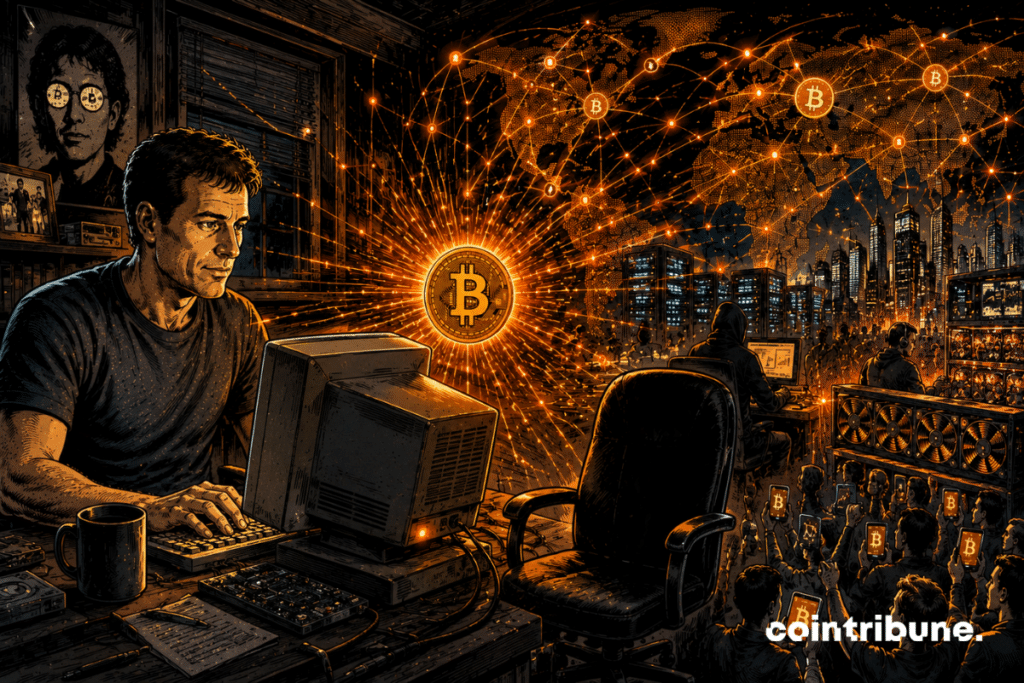
On January 12, 2009, Satoshi Nakamoto sent 10 BTC to Hal Finney. The network was then only a few days old. No exchange. No ETF. And not really any price either. Finney had downloaded the Bitcoin software very early and was exchanging directly with Satoshi on how it worked. He reported bugs and participated in the first tests.
Two days earlier, he had published a now-famous message: “Running Bitcoin.” At the time, nothing guaranteed that the project would survive more than a few weeks. However, Finney did not come out of nowhere.
Since the 1990s, he belonged to the cypherpunk movement, a community of developers who used cryptography to defend privacy and freedom on the Internet. He also worked at PGP Corporation, around the encryption software Pretty Good Privacy. In 2004, he developed Reusable Proofs of Work, or RPOW. Five years before Bitcoin.
Hal Finney had already worked on post-cash
RPOW remains one of the reasons why his name regularly comes up when telling the origins of Bitcoin. The system allowed the creation and transfer of digital proofs of work. It didn’t have all the features of Bitcoin, but several ideas are found in the currency later imagined by Satoshi.
Finney was therefore already thinking about digital scarcity. There was also a look back at RPOW as one of Bitcoin’s technical ancestors. His career makes the follow-up all the more special. When Satoshi published the white paper in October 2008, Finney had exactly the profile of the person likely to be interested: cryptographer, cypherpunk, developer, and already familiar with experimental digital currencies.
He answered the call. Then his health deteriorated. Finney learned in 2009 that he suffered from amyotrophic lateral sclerosis. The disease progressed rapidly. In 2013, he said he was almost completely paralyzed. He nevertheless continued to program with adapted devices.
Hal Finney died on August 28, 2014, in Phoenix, at 58. His body was then cryopreserved by the Alcor Life Extension Foundation, according to the provisions he had taken. Bitcoin was then worth a few hundred dollars.
The Satoshi mystery refuses to disappear
Just look at his career to understand why the theories continue. Finney had the skills. He was present from the first days. He knew the code. And he received the first transaction from Satoshi. And for several years, he even lived in the same city as a man named Dorian Satoshi Nakamoto, another character later associated with the mystery.
That’s a lot of coincidences. None constitute proof. Finney always denied having created Bitcoin. Known exchanges between him and Satoshi also show two distinct interlocutors, even if some continue to think they might have been fabricated.
In April, a documentary again revived the theory presenting Hal Finney and Len Sassaman behind Satoshi Nakamoto. Still no cryptographic proof. Twelve years after his death, Finney therefore retains a rather special place. He can be told without any theory about Satoshi and remain one of the most important figures in Bitcoin.
First recipient. First tester. And probably one of the few humans to have exchanged directly with Satoshi when Bitcoin was still worth almost nothing. The 10 BTC of January 2009 would exceed 800,000 dollars today. The transaction itself is worth much more in the history of Bitcoin.
Maximize your Cointribune experience with our "Read to Earn" program! For every article you read, earn points and access exclusive rewards. Sign up now and start earning benefits.

Fascinated by Bitcoin since 2017, Evariste has continuously researched the subject. While his initial interest was in trading, he now actively seeks to understand all advances centered on cryptocurrencies. As an editor, he strives to consistently deliver high-quality work that reflects the state of the sector as a whole.
The views, thoughts, and opinions expressed in this article belong solely to the author, and should not be taken as investment advice. Do your own research before taking any investment decisions.