Bitcoin: Spot ETF Withdrawals Reach an Unprecedented Level in November
The cryptocurrency market is going through a new zone of turbulence. In November, American spot ETFs recorded unprecedented capital outflows, while Bitcoin struggles to maintain its recent gains. Cumulative withdrawals now reach 4.71 billion dollars, exceeding the previous monthly record. This pressure occurs in a context marked by the decline of technology stocks and concerns over American interest rates. Several price levels therefore become particularly important for investors.

In brief
- American Bitcoin spot ETFs record 570 million dollars in net outflows, their fifth consecutive day of withdrawals.
- Cumulative outflows in November reach 4.71 billion dollars, exceeding the previous record of 4.5 billion set in June.
- The IBIT fund from BlackRock alone accounts for 509 million dollars of withdrawals.
- Bitcoin returns near 60,000 dollars, while American rates and inflation data further threaten risky assets.
Bitcoin ETFs Record 4.71 Billion Dollars in Outflows
The trend of American exchange-traded funds confirms the decline in investor interest. According to data from Farside Investors, the spot ETFs recorded 570 million dollars in net outflows. This new drop marks a fifth consecutive session of withdrawals according to Farside Investors data. The IBIT fund from BlackRock alone concentrates 509 million dollars of these movements.
Cumulative outflows since the beginning of the month now reach 4.71 billion dollars. This amount exceeds the previous record of 4.5 billion set in June. American funds thus experience their worst monthly performance since their launch. This evolution accompanies the drop in bitcoin and reflects a reduction in exposure by some institutional investors.
Adam Haeems, head of asset management at Tesseract Group, highlighted this correlation to CoinDesk. According to him, Bitcoin declined in seven of the eight American sessions following Jensen Huang’s departure. He also specified that each drop observed last week coincided with ETF outflows. For Haeems, the latest flows represent an important first test to measure the strength of the rebound.
Bitcoin Under Pressure After the Decline of Technology Markets
After briefly surpassing 64,000 dollars on Monday, the price fell back around 60,000 dollars. This evolution occurs on the day of Jensen Huang’s return as head of Nvidia. The reintegration of the leader had contributed to approximately a 6.8% rise in the Nasdaq 100. However, equity markets then lost momentum, while micro futures contracts on the index declined by 1.3%.
The level of 60,000 dollars now constitutes an important threshold to monitor. If Bitcoin manages to maintain this price until the American close, the bearish scenario mentioned by Haeems could lose strength. Conversely, a sustained break below this threshold would bring back into view the two-year low. This is located below 55,500 dollars, the level reached the previous week.
American monetary conditions add additional pressure on risky assets. A 25 basis points rise of Fed rates in December now seems almost certain. Moreover, the yield of two-year Treasury bonds nears 4.7%, while the dollar reaches its highest level since March 2025. This combination reduces the appeal of Bitcoin and other investments exposed to market variations.
Inflation, Fed Rates and Technical Signals to Watch
Upcoming economic releases could still modify investors’ expectations. Consumer confidence data should be published today, before the PCE inflation report expected tomorrow. Figures higher than forecasts could revive bets on a 50 basis point rate hike. Markets will therefore closely monitor these indicators to assess the American monetary trajectory.
On the weekly chart, the price currently moves around the Fibonacci level of 0.618. Meanwhile, the RSI index falls to around 34, just above the threshold of 30. This last level often corresponds to an oversold condition. These indicators suggest a possibility of a technical rebound, without confirming a lasting reversal.
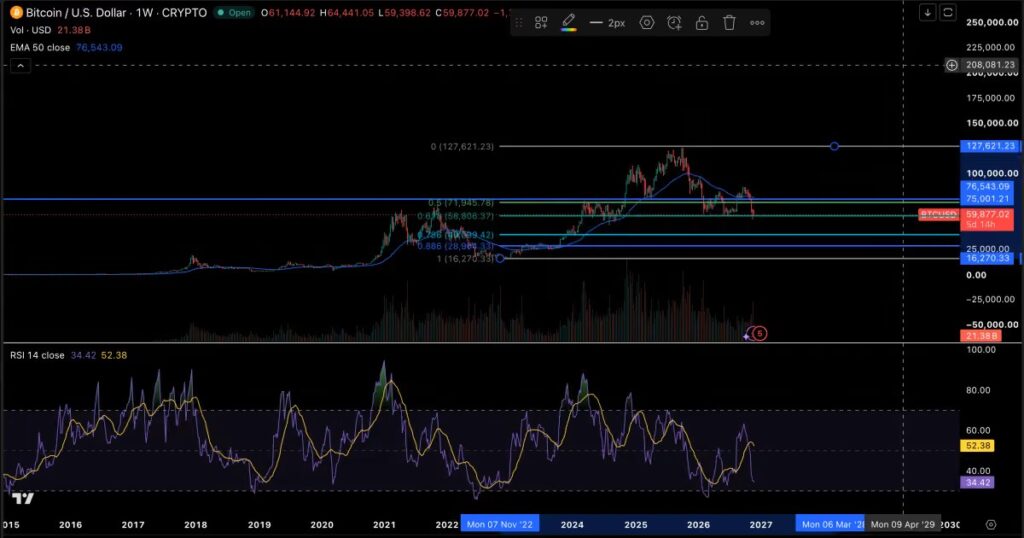
The price remains, however, below its 50-week exponential moving average, located at 76,500 dollars. This gap reminds that the underlying trend still shows signs of weakness. A rebound could therefore simply indicate a pause in the decline, rather than a solid recovery. Future ETF flows and economic data will help better evaluate this evolution.
Bitcoin’s evolution will therefore depend not only on its ability to defend the 60,000 dollars, but also on the behavior of institutional investors. If withdrawals slow down, the market could regain some short-term stability. Otherwise, a new drop towards previous supports would remain possible.
Maximize your Cointribune experience with our "Read to Earn" program! For every article you read, earn points and access exclusive rewards. Sign up now and start earning benefits.

Journaliste et rédacteur web passionné par l’univers des cryptomonnaies et des technologies Web3. J’y traite les dernières tendances et actualités afin de proposer un contenu de haute qualité à un large public du secteur.
The views, thoughts, and opinions expressed in this article belong solely to the author, and should not be taken as investment advice. Do your own research before taking any investment decisions.