Bitcoin: Two Major Forks Set to Shake August 2026
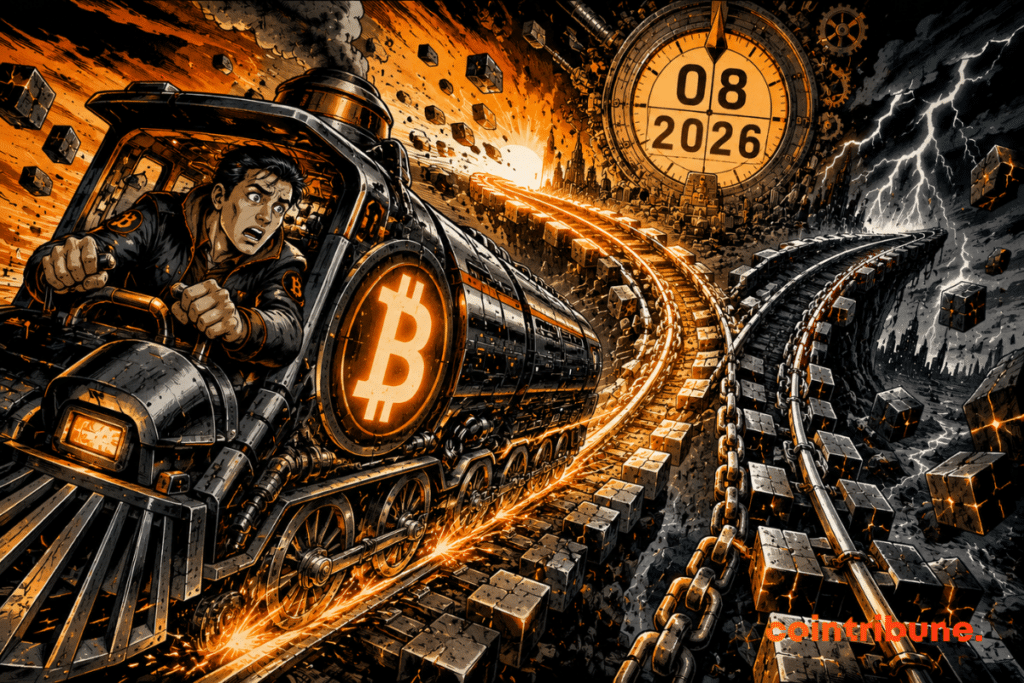
Bitcoin is approaching two major forks scheduled for August 2026. The first, BIP-110, aims to limit certain data recorded on the network. The second, eCash, aims to create a separate chain with new rules. Two very different projects, but the same risk: reigniting the debate about what Bitcoin should remain.
In brief
- Bitcoin is facing two distinct forks in August 2026.
- BIP-110 aims to limit certain data recorded on the network.
- eCash aims to create a separate chain with an asset distributed to BTC holders.
Bitcoin faces two very different forks
Bitcoin could experience a more political than technical August. The first case concerns BIP-110, a Bitcoin fork of the soft fork type. It seeks to temporarily tighten certain rules without automatically creating a new currency.
The second case concerns eCash. This time, it is an acknowledged hard fork. The project does not seek to modify Bitcoin from within. It wants to create a separate chain, with its own asset, distributed to BTC holders at the moment of separation.
The difference is crucial. A soft fork remains compatible with old nodes if the activation goes smoothly. A hard fork, on the other hand, creates a break. Nodes that do not follow the new rules reject the new chain. BIP-110 targets uses linked to Ordinals, inscriptions, and BRC-20 type tokens. Its goal is to limit certain forms of data integration in Bitcoin transactions.
The proposal would invalidate several technical constructions deemed too heavy. It would notably limit certain witness elements, some scriptPubKey outputs, and the use of undefined Taproot versions. The stated goal is to refocus Bitcoin on its monetary function.
This debate is not new. Since the arrival of Bitcoin Ordinals, part of the community believes that non-financial data unnecessarily clogs blocks. Others on the contrary defend the idea that a block paid for by fees must remain neutral. BIP-110 adds a nuance: it would be temporary. The expected duration is around one year. This is not enough to calm critics, because embedding this type of filter in consensus remains a heavy precedent.
eCash wants to create a new chain
The eCash project is led by Paul Sztorc, known for his work on Drivechain. Unlike BIP-110, eCash does not depend on adoption by the main Bitcoin network. It must exist as a separate chain.
The launch is scheduled around block 964,000, likely August 21. BTC holders would receive an equivalent balance on eCash. A coin separation tool is planned to avoid errors between the two assets.
eCash’s big promise is based on Drivechains. These mechanisms, linked to BIP-300 and BIP-301, would allow connecting multiple sidechains to a model close to Bitcoin. Targeted uses range from privacy to specialized markets, including financial experiments.
But the project is already divisive. Some see it as a way to test functions impossible to integrate into Bitcoin Core. Others denounce a risk of confusion, new fragmentation, and controversial economic choices around some old UTXOs.
Bitcoin holders must remain cautious
For BIP-110, there is no new asset to claim if activation follows the classic scenario. The main issue concerns wallet, node, and transaction compatibility using advanced constructions.
Miner signaling levels remain low. This reduces chances of smooth activation but does not eliminate the risk of tension. A difficult coordination period between miners, exchanges, and nodes could be enough to create uncertainty.
For eCash, the situation is different. Bitcoins held on a platform or ETF will not necessarily give rights to the new asset. Exchanges can choose not to credit anything, or only allow withdrawals later.
Self-custody users will have more control but also more responsibilities. Reliable tools, replay protection, and clear wallet support must be awaited before any claim attempt.
These two forks remind us that Bitcoin remains a living system. Its strength does not only come from its code. It also depends on social coordination between miners, developers, holders, companies, and institutions. August 2026 may not decide Bitcoin’s future, but it will once again test its capacity to absorb disagreements without losing its course. The eCash project will especially show if a fork can still mobilize a real economic base in a market now dominated by ETFs and major custodians.
Maximize your Cointribune experience with our "Read to Earn" program! For every article you read, earn points and access exclusive rewards. Sign up now and start earning benefits.

Enseignante et ingénieure IT, Lydie découvre le Bitcoin en 2022 et plonge dans l’univers des cryptomonnaies. Elle vulgarise des sujets complexes, décrypte les enjeux du Web3 et défend une vision d’un futur numérique ouvert, inclusif et décentralisé.
The views, thoughts, and opinions expressed in this article belong solely to the author, and should not be taken as investment advice. Do your own research before taking any investment decisions.