Bitcoin under pressure: Oil and the Fed dictate the trend
The financial market is going through a period of strong turbulence. Indeed, international tensions are shaking the global economy. Currently, Bitcoin is experiencing significant instability. Analysts observe that macroeconomics now drives the course of this digital currency. Consequently, technical fundamentals matter much less today. Investors are closely monitoring global political decisions instead. Ultimately, these external factors dictate the overall trend across the entire sector.

In brief
- Geopolitics takes control of the markets: tensions in the Middle East, soaring oil prices, and falling stock indexes heavily weigh on Bitcoin.
- Rising oil fuels inflation and pushes the Fed to maintain a strict monetary policy, which reduces liquidity and slows down the momentum of bitcoin and risky assets.
- Institutionals withdrawing: despite some recent inflows, major investors remain cautious, increasing volatility and weakening the entire crypto market.
Geopolitical tensions: the impact on Bitcoin’s price
Recent attacks in the Middle East worry traditional markets. First, the bitcoin price slid below $65,000 this weekend. Then, buyers quickly brought the price back up to $67,000. However, the Strait of Hormuz remains completely closed to commercial ships.
In its article posted on X, the algorithmic trading firm Wintermute estimates that this maritime blockade prolongs the current international crisis. The airspace above the Gulf region experiences severe restrictions.
On one hand, some political leaders hope for a very quick resolution. However, other officials foresee a much longer conflict. Moreover, traditional finance reacts strongly to these unexpected events. The oil barrel gains 9% almost instantly, according to reports. Gold adds a trillion to its total valuation very rapidly. Meanwhile, the US stock index falls sharply. In summary, fear spreads among all global economic actors, Wintermute’s report indicates.
Oil, Fed and Bitcoin: inflationary pressure weakens markets
First, the surge in oil reignites global inflation and increases the energy bill. Wintermute reports that the barrel recently surpassed $80, with projections up to $100. In this context, more expensive energy mechanically causes a widespread price increase. This inflationary dynamic is settling durably and weighs on the cost of living.
Consequently, digital assets are not spared. Bitcoin indirectly undergoes this macroeconomic pressure, often underestimated by traders. Thus, the high energy cost slows investment appetite and strengthens risk aversion.
Then, facing persistent inflation, the US Federal Reserve adopts a wait-and-see stance. Rate cuts are postponed, which has frozen financial markets for several months. As a result, this monetary caution penalizes stocks and directly affects the crypto sector. Maintaining high benchmark rates limits liquidity access and reduces the appeal of risky assets. Ultimately, bitcoin moves at the pace imposed by traditional finance, while hopes of monetary easing gradually fade.
Institutional investors desert cryptocurrency
Wintermute notes that capital flows show highly contradictory directions. Last week, index funds attracted a billion dollars. However, annual withdrawals still exceed 4.5 billion dollars in total. Demand from major financial players remains negligible currently. Trading volume plunges compared to last autumn’s peaks. Moreover, price fluctuations increase quite spectacularly. The volatility index jumps strongly on specialized platforms.
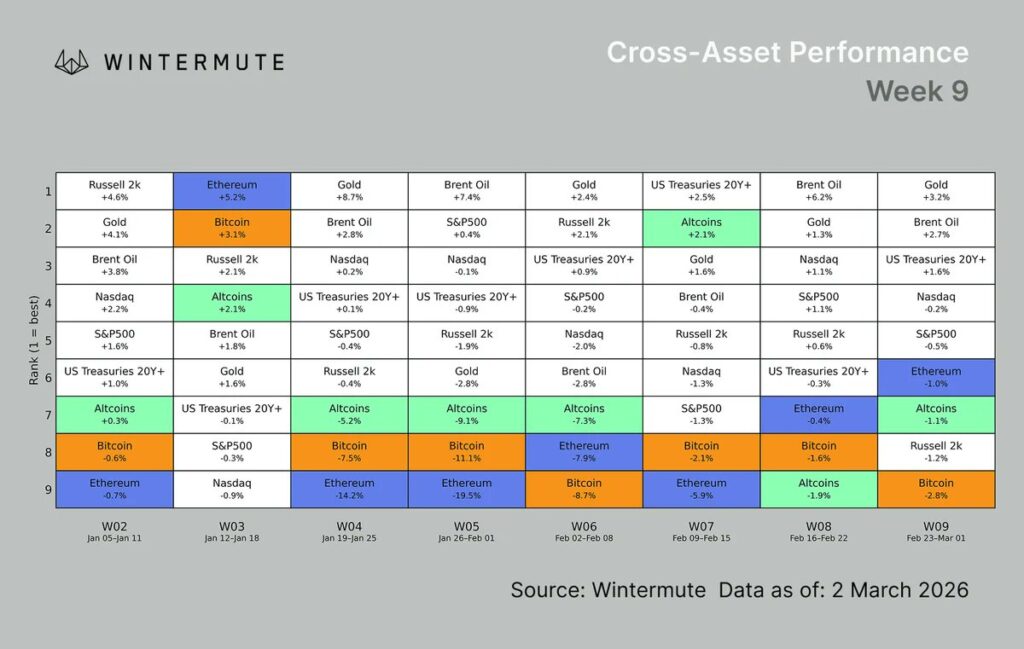
Daily fluctuations astonish many financial experts today. Meanwhile, speculators massively buy protection contracts against declines. Finally, alternative currencies struggle to find a durable positive rebound. The vast majority of secondary tokens show rather disappointing results. In summary, the absence of professionals weakens this entire financial ecosystem.
The virtual market is going through a very complex and uncertain period. Nevertheless, current prices already reflect much bad macroeconomic news. The bitcoin price has lost 45% since its all-time high. Speculators flee the sector quickly during major drops. Conversely, long-term holders wisely keep their portfolios.
Looking ahead, analysts identify a very strategic buying zone. A token priced between $40,000 and $50,000 attracts experts’ attention. This level offers an intriguing profit potential over about eighteen months. In conclusion, moderation guides all strategies amid current global crises.
Maximize your Cointribune experience with our "Read to Earn" program! For every article you read, earn points and access exclusive rewards. Sign up now and start earning benefits.

Journaliste et rédacteur web passionné par l’univers des cryptomonnaies et des technologies Web3. J’y traite les dernières tendances et actualités afin de proposer un contenu de haute qualité à un large public du secteur.
The views, thoughts, and opinions expressed in this article belong solely to the author, and should not be taken as investment advice. Do your own research before taking any investment decisions.