BRICS Challenge Dollar Dominance In Energy Markets
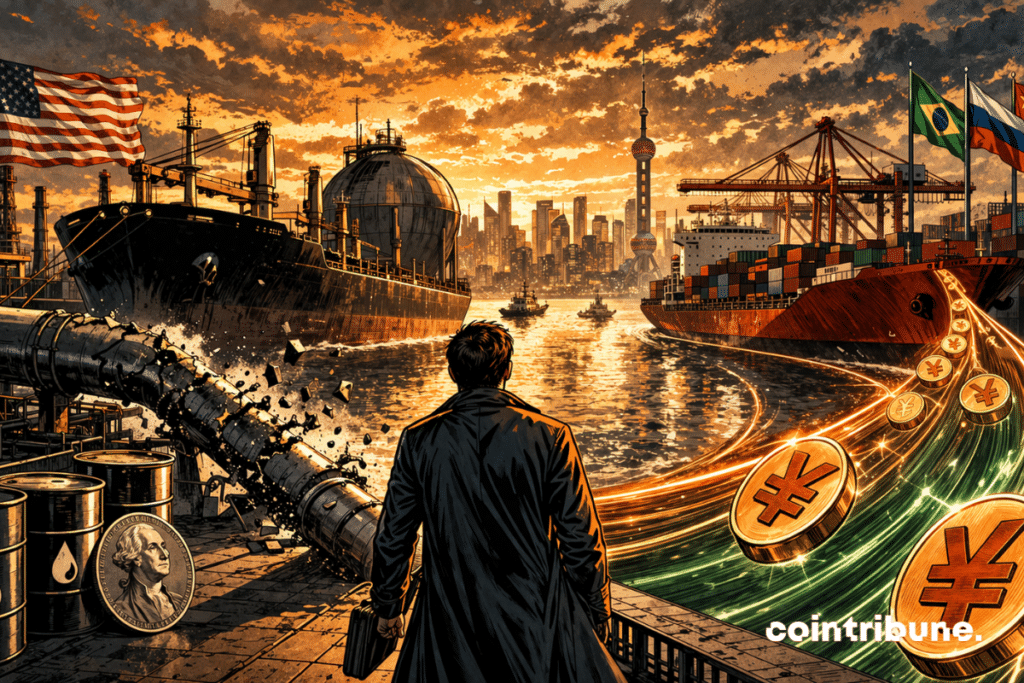
Oil, a historic pillar of the dollar, is beginning to slip away from it. Through a series of discreet but strategic agreements, the BRICS accelerate a shift that undermines the established monetary order. The yuan is gradually asserting itself in energy trade, supported by new financial infrastructures. Between geopolitical rivalries and the reconfiguration of global flows, this dynamic opens a breach in the dominance of the greenback and signals a profound mutation in the international monetary system.
In Brief
- The oil market is initiating an unprecedented shift with the emergence of the yuan in energy transactions.
- The BRICS accelerate de-dollarization by directly bypassing the dollar in their strategic exchanges.
- Countries like India and Iran adopt yuan payments, illustrating a concrete change in global trade.
- Despite this dynamic, the dollar retains a dominant position, revealing a gradual transition to a multipolar order.
Oil Shifts Out of the Dollar
The challenge to the petrodollar now materializes in concrete transactions between major energy powers. Several BRICS countries are intensifying the use of the yuan in their trades, thereby bypassing traditional circuits dominated by the dollar.
This movement takes place in a context of geopolitical tensions where the American currency is seen as an instrument of influence. Vladimir Putin summarizes this perception by stating: “The United States has turned the dollar into a weapon”.
This view is shared by some Western analysts. David Lubin, a researcher at Chatham House, observes that “this growing feeling that the dollar is used as a weapon partly explains why its dominance is increasingly questioned…”.
Behind these remarks, a tangible evolution emerges: the increasing use of alternative currencies in strategic exchanges, especially in the energy sector, historically structured around the greenback.
- India purchased about 60 million barrels of Russian oil in March, some of which was paid directly in yuan ;
- Indian Oil Corporation made payments without dollar conversion, marking a technical break in energy transactions ;
- Iran now charges its tolls in the Strait of Hormuz in yuan, amounting to about 2 million dollars per passage, over an area representing nearly 20 % of the world’s oil.
An Alternative Financial Architecture Takes Shape
Beyond oil transactions, a deeper transformation is underway: the construction of a parallel financial system. The mBridge platform has already handled 387.2 billion yuan (approximately 55 billion dollars), 95% of which was in digital yuan, while the Chinese payment system CIPS recorded 245,000 billion dollars in transactions in 2025.
These infrastructures provide concrete alternatives to circuits dominated by the dollar, allowing participating BRICS countries to reduce their reliance on the Western financial system.
At the same time, macroeconomic indicators confirm this evolution. The dollar’s share in global reserves has dropped from 71% to 56.3% since 2008, while central banks have accumulated more than 1,000 tons of gold per year for the past three years. Despite this, the greenback retains a dominant position, still representing 89.2% of transactions in the foreign exchange market, and the yuan is constrained by Chinese capital controls.
This dynamic paves the way for a more fragmented monetary system. Projections mention an upcoming balance among several poles, dominated by the dollar, the euro, and the yuan. While the shift remains gradual, the observed changes in energy trade and financial infrastructures indicate that the transition is already underway, with lasting implications for the global economic order.
Maximize your Cointribune experience with our "Read to Earn" program! For every article you read, earn points and access exclusive rewards. Sign up now and start earning benefits.

Diplômé de Sciences Po Toulouse et titulaire d'une certification consultant blockchain délivrée par Alyra, j'ai rejoint l'aventure Cointribune en 2019. Convaincu du potentiel de la blockchain pour transformer de nombreux secteurs de l'économie, j'ai pris l'engagement de sensibiliser et d'informer le grand public sur cet écosystème en constante évolution. Mon objectif est de permettre à chacun de mieux comprendre la blockchain et de saisir les opportunités qu'elle offre. Je m'efforce chaque jour de fournir une analyse objective de l'actualité, de décrypter les tendances du marché, de relayer les dernières innovations technologiques et de mettre en perspective les enjeux économiques et sociétaux de cette révolution en marche.
The views, thoughts, and opinions expressed in this article belong solely to the author, and should not be taken as investment advice. Do your own research before taking any investment decisions.