China Targets Strategic US Defense And Technology Sectors
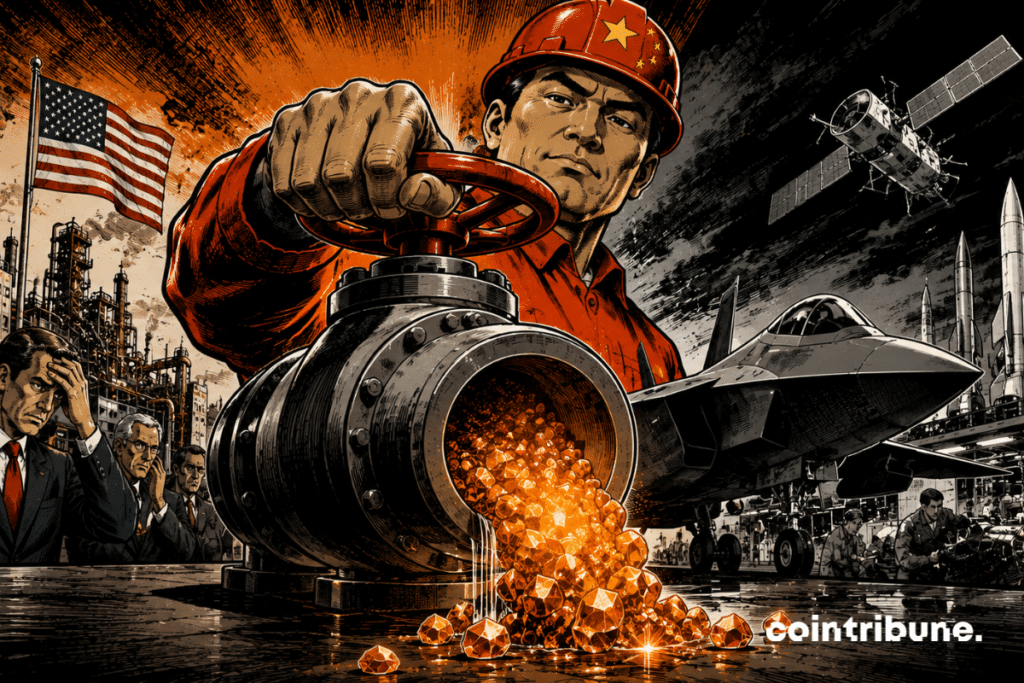
The growing entanglement of national security, technological supply chains and financial sovereignty is profoundly changing global macroeconomic balances. Financial markets and the crypto ecosystem were beginning to observe signs of institutional stabilization when a major diplomatic rupture just occurred. On Monday, June 22, China officially ended the trade truce by announcing massive sanctions against dozens of American companies linked to the strategic sectors of defense and rare earths. Beijing’s offensive revives economic hostilities with Washington and threatens to strangle high-tech industries that depend on these essential raw materials for advanced infrastructures.
In brief
- China abruptly ends trade truce with the United States by announcing a series of sanctions targeting American companies active in defense, robotics, and rare earths.
- Beijing bans exports of dual-use products to several strategic American companies, increasing pressure on sectors heavily dependent on Chinese supply chains.
- A second wave of measures hits Chinese public markets, excluding dozens of American companies in aerospace, defense, and advanced technologies.
- This escalation marks the breakdown of diplomatic efforts undertaken over several months between Washington and Beijing, despite recent discussions on rare earths and bilateral trade.
Beijing’s retaliation : China’s blockade of dual-use technologies
While a trade agreement between China and the United States rekindled optimism, Beijing’s decision directly responds to Washington’s regulatory offensive launched in early June 2026 when the Pentagon expanded its blacklist by adding Chinese tech giants Alibaba, Baidu, and BYD, under the label “Chinese military companies” operating on U.S. soil. The Chinese Ministry of Commerce strongly condemned this initiative, calling it an “unacceptable act by the U.S. government”. To immediately retaliate, the ministry put ten American companies and entities on a list completely banning the export of dual-use products, both civilian and military.
China issued a strict directive : “no organization or individual, regardless of country or region, is allowed to transfer or provide dual-use items from China to these entities”. To prevent any transition, the central government also demanded that “all ongoing export activities must cease immediately”.
The ten entities affected by this decree include key players in the technology ecosystem, robotics, and critical mineral supply :
- USA Rare Earth : a strategic company engaged in developing an independent domestic supply chain for permanent magnets and rare earth processing in the United States ;
- Red Cat : a manufacturer specializing in the development of tactical drones and advanced robotic systems ;
- AVEOX : a designer of high-power electromechanical systems essential to critical motorization technologies.
By targeting these specific companies, China, an influential member of the BRICS alliance, intends to paralyze the innovation and manufacturing capabilities of subcontractors in the American military-industrial complex, which depend on its hegemony in rare earth refining. The neutral and strictly executive tone of official Chinese statements indicates an intent to impose uncompromising administrative rigor, turning flows of essential components into true instruments of political pressure.
Public market embargo and the collapse of the Sino-American truce
The punitive arsenal implemented by Beijing goes beyond raw material export restrictions, aggressively extending to public markets through a second directive, this time from the Chinese Ministry of Finance. This part expressly forbids Chinese public administrations, ministries, and local authorities from purchasing technologies and equipment from forty-six American companies.
The Ministry of Finance inserted this rule into a decree clearly stating that “buyers may not acquire products made” by these particular companies. This retaliation measure directly targets specialized divisions of aerospace and armament giants, including Lockheed Martin, Raytheon, the space, defense, and security branch of the Boeing group, as well as subsidiaries of General Dynamics and the aircraft manufacturer Sierra Nevada Corporation.
Such regulatory escalation marks the abrupt collapse of a relative lull that had lasted since October 2025, characterized by intense bilateral negotiations to reduce tariffs on tens of billions of euros worth of merchandise. This suspension comes barely a month after President Trump’s official visit to China, while Beijing had committed to reviewing Washington’s “legitimate concerns” about the security of rare earth supplies.
Diplomatic preparations also included an official invitation from President Xi Jinping to a summit in Washington scheduled for next fall. This de facto cancellation of these economic compromises shows that Beijing prefers to defend its technological champions against Pentagon sanctions, even if it means sacrificing short-term trade agreements.
Macroeconomic Implications and New Sovereignty Perspectives
This freeze in trade raises questions about the long-term resilience of Western supply chains and the stability of global markets. Deprived of direct access to critical minerals necessary for manufacturing semiconductors and supercomputers, American high-tech companies will have to accelerate the development of complex and costly industrial alternatives.
This increased geopolitical fragmentation could amplify the volatility of traditional capital markets for the global financial ecosystem and the decentralized technology sector, pushing fund managers to reassess asset allocation in the face of unpredictable regulatory risks.
This crisis reveals the birth of a bipolar world where computing infrastructures, from artificial intelligence to highly secure data processing, are held hostage to conflicts between states. Opinions differ on the West’s ability to quickly catch up industrially without resorting to Chinese refining capacities.
Some experts fear in this Chinese counterattack prolonged inflation of advanced electronic components, while others see a historic opportunity for reshoring. With continuing risks of cross-sanctions, administrative exclusions, and blockages of centralized monetary flows, the need for resilient architectures, alternative supply networks, and reserve assets independent of state decisions appears more than ever as a central strategic reflection topic for the years to come.
Maximize your Cointribune experience with our "Read to Earn" program! For every article you read, earn points and access exclusive rewards. Sign up now and start earning benefits.

Diplômé de Sciences Po Toulouse et titulaire d'une certification consultant blockchain délivrée par Alyra, j'ai rejoint l'aventure Cointribune en 2019. Convaincu du potentiel de la blockchain pour transformer de nombreux secteurs de l'économie, j'ai pris l'engagement de sensibiliser et d'informer le grand public sur cet écosystème en constante évolution. Mon objectif est de permettre à chacun de mieux comprendre la blockchain et de saisir les opportunités qu'elle offre. Je m'efforce chaque jour de fournir une analyse objective de l'actualité, de décrypter les tendances du marché, de relayer les dernières innovations technologiques et de mettre en perspective les enjeux économiques et sociétaux de cette révolution en marche.
The views, thoughts, and opinions expressed in this article belong solely to the author, and should not be taken as investment advice. Do your own research before taking any investment decisions.