Russia: Vladimir Putin Signs Law Legalizing Cryptocurrency Transactions
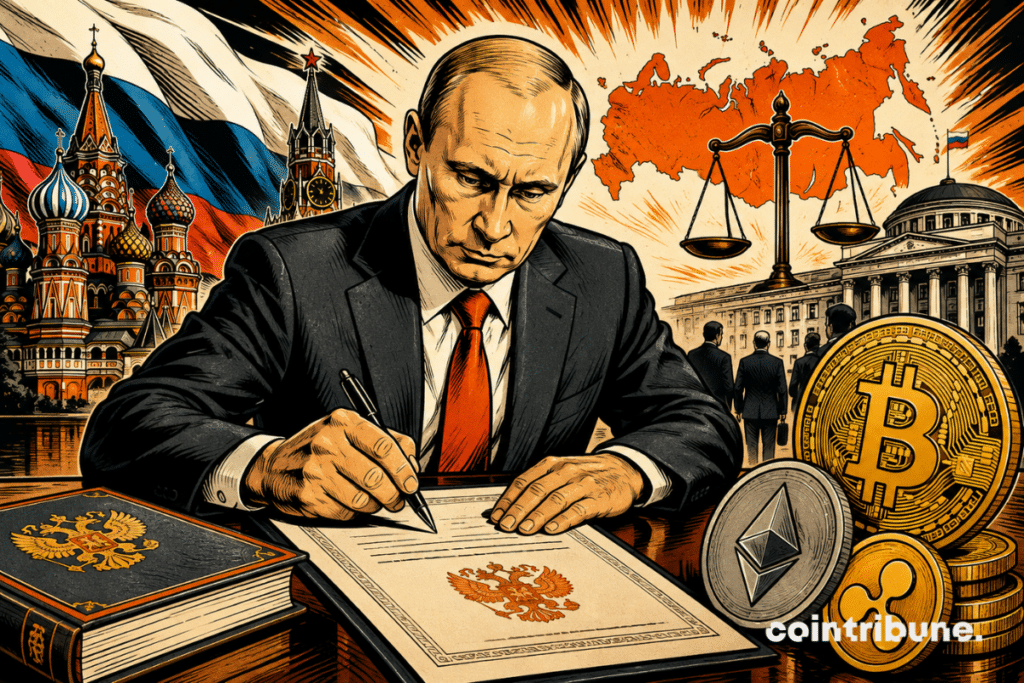
Russia takes a new step in the regulation of digital assets with the adoption of a highly anticipated law on crypto transactions. After several months of parliamentary debates, President Vladimir Putin signed the text defining the rules applicable to investors, platforms, and financial institutions. This reform establishes an unprecedented regulatory framework in the country and provides for a gradual implementation starting September 1, 2026.
In Brief
- Russia legalizes cryptocurrency transactions thanks to a new regulatory framework that will come into effect on September 1, 2026.
- Purchases and exchanges of cryptocurrencies will be allowed, but payments in digital assets will remain prohibited.
- Platforms, banks, and custodians will need to obtain approval from the Central Bank of Russia to operate.
- Individual investors will be subject to a knowledge test and an annual purchase limit of 300,000 rubles.
- Starting July 1, 2027, all cryptocurrency transactions must go through authorized intermediaries.
Russia Establishes Its First Comprehensive Regulatory Framework
President Vladimir Putin signed the law titled “On Digital Currency and Digital Rights,” marking an important step in organizing the cryptocurrency market. This text, which is nearly 300 pages long, constitutes the first complete regulation dedicated to digital assets in the country. It had already received approval from both chambers of Parliament before its official promulgation.
The draft law was presented in April before being examined by parliamentarians. The State Duma adopted it on July 21, then the Federation Council validated it on July 24. Initially expected earlier in the summer, its effective date was finally set for September 1, 2026, to allow several technical adjustments on certain provisions.
Russia now authorizes several operations related to digital assets, notably investment and trading activities. However, the text still prohibits the direct use of cryptocurrencies as a means of payment. The ruble thus retains its status as the sole legal currency for settlements within the national territory.
This reform also sets specific obligations for market players. Specialized platforms, traditional financial institutions, and various intermediaries will have to comply with a defined framework to offer crypto services in a regulated environment.
Crypto Platforms Must Meet Strict Requirements
The new regulations require that all cryptocurrency operations be conducted exclusively through platforms authorized by the Central Bank of Russia. This obligation aims to centralize trading activities under the direct supervision of the monetary authority. Companies wishing to operate must obtain the necessary authorizations before offering their services.
Exchanges, currency conversion offices between fiat and digital assets, and clearinghouses, as well as several categories of intermediaries, may participate in the market. Banks will also be part of the authorized institutions operating in this new regulatory environment once they meet the criteria set by the law.
The text also creates a new category of actors called digital custodians. These organizations will ensure the safekeeping of digital holdings and the accounting of transactions made by their clients. Custodians must be registered with the Central Bank and hold capital ranging from 50 to 250 million rubles depending on their activities.
Additionally, these platforms will be required to keep all transaction histories and monitor transfers made by their users. They must detect movements deemed suspicious within the crypto ecosystem to meet the requirements of the new regulatory framework.
Individual Investors Remain Subject to Several Limits
The most visible change concerns individuals wishing to invest in cryptocurrencies. For the first time, residents will legally be able to acquire and hold Bitcoin as well as other similar digital assets. However, this possibility comes with several restrictions aimed at non-professional investors.
Before any investment, each user must pass a test to assess their knowledge of these assets and the associated risks. This procedure will determine their level of access to the regulated market. People considered unqualified will only be able to access certain cryptocurrencies among the largest on the market.
The law also establishes an annual investment ceiling. Unqualified investors can buy up to 300,000 rubles worth of cryptocurrency per year, only through a single authorized broker. Financial brokers and management companies will act as intermediaries between investors and platforms, including those located abroad.
A recent survey conducted by the Russian Public Opinion Research Center VCIOM (ВЦИОМ), and reported by Cryptopolitan, shows that nearly 70% of citizens do not see significant utility in cryptocurrencies despite their upcoming legalization. In Russia, these assets will mainly retain an investment role since their use for payments remains prohibited.
Banks Gain New Control Powers
The text also grants important prerogatives to banks. Financial institutions will be able to block any cryptocurrency transaction when deemed necessary. A mandatory cooling-off period of forty-eight hours will also apply to transfers between digital wallets as well as conversions to fiat currency accounts.
Only assets with the highest market capitalization, high liquidity, and a sufficiently long price history will be allowed to circulate freely on regulated platforms. According to criteria mentioned by the Deputy Governor of the Central Bank, Bitcoin, Ethereum, and USDT currently meet these conditions.
The legislation also complements the 2021 law on digital financial assets. However, it does not directly mention stablecoins, although several of these assets could fall under the new rules depending on criteria set by the authorities. Wallets opened with authorized institutions will become the main way to receive, hold, and transfer digital assets within the territory.
Finally, self-hosted wallets will remain authorized for individuals participating in international economic activities. From July 1, 2027, crypto transactions carried out by residents and companies in Russia must, however, exclusively pass through authorized intermediaries. The Bank of Russia has already begun publishing draft guidelines to specify future rules regarding exchanges, safekeeping, and margin trading of digital assets.
This reform now opens a new phase in crypto regulation in Russia. The coming months will allow observation of the publication of implementing texts and the establishment of necessary procedures before the system’s entry into force in September 2026. Authorities will then continue to develop additional rules planned for 2027 to regulate all operations performed on the digital asset market within this new legal framework.
Maximize your Cointribune experience with our "Read to Earn" program! For every article you read, earn points and access exclusive rewards. Sign up now and start earning benefits.

Journaliste et rédacteur web passionné par l’univers des cryptomonnaies et des technologies Web3. J’y traite les dernières tendances et actualités afin de proposer un contenu de haute qualité à un large public du secteur.
The views, thoughts, and opinions expressed in this article belong solely to the author, and should not be taken as investment advice. Do your own research before taking any investment decisions.