China's Gold Buying Adds Support Above $4,400
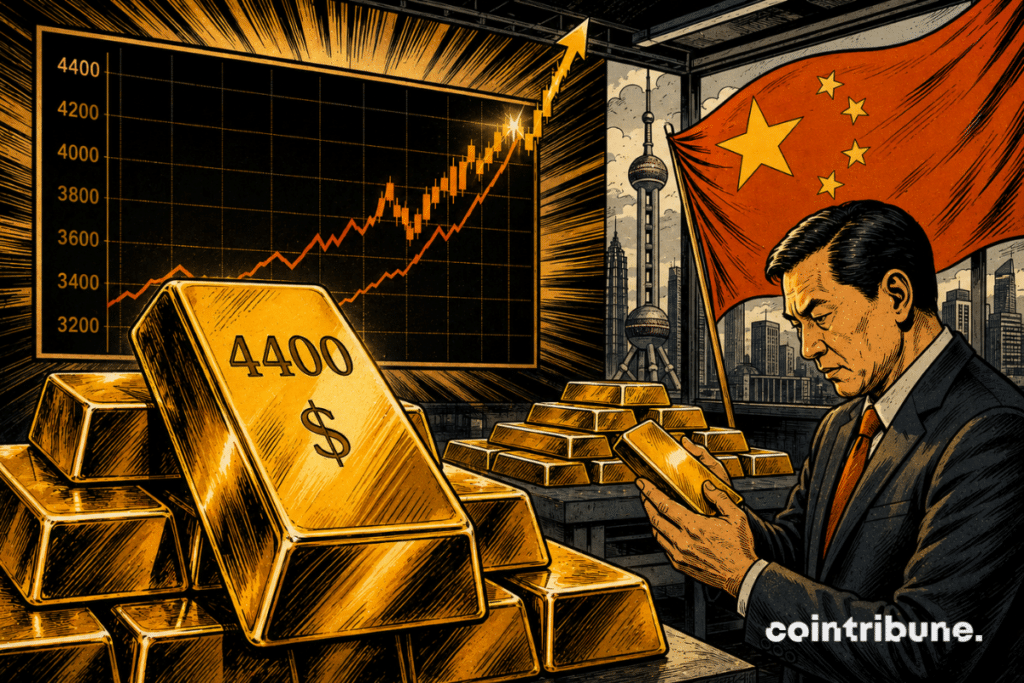
Gold has just crossed a threshold that draws all attention. Above 4,400 dollars an ounce, the precious metal benefits from a particularly favorable cocktail: weakness in the US employment market, anticipation of a more flexible monetary policy, and continued purchases from China. Added to these factors are geopolitical tensions and the rise in oil prices, which revive inflation fears. Faced with economic and monetary uncertainties, investors and central banks are strengthening their exposure to gold.
In brief
- The yellow metal has crossed the $4,400 mark to reach a two-month high between $4,434 and $4,435 an ounce.
- The unexpected loss of 23,000 jobs in the United States in July lowers bond yields and validates the technical break above the 100-day moving average.
- The People’s Bank of China accumulates gold for the 21st consecutive month, bringing its official reserves to 76.08 million ounces.
- The 5% rise in oil revives inflation fears and challenges the usual correlation between energy and precious metals.
US employment statistics reignite speculation on Fed rates
The release of the latest report on employment in the United States had a real impact on the precious metals market. Indeed, 23,000 jobs were cut in the US economy during July. This situation took many economists by surprise. They had expected about 80,000 new positions to be created. The previous months’ figures, significantly revised downward, contributed largely to this result.
These disappointing labor market statistics quickly forced traders to revise their various expectations regarding the Federal Reserve’s monetary policy. By drastically reducing bets on a probable short-term rate hike, investors contributed to the drop in yields on US Treasury bonds. They thus restore significant leeway to gold. The yellow metal then reached an intraday high between $4,434 and $4,435 an ounce. It then soared to $4,467 this evening, a remarkable increase after the summer correction that had brought the price back to $3,966.
Moreover, this rebound allowed the precious metal to clearly surpass its 100-day moving average. This is a signal closely watched by traders, as it is likely to trigger a wave of additional acquisitions. From a technical analysis perspective, the decline in bond yields can reduce gold’s opportunity cost compared to debt securities or cash investments, since it yields no return. Such a situation can encourage capital to withdraw from bonds.
Thus, attention is now focused on the upcoming release of the US Consumer Price Index (CPI) statistics. These data will determine whether this rebound beyond $4,400 can be maintained or if a rise in yields would invalidate this bullish breakout. The 200-day moving average and the $4,500 threshold are the next major technical targets identified by investors.
To summarize, several key figures should be remembered :
- The intraday high reached : between $4,434 and $4,435 an ounce ;
- The stabilization price : $4,378.50 at noon, then $4,382.43 at 1 pm EDT on August 11 ;
- A low point of the summer correction estimated at $3,966 an ounce.
Gold buying: The People’s Bank of China strengthens its shield against monetary tensions
Like the US macroeconomic environment, the momentum driven by gold is supported institutionally by the People’s Bank of China (PBOC). Indeed, the central bank of the Middle Kingdom has just extended its gold acquisition program for the 21st consecutive month. This regularity materialized in the purchase of an additional 20 tons, approximately 640,000 ounces, during July.
Thus, the official figures of China’s gold reserves, a key member of the BRICS alliance, now rise to about 76.08 million ounces thanks to this addition. The steady positive flows in Chinese gold-backed ETFs also reinforce this trend, supporting an alignment between state strategy and private investors’ appetite.
The ultimate appeal of gold for central banks lies in its balance sheet and sovereign neutrality. It is an independent asset. The precious metal does not depend on the signature of any government or monetary issuer. Such a quality offers a structural floor under prices even during the US dollar’s strength periods. Systematic accumulation by major state financial institutions contributes to reducing the floating supply on the global market. Moreover, this trend provides sustainable support to the price, regardless of daily fluctuations observed in the US derivatives market.
Geopolitical risks in the Middle East and the oil shock
Geopolitical tensions in the Middle East undoubtedly weigh heavily on this monetary picture. Thus, the closure of the Strait of Hormuz and the deterioration of relations between Tehran and Washington raise fears of continuing disruptions in energy supply. Such instability caused a 5% jump in crude oil prices, fueling the threat of a general increase in production costs.
Economist Peter Schiff spoke on this matter on the social network X. He stated that “gold and silver rose today, alongside a 5% increase in oil. Precious metals are breaking free from the negative correlation that recently developed with oil. Gold and oil should move upward together as inflation drives the CPI and bond yields higher, while the US economy weakens with continuing job destruction.” Moreover, he added: “gold now exceeds $4,400. Silver is approaching $66. The market is sending you a signal. Are you listening?”.
A risk of stagflation can thus emerge from the joint surge in energy commodity prices and precious metals. In such a scenario, where economic stagnation is accompanied by a rise in the price index, the Federal Reserve (Fed) would face a dilemma between supporting a faltering job market and fighting inflation caused by energy.
Maximize your Cointribune experience with our "Read to Earn" program! For every article you read, earn points and access exclusive rewards. Sign up now and start earning benefits.

Diplômé de Sciences Po Toulouse et titulaire d'une certification consultant blockchain délivrée par Alyra, j'ai rejoint l'aventure Cointribune en 2019. Convaincu du potentiel de la blockchain pour transformer de nombreux secteurs de l'économie, j'ai pris l'engagement de sensibiliser et d'informer le grand public sur cet écosystème en constante évolution. Mon objectif est de permettre à chacun de mieux comprendre la blockchain et de saisir les opportunités qu'elle offre. Je m'efforce chaque jour de fournir une analyse objective de l'actualité, de décrypter les tendances du marché, de relayer les dernières innovations technologiques et de mettre en perspective les enjeux économiques et sociétaux de cette révolution en marche.
The views, thoughts, and opinions expressed in this article belong solely to the author, and should not be taken as investment advice. Do your own research before taking any investment decisions.