Consensys Discovers a North Korea-Linked Developer Infiltrated Its Teams
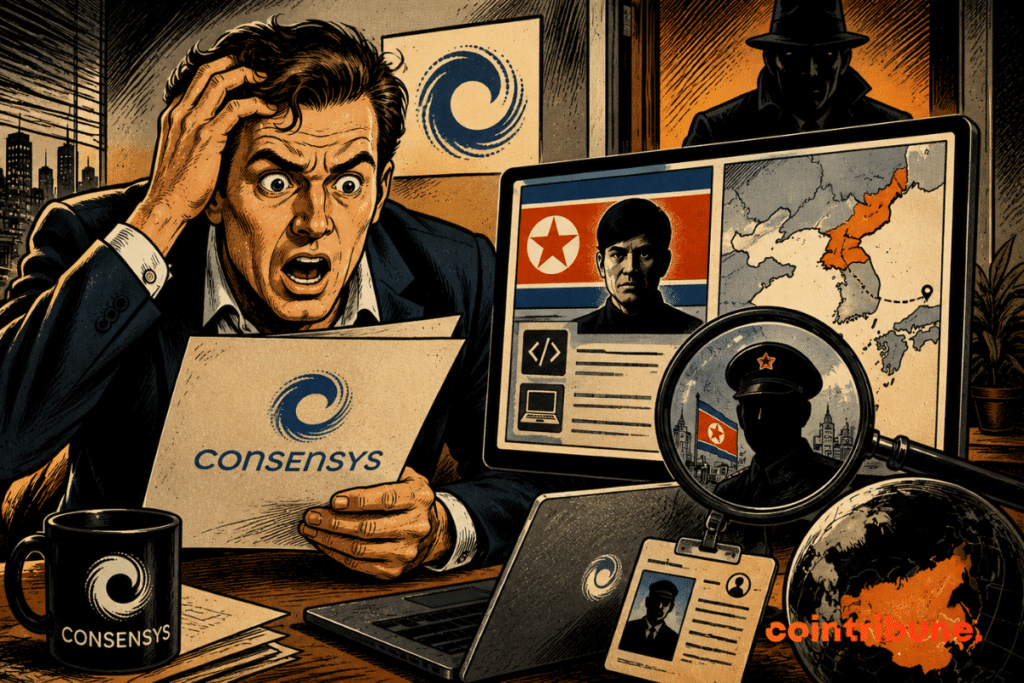
The Blockchain company Consensys accidentally employed a developer linked to North Korea, who accessed some of its systems for a month. The incident, revealed on July 17, 2026, did not result in any theft of funds or malicious code according to the company. How far do North Korean networks infiltrate development teams in the sector?
In brief
- Consensys collaborated for one month with a consultant under the alias Tyler Knapp, linked to North Korea.
- The company assures that no assets, data, or malicious code were compromised.
- The case is part of a wave of fraudulent job offers driven by North Korean groups.
Consensys discovers the North Korean threat after a hiring
The story begins like a routine outsourcing. Consensys had gotten used to calling on third-party providers to strengthen its engineering teams, without imagining that the North Korean threat would be hiding behind one of them. According to Matt Corva, the company’s legal director, a trusted third-party service provider introduced the individual and Consensys never employed him.
From the establishment of the connection, the company detected the risk, immediately cut all access, and opened an internal investigation. This concluded the absence of asset or data diversion, malicious code, and impact on user security. The speed of the reaction undoubtedly confined the incident to an alert without lasting operational consequence.
The initial alert was raised by Drop Site, which revealed the case the Friday before publication. The developer operated under the alias Tyler Knapp, a pseudonym hiding a profile linked to the Democratic People’s Republic of Korea, the official designation of North Korea.
An infiltration that is part of a larger campaign
The Consensys episode is not isolated. North Korean hacker groups, including the famous Lazarus collective, have long targeted crypto companies by sending fake job offers to developers or directly applying to access source code. These methods enable Pyongyang to generate revenue by bypassing international sanctions hitting the regime.
Consensys has also announced that it will reassess its outsourcing practices in engineering and development. Caution is now required for any company in the sector that calls on external consultants, as stolen profiles become increasingly difficult to detect. Such a level of sophistication forces security teams to thoroughly review their identity verification procedures.
North Korea is regularly blamed for the majority of volumes stolen on the market in recent years. The escalation reflects a state strategy where cyber espionage directly finances the nuclear program, turning every innocent recruitment into a potential breach.
A security reflex to generalize in crypto
Matt Corva wanted to reassure on the substance. Consensys never hired him as an employee and the consultant deployed no malicious code on the company’s products. The company temporarily suspended its product releases during the investigation, before resuming normal operations. This responsiveness limited damage in the face of a real intrusion.
“Knapp” was introduced to us by an existing relationship with a reputed third-party service provider and collaborated with Consensys as a consultant. He was never hired as a Consensys employee.
The lesson goes far beyond a single case study. While attacks targeting crypto break records in 2026, verifying the identities of external providers becomes a strategic issue for the entire sector. Security protocols must now integrate the risk of state infiltration from the recruitment stage, not only after access has been granted.
In summary, Consensys avoided the worst thanks to rapid detection, but the case illustrates the vulnerability of outsourcing chains. The multiplication of North Korean attacks, the sophistication of fake identities, and pressure on security budgets paint a structural risk. Protecting development teams now imposes itself as a priority, as reminds the resurgence of crypto-related hacks documented this year.
Maximize your Cointribune experience with our "Read to Earn" program! For every article you read, earn points and access exclusive rewards. Sign up now and start earning benefits.

Passionné par le Bitcoin, j'aime explorer les méandres de la blockchain et des cryptos et je partage mes découvertes avec la communauté. Mon rêve est de vivre dans un monde où la vie privée et la liberté financière sont garanties pour tous, et je crois fermement que Bitcoin est l'outil qui peut rendre cela possible.
The views, thoughts, and opinions expressed in this article belong solely to the author, and should not be taken as investment advice. Do your own research before taking any investment decisions.