Crypto ETF: Grayscale Drops Cardano, Hedera and Polkadot
Shock on the crypto ETF market! On August 7, Grayscale withdraws three ETF files within 190 seconds. No official reason has been communicated by the institutional investment giant. Nevertheless, this massive withdrawal already raises questions about the future of altcoin ETFs in the United States.

In brief
- Grayscale withdrew its three crypto ETF applications for Cardano, Hedera and Polkadot in only 190 seconds, on August 7.
- The documents filed with the SEC give no commercial or regulatory explanation.
- Other Grayscale crypto ETF projects like Bittensor and Zcash remain active and at an early stage.
A lightning withdrawal that leaves the SEC speechless
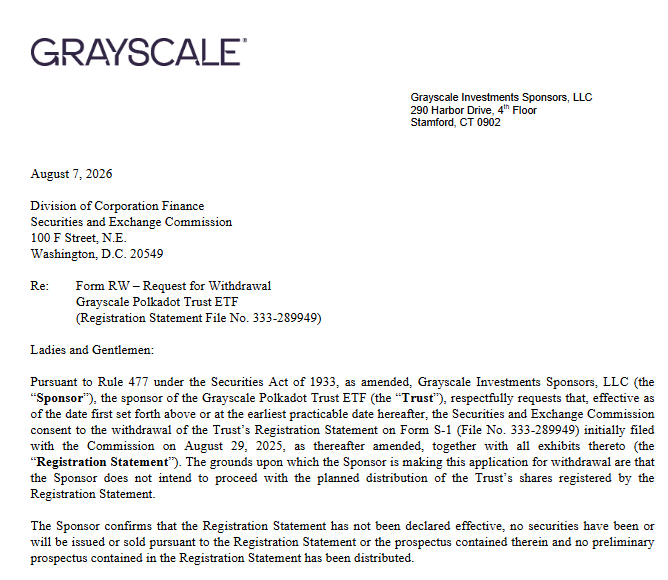
The documents filed with the SEC are formal. At 4:33:37 PM, Grayscale files the first RW Form to withdraw the Grayscale Cardano Trust ETF. 78 seconds later, it’s the turn of the Grayscale Hedera Trust ETF. At 4:36:47 PM, the Grayscale Polkadot Trust ETF meets the same fate. In all: three crypto ETFs massacred in less than four minutes.
Each document moreover uses the same phrase:
Grayscale does not intend to continue the proposed distribution of shares.
These are thus voluntary withdrawals under Rule 477, not a SEC rejection.
For now, Grayscale Investments has provided no official explanation. That said, various hypotheses are already circulating within the crypto community:
- The first concerns potentially weak investor demand for single-asset spot ETFs on ADA, HBAR, and DOT.
- The second suggests a strategic decision to focus resources on priority projects, such as the Worldcoin ETF filed in July or the already launched Hyperliquid Staking ETF.
- A third, more structural hypothesis points to the current regulatory complexity in the United States.
Two days before these withdrawals, Grayscale analysts had indeed warned of the risk of a “crypto exodus” if the CLARITY Act was not adopted by the Senate.
A reversal for Grayscale’s crypto ETFs
The recent decision by Grayscale contrasts with the momentum gained earlier this year. The company had in fact filed its crypto ETF applications for Cardano and Polkadot, alongside a broader wave of filings from other asset managers.
The associated listing proposals had in fact already been withdrawn by the exchanges themselves. NYSE Arca abandoned the Cardano one in September last year and Nasdaq those of Hedera and Polkadot in November.
Despite these withdrawals, Grayscale also does not seem to be totally disengaging from the crypto ETF market. Proof of this: it continues to push other projects, notably on Bittensor, Aave, BNB, NEAR Protocol and Zcash. Their Registration Statements are still under review.
That’s not all! Two staking products have also reached an advanced stage. We are referring to the Avalanche Staking ETF and the Hyperliquid Staking ETF, whose filings were declared effective respectively in March and June 2026.
For holders of ADA, HBAR, and DOT, the door is also not definitively closed. The fact is that a RW form withdrawal does not prevent Grayscale (nor any other issuer) from refiling a crypto ETF application if demand or the regulatory context evolves.
Crypto ETF withdrawal by Grayscale: consequences were immediate!
In the cryptocurrency market, the news struck like a thunderclap in an already stormy sky.
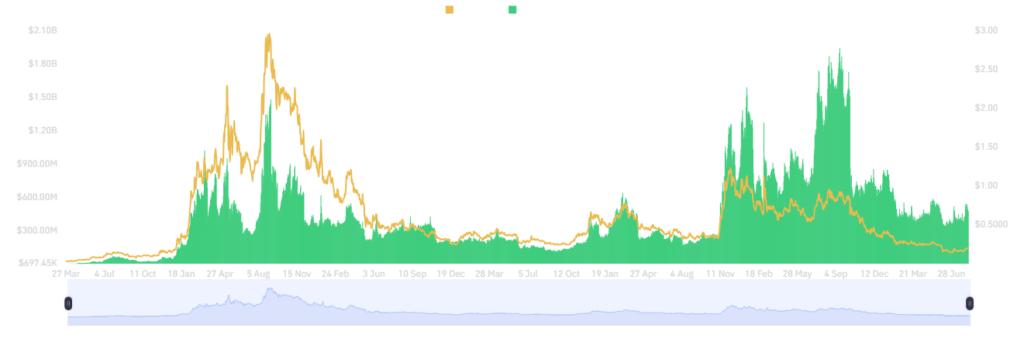
- The price of the altcoin Cardano (ADA) dropped more than 2% in twenty-four hours.
- Hedera (HBAR) and Polkadot (DOT) followed the same trajectory.
Coinglass data also shows mixed sentiment on derivatives. Open interest in ADA futures contracts rose by nearly 1%. This means some crypto traders are betting on a rebound. Whale activity remains weak though. Decoding: without massive crypto liquidity, a rise back to $0.47 seems compromised.
In any case, this massive withdrawal by Grayscale of three major altcoin ETFs raises questions about the future of crypto ETFs in the United States. If regulation remains unclear and institutional demand uncertain, other issuers might follow the same path. The adoption of the CLARITY Act could well be the key to reassuring the market and enabling the emergence of new spot ETFs on altcoins. Story to follow…
Maximize your Cointribune experience with our "Read to Earn" program! For every article you read, earn points and access exclusive rewards. Sign up now and start earning benefits.

My name is Ariela, and I am 31 years old. I have been working in the field of web writing for 7 years now. I only discovered trading and cryptocurrency a few years ago, but it is a universe that greatly interests me. The topics covered on the platform allow me to learn more. A singer in my spare time, I also cultivate a great passion for music and reading (and animals!)
The views, thoughts, and opinions expressed in this article belong solely to the author, and should not be taken as investment advice. Do your own research before taking any investment decisions.