EU Weighs New Sanctions After Drone Attack in Germany
On August 4, an employee finds a booby-trapped drone near a Ukrainian cargo plane at Leipzig-Halle airport. Germany now accuses Russia. Result: Brussels is preparing a new round of sanctions today. The newly legalized Russian crypto sector finds itself on the front line of this diplomatic standoff.
In brief
- Berlin attributes the foiled August 4 attack in Leipzig/Halle to Moscow.
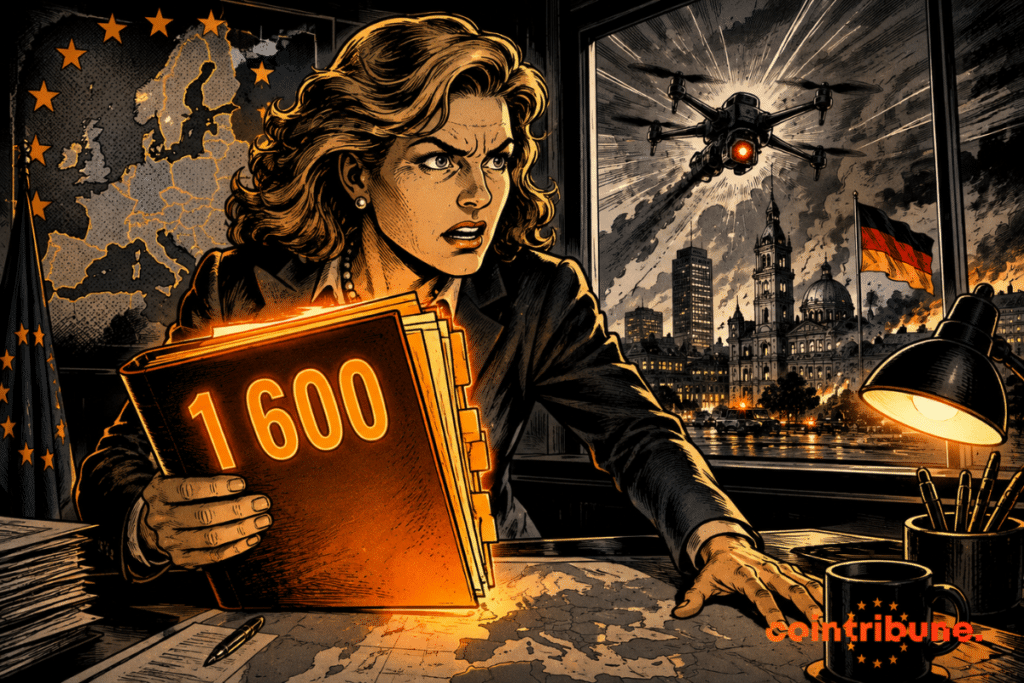
- The EU plans 1,600 listings related to the Russian military complex.
- New measures could also target financial and crypto circuits.
- No additional crypto targeting is confirmed at this stage.
Drone Attack in Leipzig: Facts the Crypto Market Must Know
On August 4, an employee at Leipzig-Halle airport spots a drone loaded with explosives near a cargo plane belonging to the Ukrainian carrier Antonov Airlines. A bomb disposal robot neutralizes the device. Result: 0 casualties. A second drone is destroyed after hitting an aircraft near the site.
Nearly a month later, on September 1, German Interior Minister Alexander Dobrindt states that “the investigation elements prove Russian responsibility” in this attack attempt. His counterpart for Foreign Affairs, Johann Wadephul, clarifies that several clues correspond to Russian hybrid operations already documented in Ukraine:
- the drone’s configuration;
- its components;
- its explosives;
- its firing system.
Good to know: Leipzig-Halle is not an airport like others. It has served as the European base for Antonov cargo planes since the 2022 invasion. NATO and the German army also use it.
The incident thus directly affects Western military logistics. A point the crypto market cannot ignore. The fact is that previous escalations were always followed by new sanctions packages also targeting Russian digital financial rails.
Sanctions: What Brussels Is Preparing Against Russia
Why does the European Union mention a new sanction train? Because the head of European diplomacy, Kaja Kallas, considers the attack has all the characteristics of state terrorism.
Gathered informally in Dublin on September 2, foreign ministers summoned Russian ambassadors. They are considering drafting a Russia sanctions package targeting about 1,600 individuals and entities linked to the Russian military-industrial complex, with adoption hoped as early as next month.
On a bilateral level, Germany announces:
- the closure of the Russian consulate in Bonn effective September 18;
- termination of the lease of the “Russian House” in Berlin (suspected of serving as a propaganda relay);
- enhanced border controls for Russian nationals.
Berlin also promises increased pressure on Moscow’s oil ghost fleet. This network of tankers is used to sell Russian oil despite the embargo.
The crypto sector is not spared. Fourteen crypto service platforms already have their transactions banned with European operators. These are based in:
- Georgia;
- Panama;
- United Arab Emirates;
- Marshall Islands;
- Kyrgyzstan;
- Belarus.
For the first time, the EU introduces the possibility of a total ban on crypto-asset services by third country. This unprecedented tool aims to deter jurisdictions hosting platforms facilitating Russia’s sanctions evasion.
Russian Crypto Law: How Is Moscow Circumventing Western Sanctions?
On September 1 (the very day Berlin formalized its accusations), a text aiming to legalize cryptocurrencies as investment assets came into force in Russia. Specifically, this law transforms crypto into a means of payment for cross-border trade. Providing Russian companies a way to bypass sanctions imposed on conventional currency payments since the war in Ukraine began.
For Brussels, this timeline is no coincidence. The 21st sanctions package adopted since 2022 has tightened Russia’s access to the traditional financial system. And Moscow is responding by consolidating a parallel crypto economy.
Note that the 21st sanctions package was adopted on July 23. It targets over 100 banks and crypto operators as well as more than 40 ships of the ghost fleet. It also freezes the Russian oil price cap at $44 per barrel.
Garantex, Grinex, Belarus: Crypto at the Heart of the Clash with the EU
Why is the EU now targeting an entire country? The 21st package introduced a first: the power to ban crypto services in an entire third country. This decision follows the reappearance of the sanctioned platform Garantex in the form of a nearly identical clone called Grinex, just months after its forced closure.
This episode illustrates the structural limit of classic crypto sanctions: closing a crypto exchange is not enough if its infrastructure, digital wallets, and teams redeploy elsewhere under another brand. This risk of circumvention is what European crypto regulators fear ahead of a new package. This justifies a strengthening of AML compliance required from platforms operating in Europe.
Frozen Assets, Digital Ruble: What Are the Scenarios Going Forward?
Two issues progress in parallel:
- On one hand, about 200 billion euros of frozen assets of the Russian central bank remain blocked mostly in Belgium, which fears legal responsibility in case of seizure.
- On the other, ministers show a “broad consensus” to ban visas for Russians who fought in Ukraine and tighten rules for tourists.
For its part, Moscow denies any involvement. The spokesperson of the Russian Foreign Ministry, Maria Zakharova, denounces a “completely fabricated pretext.” Vladimir Putin calls the German measures a serious mistake. Deputy Minister Alexander Grouchko warns that Moscow will respond in due time. NATO Secretary General Mark Rutte, for his part, promised full solidarity with Germany.
There remains a major unknown for the crypto ecosystem: at this stage, nothing guarantees the next package will specifically target stablecoins or Russian platforms. That said, the precedent of the 21st package calls for increased vigilance from regulators in the coming weeks.
In any case, the Leipzig attack opens a new chapter in the EU-Russia sanctions war and the crypto sector could become the next target. In the coming weeks, investors will need to closely monitor the various announcements.
Maximize your Cointribune experience with our "Read to Earn" program! For every article you read, earn points and access exclusive rewards. Sign up now and start earning benefits.

My name is Ariela, and I am 31 years old. I have been working in the field of web writing for 7 years now. I only discovered trading and cryptocurrency a few years ago, but it is a universe that greatly interests me. The topics covered on the platform allow me to learn more. A singer in my spare time, I also cultivate a great passion for music and reading (and animals!)
The views, thoughts, and opinions expressed in this article belong solely to the author, and should not be taken as investment advice. Do your own research before taking any investment decisions.