European Regulators Challenge Meta Over WhatsApp Access Rules
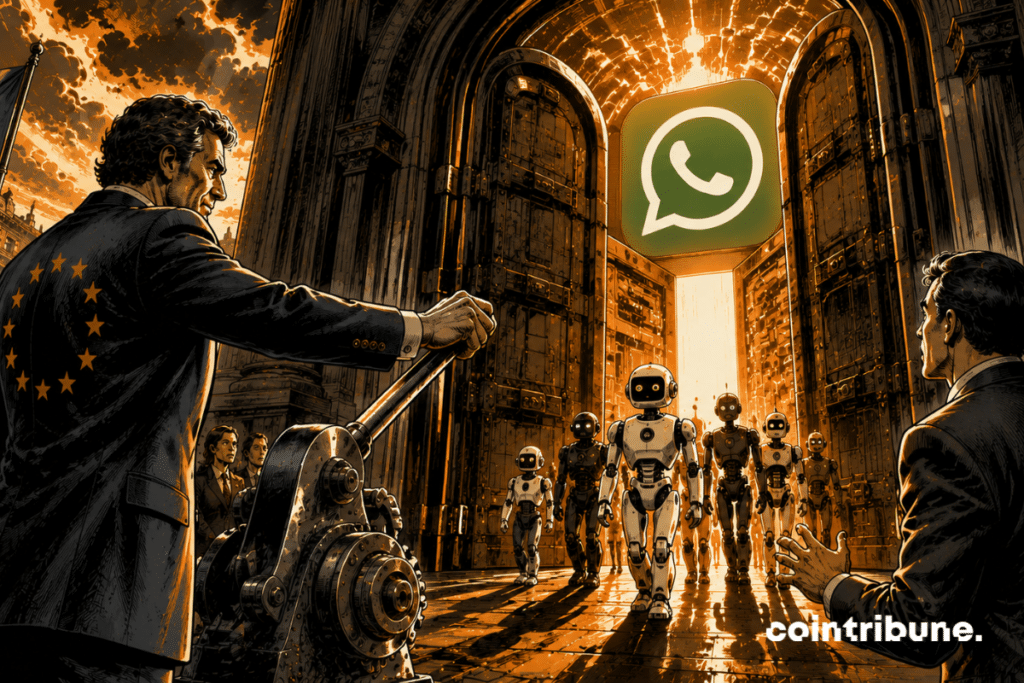
The European Union has just opened a new front against the American tech giants. In a decision that could set a precedent in the artificial intelligence sector, Brussels has ordered Meta to reopen WhatsApp to chatbots competing with Meta AI. For European regulators, Mark Zuckerberg’s group cannot use its messaging dominance to steer the future of a strategic market. Behind this injunction lies a much larger battle: the control of future access points to artificial intelligence.
In Brief
- The European Commission has ordered Meta to reopen access to WhatsApp for AI chatbots competing with Meta AI.
- Brussels believes the conditions imposed by the American giant risked penalizing competition in a growing AI market.
- This interim measure is part of an antitrust investigation to determine if Meta abused WhatsApp’s dominant position.
- The European decision could create a major precedent for digital platforms seeking to integrate their own AI services within their ecosystems.
Brussels forces Meta to restore access to WhatsApp
The European Commission has ordered Meta to restore free access to the WhatsApp Business API for developers of chatbots competing with Meta AI. This interim measure is part of an antitrust investigation opened in December 2025. According to Brussels, the pricing conditions established by the American group could prevent some players from remaining competitive in the artificial intelligence market.
The Executive Vice President in charge of competition, Teresa Ribera, stated that the fees imposed by Meta were “so high as to make competition economically unviable”. She also said that the sector’s rapid evolution required immediate intervention, without waiting for the final conclusion of the investigation.
In practice, the European decision imposes several immediate obligations on Meta :
- Restore, within five working days, the access conditions in place before October 2025 ;
- Allow developers of competing chatbots to access the WhatsApp Business API ;
- Maintain this openness until the end of the investigation or until June 2029 ;
- Comply with the Commission’s requirements during the ongoing procedure.
The case originates from several complaints filed by companies specializing in conversational agents, including the French company Agentik and the British platform Poke.com. European authorities suspect Meta of using WhatsApp’s dominant position to favor its own artificial intelligence assistant. The American group denies these accusations and has announced its intention to contest the decision.
WhatsApp establishes itself as a strategic asset in the AI war
This case, thanks to on-chain data, reveals the growing role of messaging applications in the artificial intelligence ecosystem. Conversational assistants are no longer only accessible via websites or dedicated apps. They are now directly integrated into the communication tools used daily by hundreds of millions of people. In this logic, access to WhatsApp represents a considerable advantage for AI developers seeking to reach users where they already spend a significant part of their digital time.
The European Commission considers access to these infrastructures to be a major competitive issue. Teresa Ribera has explained that the European executive could not afford to wait several years before intervening, given how fast the market is evolving. This approach marks an evolution of the European competition doctrine. Rather than sanctioning an already locked market, Brussels seeks to prevent a dominant situation from becoming irreversible. Through WhatsApp, the question of access to future distribution channels of artificial intelligence is thus at the heart of the debate.
A precedent that could reshape the sector’s rules
Meta’s reaction illustrates the importance of the issue. Thus, the group claims that the European decision mainly benefits large international competitors such as OpenAI and penalizes companies already funding the WhatsApp Business ecosystem. This divergence of views reflects a deep opposition between two market conceptions.
On one hand, Meta defends its freedom to monetize and organize its infrastructures. On the other, European regulators consider that a dominant player must not be able to control alone access to an emerging market as strategic as that of artificial intelligence assistants.
The consequences of this case could extend far beyond WhatsApp. If Brussels’ position is confirmed, other digital platforms integrating AI services could be subjected to similar requirements for openness and interoperability. Conversely, a legal victory for Meta would strengthen the ability of tech giants to build closed ecosystems around their own assistants. This confrontation ultimately reveals a central question for the coming years: will the platforms controlling digital exchanges also be able to control the main access points to artificial intelligence?
Maximize your Cointribune experience with our "Read to Earn" program! For every article you read, earn points and access exclusive rewards. Sign up now and start earning benefits.

Diplômé de Sciences Po Toulouse et titulaire d'une certification consultant blockchain délivrée par Alyra, j'ai rejoint l'aventure Cointribune en 2019. Convaincu du potentiel de la blockchain pour transformer de nombreux secteurs de l'économie, j'ai pris l'engagement de sensibiliser et d'informer le grand public sur cet écosystème en constante évolution. Mon objectif est de permettre à chacun de mieux comprendre la blockchain et de saisir les opportunités qu'elle offre. Je m'efforce chaque jour de fournir une analyse objective de l'actualité, de décrypter les tendances du marché, de relayer les dernières innovations technologiques et de mettre en perspective les enjeux économiques et sociétaux de cette révolution en marche.
The views, thoughts, and opinions expressed in this article belong solely to the author, and should not be taken as investment advice. Do your own research before taking any investment decisions.