For Franklin Templeton, AI Agents Could Accelerate Crypto Adoption
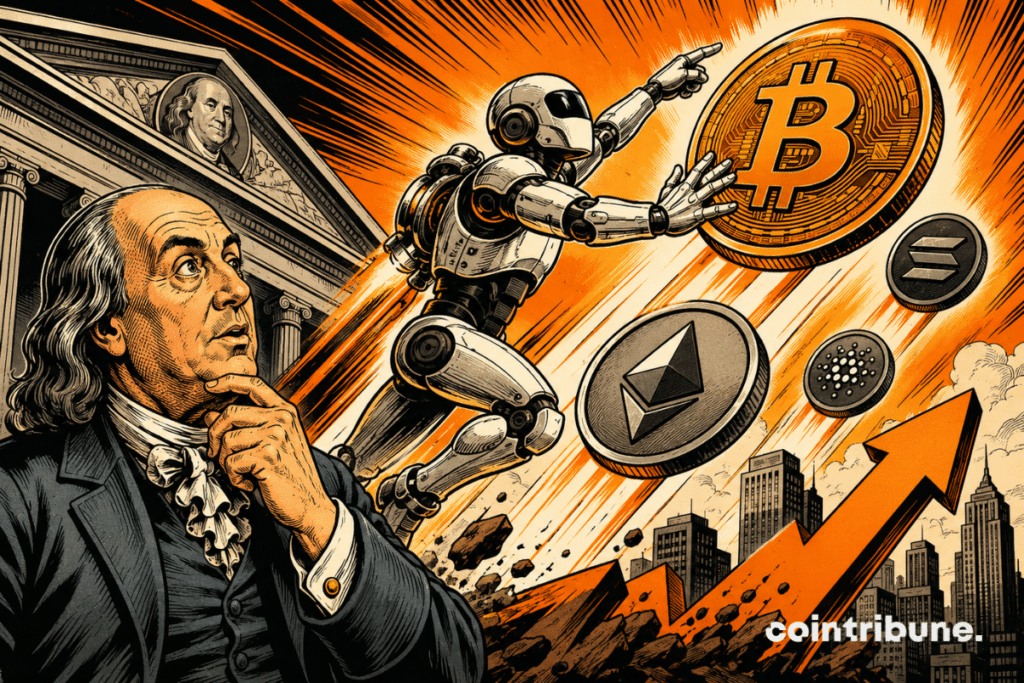
The rapid advances of autonomous agents are reigniting the debate over the infrastructures that will support tomorrow’s digital exchanges. In this context, Franklin Templeton believes that AI could transform the way payments and transactions are made. The asset manager considers that crypto will occupy a central place in this evolution thanks to blockchain networks. This analysis is based on the rise of agents able to act alone, make payments, and execute complex tasks after authorization from their user.
In brief
- Franklin Templeton believes AI agents will accelerate blockchain adoption.
- Autonomous agents will be able to buy, pay, and book without continuous intervention.
- Blockchains are presented as more suitable than traditional payment networks.
- Several actors are already developing payment infrastructures for AI agents.
- Automated commerce could reach up to 5 trillion dollars by 2030.
Why AI Could Drive Blockchain Adoption
For Sandy Kaul, head of digital assets and innovation at Franklin Templeton, investing in AI-related companies such as Nvidia is not enough to benefit from the full technological transformation. In her article published on X, she believes the next step is based on autonomous agents capable of acting, paying, and making decisions without soliciting the user at every action. This evolution would profoundly change the infrastructures used for digital exchanges.
The asset manager, which manages nearly $1.8 trillion, believes these new software programs will mainly operate on blockchain networks. According to her analysis, these infrastructures will allow agents to perform their operations efficiently. Crypto would then become a key element of this environment, as transactions would be based directly on decentralized networks rather than traditional financial systems.
Blockchain will play an essential role in enabling agentive AI to realize its potential in consumer transactions, and the growth of agentive AI will likely become the “flagship” use case driving blockchain adoption.
Sandy Kaul, Head of Digital Assets and Innovation at Franklin Templeton. Source: X / @FTDA_US
Thus, Franklin Templeton considers that blockchain could become the main driver of autonomous agents’ adoption. The group states that this technology will play an essential role in enabling these systems to reach their full potential in consumer transactions.
Autonomous AI Agents Capable of Acting Without Constant Supervision
Unlike traditional conversational assistants, AI agents are no longer limited to providing answers or information. Once authorization is granted, they can make purchases, book services, or perform payments without ongoing human intervention. This autonomy represents a significant change in the use of digital tools.
Franklin Templeton relies notably on a Capgemini study to illustrate this evolution. The firm describes this new generation of software as:
Systems capable of understanding their environment, planning actions, and accomplishing complex tasks to achieve specific goals. The objective is thus no longer solely to respond to a request but to directly execute the necessary operations.
AI consulting firm Capgemini.
Economic prospects follow this trend. According to forecasts cited by Sandy Kaul, AI agents could represent between 15% and 25% of all e-commerce sales in the United States by 2030. Such growth would imply a sharp increase in the number of transactions performed automatically on digital infrastructures.
Crypto Networks Presented as the Answer to AI Agents’ Needs
Continuing with Franklin Templeton’s analysis, the company believes traditional payment networks were designed for a human pace of use. In an environment where thousands of operations could be executed every hour by autonomous agents, these infrastructures would quickly reach their limits. Banks could not process such a high volume within the expected timeframes.
According to them, blockchain networks would offer a different response. While Bitcoin processes about 7 transactions per second and Ethereum about 75, some newer blockchains show high performance. Aptos can reach 12,933 transactions per second (TPS), Solana 6,284, and BNB Chain 3,252. These levels approach Visa network’s operational capacity under normal conditions.
However, the digital asset manager highlights a key difference. Blockchains record and settle transactions directly on the network, whereas Visa first records the operation before settling it within a timeframe that can take several business days. For crypto, this speed of processing would constitute an advantage when thousands of micropayments must be executed automatically.
Infrastructure Already Under Development for Automated Payments
Concrete early initiatives are already emerging around AI agents. Coinbase has launched tools allowing these software programs to perform transactions and payments autonomously. Google, for its part, has presented a payment protocol intended for agents, supported by the Ethereum Foundation.
The development of these infrastructures also continues with the creation of the X402 foundation. This organization brings together forty actors, including Visa, Mastercard, and AWS. Its goal is to build an open payment infrastructure allowing software to perform payments directly between themselves on the Internet through a protocol based on old HTTP code.
In this model, each agent could buy data, access programming interfaces, or acquire computing power using a blockchain’s native token. Franklin Templeton believes crypto demand could then evolve at the same pace as the volume of these automated exchanges.
Sandy Kaul thus considers that investors wishing to capture the value created by these networks will need to take an interest in cryptocurrencies and associated altcoins. The projections cited in her analysis finally indicate that automated commerce relying on artificial intelligence could represent between 3 and 5 trillion dollars by 2030. If this evolution is confirmed, crypto could accompany the rise of autonomous agents as these new uses gain ground in the digital economy.
Maximize your Cointribune experience with our "Read to Earn" program! For every article you read, earn points and access exclusive rewards. Sign up now and start earning benefits.

Journaliste et rédacteur web passionné par l’univers des cryptomonnaies et des technologies Web3. J’y traite les dernières tendances et actualités afin de proposer un contenu de haute qualité à un large public du secteur.
The views, thoughts, and opinions expressed in this article belong solely to the author, and should not be taken as investment advice. Do your own research before taking any investment decisions.