For Standard Chartered, The UNI Token Will be Worth 100 dollars in 2030
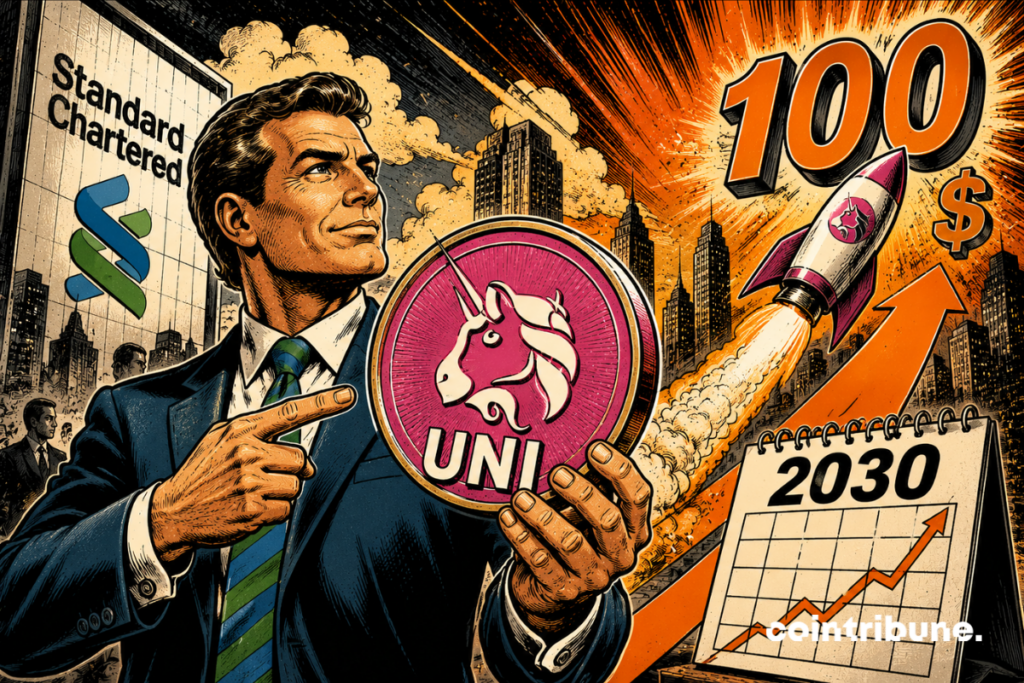
The future of decentralized finance continues to attract the attention of major financial institutions. In a new analysis, Standard Chartered estimates that the UNI token, associated with the Uniswap protocol, could reach 100 dollars by the end of 2030. This projection is mainly based on the expected growth of tokenized assets and their gradual integration into the DeFi ecosystem, a market the bank considers one of the main drivers of value creation in the coming years.
In brief
- Standard Chartered estimates that the UNI token could rise from about $2.70 to $100 by the end of 2030, a potential increase of nearly 40 times.
- The bank expects strong growth of tokenized assets in DeFi, with locked assets possibly reaching $2.7 trillion by 2030.
- Uniswap would benefit from this dynamic thanks to its decentralized model, liquidity pools, and positioning on tokenized assets and niche markets.
- The bank highlights competitive, regulatory, and operational risks that could slow Uniswap’s growth.
UNI Could Benefit From The Rise of Tokenized Assets
The bank has started coverage of the Uniswap protocol, highlighting the growth potential of decentralized finance. According to its estimates, tokenized assets used in DeFi could multiply by 37 by the end of the decade.
In this context, UNI appears as one of the main potential beneficiaries of this evolution. Geoffrey Kendrick, global head of digital asset research, believes tokenized assets on the blockchain could experience strong expansion in the coming years.
The main projections put forward by the bank are as follows:
- Tokenized assets used in DeFi could multiply by 37 by 2030.
- The market for tokenized assets on blockchain would grow from $340 billion to $4 trillion by the end of 2028.
- The share of these assets used in DeFi protocols would increase from 3.5% to 30% by the end of 2030.
- Assets locked in decentralized finance could reach nearly $2.7 trillion.
- The UNI token price would reach $6.50 by the end of 2026, $20 in 2027, $40 in 2028, $65 in 2029 and $100 in 2030.
According to this analysis, Uniswap is in a favorable position to capture a significant part of this growth. With more assets available in its liquidity pools, the protocol’s activity could increase significantly. Kendrick also believes UNI could outperform ether and bitcoin during this period, thanks to the expected expansion of activity related to tokenized assets.
Standard Chartered Bets On Uniswap’s Business Model
For Standard Chartered, Uniswap’s very structure constitutes a significant competitive advantage. Geoffrey Kendrick compares the protocol to YouTube, while associating Coinbase with Netflix.
This comparison is based on Uniswap’s open nature. As users create their own liquidity pools and swap tokens directly, the platform requires less capital than centralized players. Liquidity is indeed provided by users and not by the company operating the protocol.
According to Standard Chartered, this model could allow Uniswap to better position itself in certain specific segments. The protocol notably benefits from advantages for exchanging very similar assets, such as stablecoins or staked versions of ether. It can also more easily accommodate niche tokens whose volumes remain insufficient for centralized platforms.
The bank also believes that the tokenization of real assets could become a new area of competition between Uniswap and Coinbase. However, Standard Chartered emphasizes that sustainable growth will require additional commercial efforts as well as partnerships with traditional financial institutions.
According to Kendrick, if these conditions are met, the ratio between Uniswap’s market capitalization and the fees it generates could gradually approach that observed at Coinbase.
Token Evolution and Several Challenges To Watch
Beyond market prospects, the protocol’s recent evolution is another element highlighted by Standard Chartered. Until December 2025, swap fees were fully paid out to liquidity providers.
An update called UNIfication then introduced protocol fees and an automatic UNI token burn mechanism. Governance votes later extended this system to more liquidity pools.
Since this change, Uniswap has reportedly generated about 21 million dollars in protocol fees. At the same time, nearly five million additional UNI tokens have been burned. The bank also notes that an exceptional burn of 100 million tokens reduced the total supply to 895 million units, while circulating supply dropped to 622 million.
Despite these favorable elements, Standard Chartered identifies several risks. Smaller decentralized platforms could develop solutions better suited to some specific uses. Moreover, the attraction of volumes related to tokenized physical assets will largely depend on Uniswap’s ability to expand its partner network.
Finally, Kendrick reminds us that the hook system integrated in Uniswap V4 has not yet been tested at the scale envisaged for 2030. He also points out that clearer regulatory frameworks could facilitate sector development and reduce some current obstacles.
Thus, the projection of 100 dollars for UNI relies on several converging factors: the rise of tokenization, the growth of decentralized finance, the evolution of Uniswap’s business model, and its potential rapprochement with traditional financial players. Realizing this scenario will nonetheless depend on executing this strategy and the evolution of the regulatory environment in the coming years.
Maximize your Cointribune experience with our "Read to Earn" program! For every article you read, earn points and access exclusive rewards. Sign up now and start earning benefits.

Journaliste et rédacteur web passionné par l’univers des cryptomonnaies et des technologies Web3. J’y traite les dernières tendances et actualités afin de proposer un contenu de haute qualité à un large public du secteur.
The views, thoughts, and opinions expressed in this article belong solely to the author, and should not be taken as investment advice. Do your own research before taking any investment decisions.