France: A Couple Held Hostage for €900,000 in Bitcoin
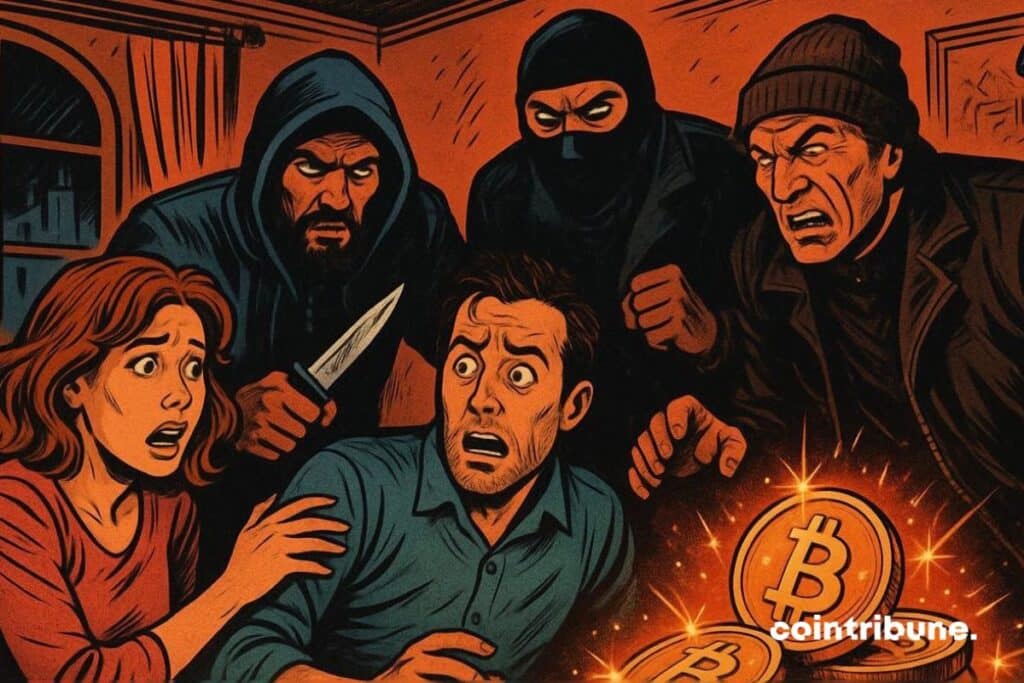
A couple in Yvelines was held hostage in their home Monday morning by three men armed with a knife. Their objective? To force them to transfer €900,000 in Bitcoin. In France, criminals no longer limit themselves to online scams but resort to violent action to seize cryptocurrencies.
In Brief
- In France, a couple in Yvelines was held hostage and forced to transfer €900,000 in Bitcoin under knife threat.
- The criminals targeting a large sum illustrate the escalation of violence related to cryptocurrencies in France.
- This case highlights the vulnerability of crypto holders, now exposed to physical risks in addition to cyber threats.
France: The Story of a Bitcoin Theft Under Threat in Yvelines
Monday morning in Chesnay, Yvelines, three individuals broke into a couple’s home. Armed with a knife, they tied up the husband and slightly injured the wife before forcing them to transfer €900,000 in Bitcoin (BTC) to an unknown account. The criminals then fled in a white van, leaving the victims locked inside.
The woman managed to escape and alert neighbours, allowing a quick intervention by the authorities. According to initial information, the criminals acted to obtain a “large sum”, confirming the financial motive behind this targeted attack. This case raises questions about the security of cryptocurrency holders in France, now exposed to physical risks.
Bitcoin: Why Are Criminals Abandoning Scams for Physical Attacks?
Cryptocurrencies, particularly Bitcoin, are increasingly attracting attention in France. Long targeted by online scams, crypto asset holders now face a much more concrete threat: home invasions. Criminals, once limited to virtual scams, are turning to physical violence to seize digital fortunes directly. This escalation is explained by several factors:
- Firstly, the relative anonymity of Bitcoin transactions makes tracing stolen funds particularly difficult;
- Secondly, the often high value of crypto wallets makes their owners lucrative targets;
- Finally, the lack of physical protection around these digital assets encourages criminals to act without fear.
Similar cases are multiplying in France, such as the kidnapping of David Balland, co-founder of Ledger, in January 2025; or the theft under threat in Paris in May 2025. These cases illustrate a worrying trend… Criminals adapt their methods to maximize their gains, even if it means resorting to violence.
How to Protect Yourself Against the Rise in Crypto-Related Crimes?
Here are some essential measures:
- Avoid storing large sums in internet-connected wallets and favour Cold Wallets;
- Do not publicly disclose your status as a cryptocurrency holder, especially on social media;
- Keep contact details for competent authorities within reach and consider crisis management training.
The Yvelines hostage-taking marks a turning point in crypto-related crime in France. Criminals, once limited to online scams, no longer hesitate to resort to violence to seize bitcoins. This development raises questions… How can financial innovation and personal security be reconciled?
Maximize your Cointribune experience with our "Read to Earn" program! For every article you read, earn points and access exclusive rewards. Sign up now and start earning benefits.

The world is evolving and adaptation is the best weapon to survive in this undulating universe. Originally a crypto community manager, I am interested in anything that is directly or indirectly related to blockchain and its derivatives. To share my experience and promote a field that I am passionate about, nothing is better than writing informative and relaxed articles.
The views, thoughts, and opinions expressed in this article belong solely to the author, and should not be taken as investment advice. Do your own research before taking any investment decisions.