Frozen Stablecoins: Your Private Key Isn’t Enough
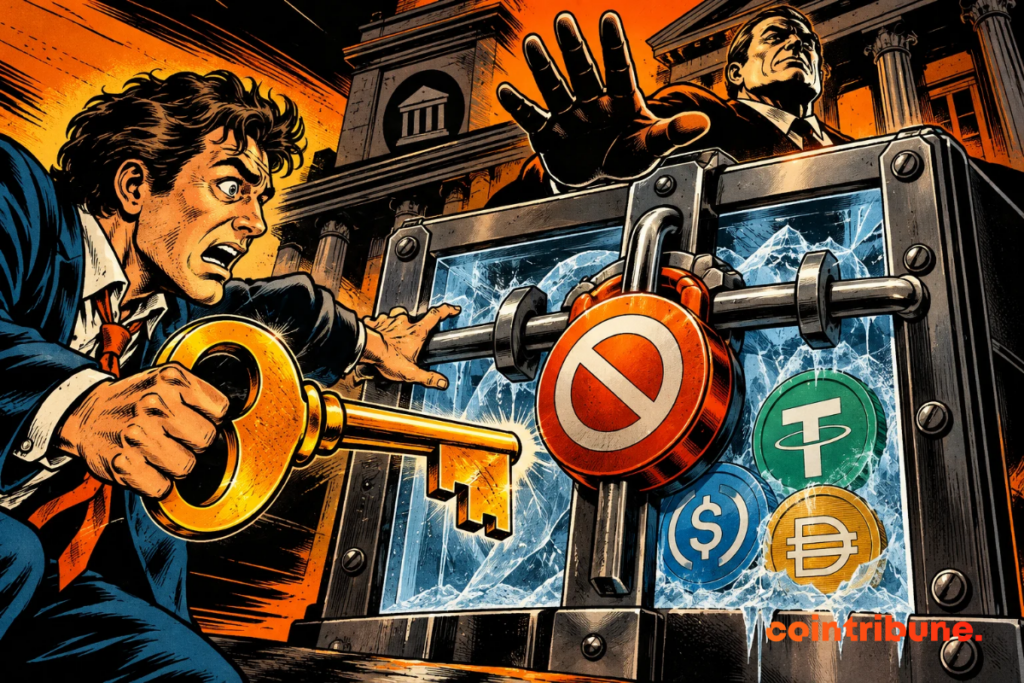
A blocked stablecoin remains visible in your wallet, but you can no longer transfer it. Circle can indeed block an address for USDC and EURC, even if you alone hold the private key. Tether applies the same principle to USDT. On April 23, 2026, it announced having contributed to freezing 344 million dollars on two addresses.
In brief
- $344 million: on April 23, 2026, Tether said it had helped freeze this amount in USDT.
- More than $4.4 billion: the total Tether attributed, as of April 23, 2026, to freezes carried out with law enforcement.
- 7 roles: that’s how many the USDC contract defines, all controlled by Circle, including the one that blocks an address.
- 5 business days: Circle’s indicative redemption timeline in Europe, once checks are complete.
Blocked stablecoin: the private key does not command the contract
A stablecoin like USDC is not stored in your wallet. It is a balance recorded in a smart contract, managed by its issuer. Your private key allows you to sign a transfer. However, it is the contract that decides whether to execute it.
Yet this contract provides several roles reserved for Circle. Its technical documentation on GitHub lists seven, including two that directly act on transfers. First, the “blacklister” role prevents any transfer to or from an address. Then, the “pauser” role can suspend all transfers in case of a serious flaw or compromised key.
With a blocked stablecoin, your address can neither send nor receive USDC. Your transaction fails, even with a valid signature. The blocking is recorded token by token, and your other cryptos remain usable. Circle can nevertheless target the same address for USDC as for EURC, and on several blockchains.
What Circle and Tether say they block, and why
Circle describes its reasons in its stablecoins access denial policy. The company announces blocking addresses to comply with a law, regulation, or court decision. It also cites government requests related to sanctions. An imminent threat to national security or an urgent law enforcement request may also suffice. Finally, it reserves an exception to protect the security of its network. Its terms of service go further. Circle reserves the right to block, at its sole discretion, an address it believes is linked to illicit activity.
Tether, issuer of USDT, acts in the same way. In its April 23, 2026 press release, it says it helped the US government freeze 344 million dollars. It cites information passed by several US authorities. The title mentions OFAC, the US Treasury service responsible for sanctions. The same day, Tether said it was working with more than 340 law enforcement agencies in 65 countries. Its CEO, Paolo Ardoino, sums up his position as: “USDT is not a haven for illicit activities.”
These amounts come, however, from the issuers themselves. Each blocking and unblocking leaves a public trace on the blockchain. The issuers do not publish the reason.
Blocked stablecoin: a block does not cancel a payment
A block freezes funds, but it erases nothing. The European USDC white paper acknowledges this: “Circle SAS cannot prevent transactions on the blockchain from being irreversible.” A confirmed payment thus remains in the chain’s history.
For a scam victim, the difference matters. If the scammer still holds the USDCs, a block can prevent them from moving them. It does not, however, return them to the victim. Circle’s policy does not provide for blocking at the request of an individual. It targets requests and orders from authorities, as well as network security.
Blocked stablecoin: the right to reimbursement under conditions
The USDC terms, updated October 15, 2026, go further than a simple freeze. They apply to holders located outside the European Economic Area. After an exchange with a blocked address, they consider a specific case: suspected illicit activity, reported to authorities. The European white paper contains an equivalent clause.
In certain circumstances, Circle may deem it necessary to report this suspected illicit activity to authorities, and you could lose all rights associated with your USDCs, including the possibility of obtaining a dollar reimbursement.
Circle, USDC terms of use
The EURC terms, Circle’s euro stablecoin, provide the same loss for its holders. In Europe, the MiCA regulation still guarantees reimbursement at nominal value, at any time. The Circle France reimbursement policy, updated September 15, 2026, reiterates this right. It nevertheless excludes “restricted persons.” Notably targeted are a sanctioned or non-identifiable holder, and residents of sanctioned countries. A suspicious transaction is also sufficient.
For an eligible individual, the procedure goes through a form and identity verification. A European bank account IBAN is also required, capable of receiving dollars for USDC. Circle France then provides a deposit address, then checks the history of received tokens. Payment should not exceed five business days, barring anomalies. However, a blocked address cannot send its USDC to this deposit address. The reimbursement policy does not provide any procedure specific to this case.
Conditions for unblocking
Circle can nevertheless lift a block. The USDC contract provides a dedicated function, which only Circle can call. Its policy mentions two cases where Circle can lift the block. Either an authority confirms the end of the legal obligation, or the security incident no longer justifies the measure.
However, the blocking policy does not describe any recourse for the holder. It also provides no prior warning. In Europe, the white paper allows a complaint to Circle, then referral to the ACPR, the French banking supervisor. However, it excludes from its customer service the loss of tokens held in self-custody. Circle only commits to regularly publishing the total amount of blocked stablecoins.
To find out if you hold a blocked stablecoin, check your address status yourself. On Etherscan, the “isBlacklisted” function of the USDC contract on Ethereum, in the “Read as Proxy” tab, displays this status. Each blockchain has its own contract. Also distinguish this blocking from an account freeze on an exchange platform: in that case, the interlocutor is the platform, not the issuer.
In their October 15, 2026 version, the USDC and EURC terms still allow Circle to block an address. In case of suspected illicit activity, they also provide for the possible loss of the right to reimbursement. Your crypto wallet holds your keys, but these rules fall under each stablecoin’s contract.
Maximize your Cointribune experience with our "Read to Earn" program! For every article you read, earn points and access exclusive rewards. Sign up now and start earning benefits.

Independent author, specialized in decentralized artificial intelligence and crypto ecosystems. I analyze projects by what they actually do, not by the noise around them. Openly a supporter of the Qubic project: my articles about Qubic and its direct competitors carry a disclosure.
The views, thoughts, and opinions expressed in this article belong solely to the author, and should not be taken as investment advice. Do your own research before taking any investment decisions.